Jean-Louis Hamon
1821 – 1874
In short
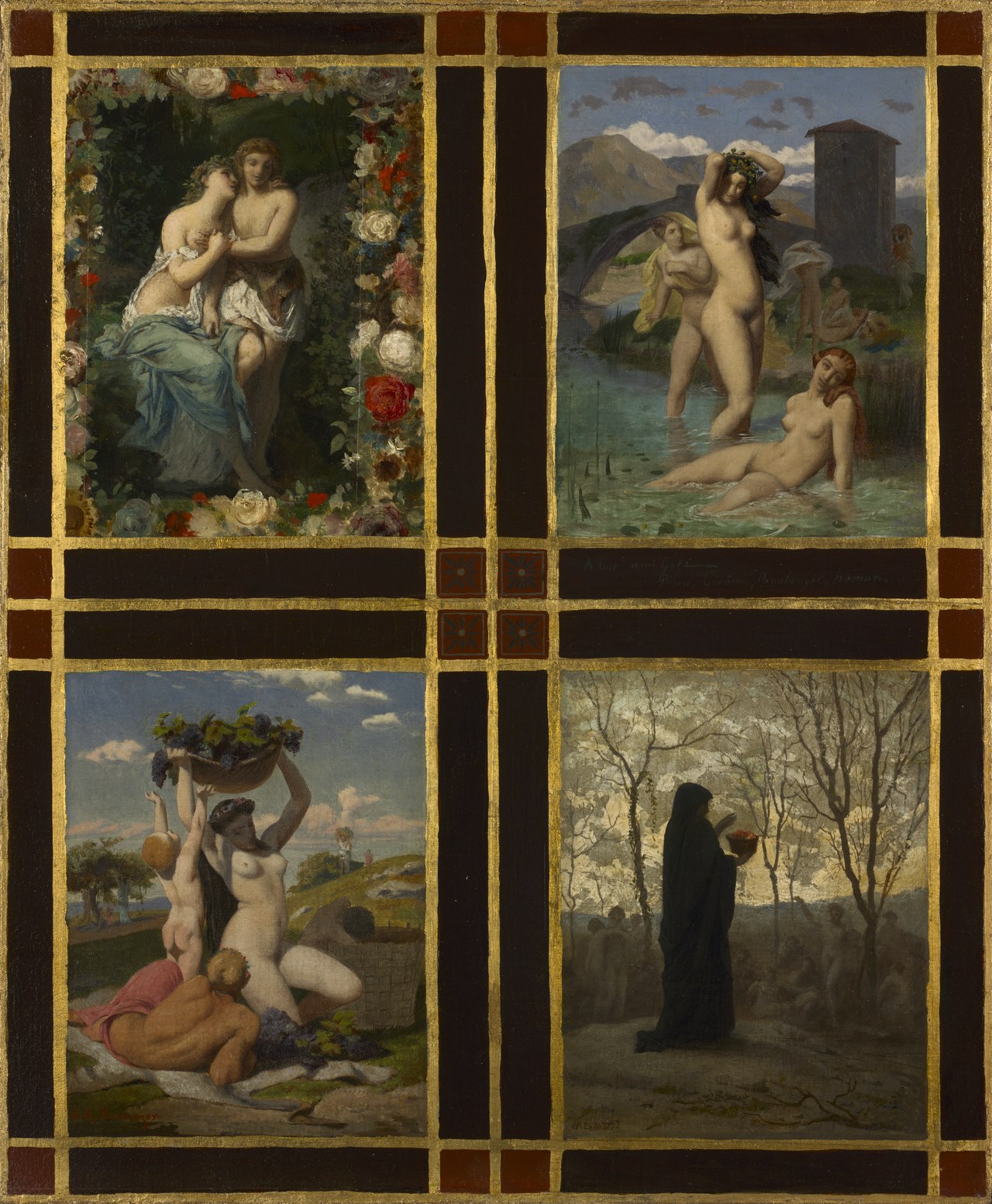
Jean-Louis Hamon (1821–1874) was a French painter associated with the Neo‑Grec movement. Born in Plouha and dying in Saint‑Raphaël, he is noted for works such as Achille découvert par Ulysse parmi les filles du roi Lycomède (1849) and The Four Seasons (1850).
Notable works



Early life Jean-Louis Hamon was born in 1821 in the coastal town of Plouha, in the Brittany region of France. Little is recorded about his family background, but contemporary sources indicate that he grew up in a modest household that valued education and the arts. As a teenager, Hamon moved to Paris, the centre of French artistic life, where he sought formal training. While the specific institution is not documented, it is highly probable that he attended the École des Beaux‑Arts or a comparable atelier, as was typical for aspiring painters of his generation. This education provided him with a solid grounding in drawing, anatomy, and the classical canon, which would later inform his adherence to the Neo‑Grec aesthetic.
Career and style Hamon's professional career unfolded during a period of intense revivalism in French art. The 1840s and 1850s saw a renewed fascination with ancient Greek art and architecture, a movement later termed Neo‑Grec. Artists in this current sought to combine the idealised forms of classical antiquity with the technical precision of academic painting. Hamon embraced this synthesis, producing works that displayed a disciplined draftsmanship alongside a vivid, often romantic, narrative content.
His early exhibitions in Paris earned him modest recognition, and by the late 1840s he was regularly showing at the Salon. Critics praised his ability to render mythological subjects with clarity and emotional resonance, noting a particular talent for integrating the serene composure of classical figures with the dramatic gestures favoured by Romanticism. Throughout his career Hamon remained faithful to the Neo‑Grec ideal, avoiding the more avant‑garde tendencies that began to emerge in the 1860s. This consistency positioned him as a reliable representative of the movement, appealing to patrons who desired works that combined timeless beauty with contemporary polish.
Signature techniques Hamon's technique can be distilled into three recurring elements:
1. Linear clarity – He employed a precise, almost architectural line to define the contours of his figures, a practice derived from his academic training. This emphasis on line over colour ensured that his compositions retained a sculptural quality.
2. Polished surface treatment – Using fine glazes and meticulous layering, Hamon achieved a smooth, luminous finish that evoked the marble surfaces of ancient statues. The subtle gradations of tone contributed to a sense of depth without resorting to heavy impasto.
3. Narrative framing – Whether depicting mythological scenes or genre subjects, Hamon placed his protagonists within carefully constructed settings that hinted at a larger story. Background elements—such as ruins, draped fabrics, or natural motifs—serve as visual cues that guide the viewer’s interpretation.
These techniques combined to create works that were both technically refined and emotionally accessible, aligning with the broader goals of Neo‑Grec art.
Major works
- Portrait of my father – Though less publicised than his mythological canvases, this intimate portrait demonstrates Hamon's capacity for psychological insight. The sitter is rendered with a restrained palette, the light falling softly across the face, highlighting the subject’s age and experience. The work underscores Hamon's versatility, showing he could apply his classical sensibility to personal, contemporary subjects.
- Achille découvert par Ulysse parmi les filles du roi Lycomède (1849) – This canvas captures a moment from the epic cycle of Achilles, portraying the hero’s discovery by Ulysses amidst the daughters of King Lycomedes. Hamon’s composition balances dynamic movement with a calm, almost idealised representation of the figures. The use of crisp outlines and a muted colour scheme evokes the marble statues of antiquity, while the dramatic narrative satisfies the Romantic appetite for heroic storytelling.
- The Four Seasons (1850) – A triptych (or series) illustrating the allegorical figures of Spring, Summer, Autumn, and Winter, each rendered in a distinct yet harmonious style. Hamon employs subtle shifts in colour temperature and light to differentiate the seasons, while maintaining a consistent linear approach. The piece exemplifies his ability to fuse allegory with natural observation, a hallmark of the Neo‑Grec tradition.
- Comédie humaine (1852) – Despite its title echoing Balzac’s literary masterpiece, this work is a visual exploration of human folly and virtue. Hamon assembles a varied group of characters in a lively interior scene, each engaged in a different activity that hints at moral commentary. The painting’s fine detailing, from the textures of fabrics to the nuanced facial expressions, showcases Hamon’s mastery of genre painting within a classicising framework.
These works collectively illustrate Hamon's dedication to the Neo‑Grec aesthetic, his skill in handling both mythic and everyday subjects, and his consistent technical proficiency.
Influence and legacy Jean‑Louis Hamon did not achieve the lasting fame of some of his contemporaries, but his contributions to the Neo‑Grec movement were significant in reinforcing the academic standards of the mid‑nineteenth century. By adhering to the movement’s ideals, he provided a reliable model for younger artists who sought to balance classical reverence with the expressive needs of their time.
After his death in 1874 in Saint‑Raphaël, Hamon's works continued to appear in regional exhibitions, particularly in Brittany, where his birthplace remained a point of local pride. Art historians regard his paintings as valuable exemplars of a transitional period in French art, bridging the strict classicism of the early nineteenth century and the more emotive, narrative-driven approaches that would dominate the later decades.
In contemporary scholarship, Hamon is frequently cited when discussing the diffusion of Neo‑Grec principles beyond Paris, illustrating how the movement permeated provincial artistic circles. His paintings also serve as reference points for curators examining the interaction between academic technique and romantic subject matter. While his name may not dominate popular art discourse, his oeuvre remains a testament to the enduring appeal of classical beauty interpreted through a nineteenth‑century lens.
Overall, Jean‑Louis Hamon stands as a representative figure of his era—a disciplined painter whose works embody the elegance, narrative depth, and technical exactness that defined the Neo‑Grec movement.
Frequently asked questions
Who was Jean‑Louis Hamon?
Jean‑Louis Hamon (1821–1874) was a French painter known for his work in the Neo‑Grec style, producing both mythological and genre scenes.
What artistic movement did Hamon belong to?
He was associated with the Neo‑Grec movement, which revived classical Greek aesthetics within a nineteenth‑century academic framework.
What are Hamon's most famous works?
His notable paintings include Achille découvert par Ulysse parmi les filles du roi Lycomède (1849), The Four Seasons (1850), Comédie humaine (1852), and the portrait Portrait of my father.
Why is Hamon important in art history?
He exemplifies the Neo‑Grec approach, bridging classicism and Romantic narrative, and his work illustrates how the movement spread beyond Paris to provincial French art circles.
How can I recognise a painting by Hamon?
Look for a crisp, linear draftsmanship, smooth, marble‑like surfaces, and subjects that blend classical motifs with clear storytelling, often set in restrained colour palettes.