Henri-Pierre Picou
1824 – 1895
In short
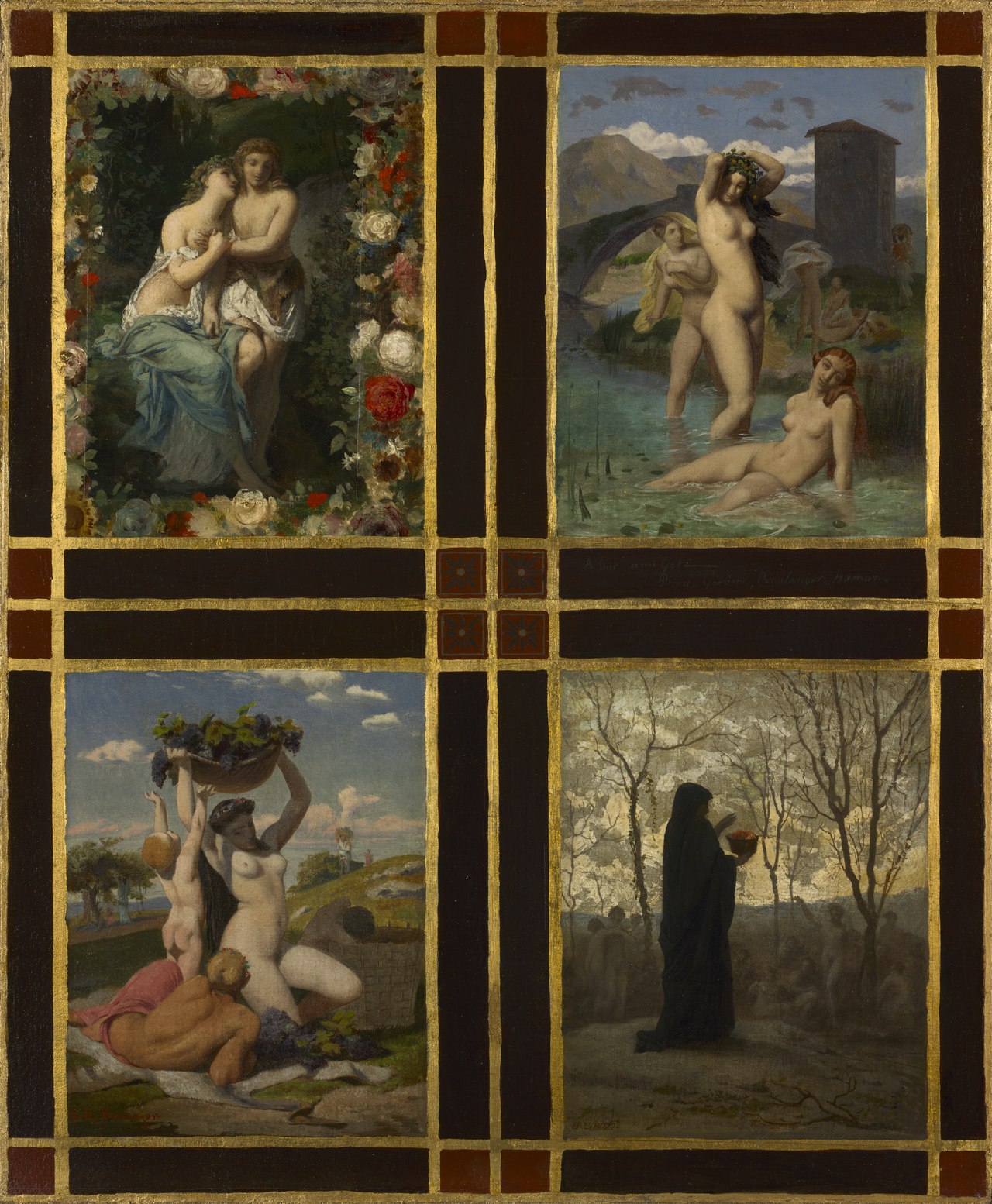
Henri‑Pierre Picou (1824–1895) was a French painter from Nantes who worked in the Neo‑Grec style, transitioning from portraiture to classical, allegorical, and mythological subjects. He is best known for works such as The Four Seasons (1850) and The Birth of Pindar (1848).
Notable works


Early life Henri‑Pierre Picou was born in 1824 in the port city of Nantes, in western France. Little is recorded about his family background, but the artistic climate of the mid‑nineteenth century offered a clear pathway for a young talent from a provincial centre. Nantes, while not a primary hub of the Parisian art world, possessed a modest network of academies and salons that nurtured local painters. Picou’s earliest training is believed to have taken place in regional workshops where he practised drawing from live models and copying classical statues—an education that would shape his later fascination with antiquity.
Career and style Picou moved to Paris in the early 1840s to pursue formal studies at the École des Beaux‑Arts. There, he entered the studio of François‑Édouard Picot, a leading exponent of academic classicism. Under Picot’s guidance, Picou honed a meticulous draftsmanship and an affinity for historical narratives. His early Salon submissions were largely portraiture, showcasing a refined ability to render flesh tones and psychological nuance. However, by the late 1840s he began to embrace the Neo‑Grec movement, an offshoot of Neoclassicism that revived the aesthetic of ancient Greece with a heightened sense of colour and decorative richness.
The Neo‑Grec style appealed to Picou’s academic training while allowing him to explore more imaginative subjects. He abandoned the conventional moralising history paintings of his peers in favour of allegorical and mythological scenes that combined idealised figures with a luminous palette. This shift aligned him with contemporaries such as Alexandre Cabanel and William-Adolphe Bouguereau, yet Picou retained a distinctive lyrical softness that set his canvases apart.
Signature techniques Picou’s technique is characterised by several recurrent elements:
* Linear clarity – He employed a precise, almost sculptural line to define the contours of his figures, a habit inherited from his academic background. * Modulated lighting – Rather than stark chiaroscuro, Picou favoured a gentle diffusion of light that bathed his subjects in an even, almost ethereal glow. This approach enhanced the timeless quality of his mythological narratives. * Colour harmony – His palette often juxtaposed warm ochres and terracotta tones with cooler blues and greens, creating a balanced visual rhythm that reinforced the decorative aspects of Neo‑Grec ornamentation. * Idealised anatomy – While grounded in careful observation, Picou’s figures are subtly stylised; musculature is softened and poses are arranged to convey poise rather than dynamism. * Narrative framing – He placed figures within architecturally suggestive settings—columns, arches, and marble steps—thereby linking the human drama to the grandeur of ancient architecture.
These techniques co‑alesced into a style that was both academically rigorous and visually appealing to the Salon juries of his day.
Major works
The Birth of Pindar (1848) – One of Picou’s earliest mythological canvases, this work depicts the celebrated Greek poet Pindar emerging from a symbolic womb of artistic inspiration. The composition balances a central, slightly larger figure with surrounding muses, rendered in soft golds and muted blues. The painting’s calm atmosphere and careful rendering of drapery exemplify Picou’s early Neo‑Grec sensibility.
The Four Seasons (1850) – Executed for a public exhibition, the piece presents the four allegorical personifications of the seasons as graceful, idealised women. Each figure is associated with characteristic attributes—flowers for spring, wheat for summer, fallen leaves for autumn, and snow for winter—set against a harmonious background that unifies the quartet. The work demonstrates Picou’s skill in integrating allegory with decorative elegance.
The Miraculous Draught (1850) – This canvas illustrates a biblical miracle in which Jesus commands a crowd to draw water from a well, and the water miraculously overflows. While the subject is religious, Picou treats it with the same classical compositional logic as his mythological pieces, employing balanced groupings and a luminous palette that soften the narrative’s dramatic intensity.
Good Adventure (1872) – A later work, Good Adventure portrays a group of youthful travellers embarking on a journey, their expressions a mixture of curiosity and optimism. The scene is set against a stylised landscape that hints at exotic locales, reflecting the broader nineteenth‑century fascination with travel and discovery. The painting’s loose brushwork and brighter colours indicate Picou’s gradual adaptation to evolving artistic trends while maintaining his academic foundation.
Young Women Bathing (1879) – This composition is perhaps Picou’s most intimate exploration of the female form. Three nude figures are shown in a tranquil river setting, their bodies rendered with a delicate softness that conveys both sensuality and modesty. The work’s subtle use of reflected light on water and the careful placement of foliage demonstrate Picou’s mature handling of light and atmosphere.
Collectively, these works trace Picou’s artistic trajectory from strict academic historicism to a more personal, decorative interpretation of classical and allegorical subjects.
Influence and legacy Henri‑Pierre Picou never achieved the lasting fame of some of his Parisian contemporaries, yet his contribution to the Neo‑Grec movement remains significant. By integrating academic precision with a decorative, colour‑rich approach, he helped sustain the popularity of mythological and allegorical painting during a period when realism and later Impressionism began to dominate the French art scene. His canvases were regularly exhibited at the Salon, earning commendations that secured commissions from both private collectors and municipal patrons.
In the decades following his death in 1895—again in his native Nantes—Picou’s works continued to appear in regional exhibitions, reinforcing the city’s cultural heritage. Modern scholars of nineteenth‑century French art cite Picou as an example of how provincial artists could navigate the Parisian academic system while preserving a distinct aesthetic voice. Although his name is less prominent in contemporary curricula, recent retrospectives of Neo‑Grec painting have re‑examined his oeuvre, highlighting his technical finesse and his role in bridging the gap between strict classicism and the more decorative tendencies that would later influence Art Nouveau.
Today, Picou’s paintings are held in several French municipal collections and occasionally surface at auction houses specialising in 19th‑century academic art. Their continued presence affirms his place within the broader narrative of French academic painting, offering insight into the visual culture that shaped the era’s artistic tastes.
--- In sum, Henri‑Pierre Picou exemplifies the disciplined yet ornamental character of Neo‑Grec painting, leaving a modest but enduring imprint on the visual history of nineteenth‑century France.
Frequently asked questions
Who was Henri‑Pierre Picou?
Henri‑Pierre Picou (1824–1895) was a French painter from Nantes who worked in the Neo‑Grec style, moving from portraiture to classical, allegorical and mythological subjects.
What artistic movement is Picou associated with?
He is associated with the Neo‑Grec movement, a decorative offshoot of Neoclassicism that revived ancient Greek motifs with a luminous colour palette.
What are Picou’s most famous works?
His most recognised paintings include The Four Seasons (1850), The Birth of Pindar (1848), Good Adventure (1872), The Miraculous Draught (1850) and Young Women Bathing (1879).
Why does Picou matter in art history?
Picou illustrates how academic French painters adapted classical subjects into a decorative language, helping sustain the popularity of mythological painting during the rise of realism and Impressionism.
How can I recognise a painting by Henri‑Pierre Picou?
Look for precise, sculptural outlines, a soft diffusion of light, harmonious colour contrasts, idealised yet gently rendered figures, and often a setting that hints at ancient architecture or mythic scenery.