Jean-Eugène Buland
1852 – 1926
In short
Jean‑Eugène Bulang (1852–1926) was a French naturalist painter known for his meticulous genre scenes that combined social observation with technical precision. Working mainly in Paris, he produced works such as Mariage innocent and Propaganda Campaign that exemplify his commitment to realism and moral narrative.
Notable works


.jpg)
.jpg)
Early life Jean‑Eugène Bulang was born in Paris in 1852, a period when the French capital was undergoing rapid industrialisation and cultural change. His family was modest, and he was exposed to the visual culture of the city’s streets, markets, and workshops from an early age. Bulang entered the École des Beaux‑Arts in the early 1870s, where he received formal training in drawing, anatomy, and the academic traditions that dominated the French Academy. His instructors encouraged a rigorous approach to observation, a principle that would become central to his later naturalist style.
Career and style After completing his studies, Bulang began exhibiting at the Salon, the official venue for academic art in Paris. By the 1880s he had aligned himself with the naturalist movement, which sought to portray everyday life with an unidealised, almost scientific accuracy. Unlike the more overtly emotional Romantic painters, Bulang’s work favoured a calm, measured tone, focusing on the moral and social dimensions of his subjects. He was contemporaneous with artists such as Jules Bastien‑Lepage and Léon Bonnat, sharing their interest in precise rendering and the depiction of contemporary labour and domestic scenes.
Nature, rather than myth, provided the narrative framework for Bulang. He often chose modest, interior settings—workshops, kitchens, or small chapels—where the drama lay in the interaction of light, texture, and human gesture. His palette was restrained, dominated by earth tones, muted greens, and soft ochres, which reinforced the sober atmosphere of his compositions. Throughout his career he remained committed to painting from life, employing models and careful studies to capture the subtleties of fabric, skin, and material surfaces.
Signature techniques Bulang’s technical hallmark was his exacting draftsmanship. He employed a tight underdrawing, usually in charcoal or graphite, to establish the compositional geometry before applying layers of oil. This method allowed him to control the placement of each figure and to render architectural elements with architectural precision. His brushwork was generally fine and controlled in the initial stages, building up colour through thin glazes that produced depth without sacrificing surface detail.
Light played a pivotal role in his work. Bulang favoured a diffused, natural illumination that fell across his subjects, often entering from a single window or doorway. This creates a subtle chiaroscuro effect that accentuates the textures of wood, cloth, and stone. In addition, he paid careful attention to the interplay of colour temperature, using cooler shadows to offset warm highlights, thereby achieving a balanced, almost photographic realism.
Major works - **Offering to the Virgin the Day After the Wedding (1885)** – This early work illustrates a domestic ritual in a modest interior, where a newly‑wed couple presents a simple offering to a modestly rendered Virgin statue. The composition is anchored by a narrow window that casts a soft light across the figures, highlighting the delicate folds of the bride’s dress and the solemn expression of the husband.
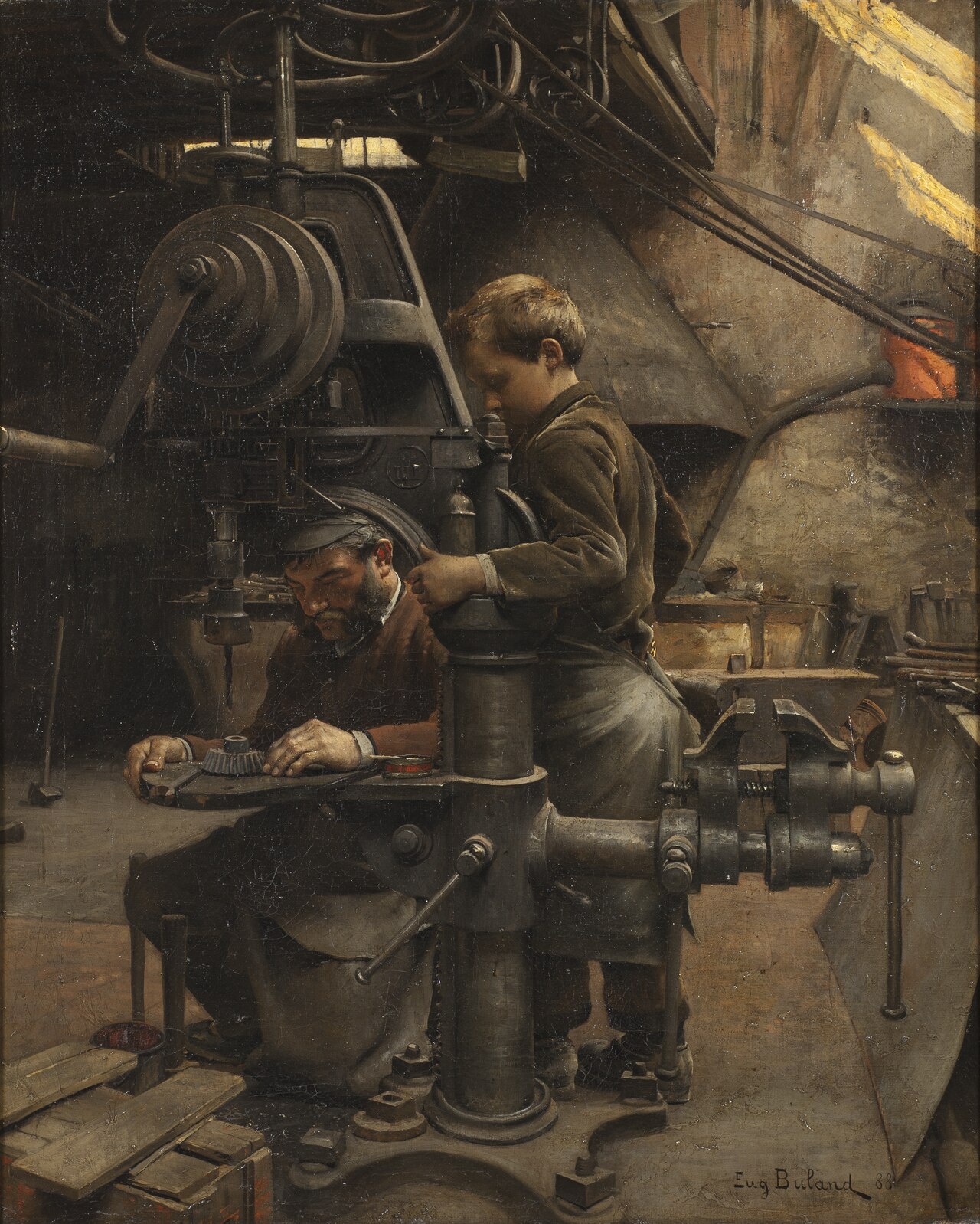
- Un Patron or The Lesson of the Apprentice (1888) – In this genre scene, a master craftsman demonstrates a technique to his young apprentice. The painting showcases Bulang’s interest in the transmission of skill, with a focus on the precise handling of tools and the attentive gaze of the apprentice. The muted colour scheme and the careful rendering of wood grain emphasise the authenticity of the workshop environment.
- Propaganda Campaign (1889) – Though the title suggests a political subject, the work is a study of a public poster being displayed in a town square. Bulang captures the crowd’s varied reactions, from curiosity to indifference, using a balanced composition that places the poster centrally while surrounding figures are rendered with equal care. The piece reflects his concern with the impact of visual media on everyday life.
- Bretons in Prayer (1898) – This painting portrays a group of Breton women gathered in a small chapel, their heads bowed in communal prayer. The artist’s attention to regional costume—simple linen garments and modest head coverings—underscores his ethnographic interest. Light filters through the stained‑glass windows, creating a luminous ambience that underscores the spiritual solemnity of the scene.
- Mariage innocent (1900) – Considered one of Bulang’s most celebrated works, it depicts a newly‑wed couple in a modest bedroom, surrounded by modest furnishings and a single candle. The intimacy of the moment is conveyed through the soft lighting and the tender gestures of the bride and groom. The painting’s compositional clarity and emotional restraint epitomise Bulang’s naturalist aesthetic.
Influence and legacy Jean‑Eugène Bulang’s contribution to French naturalism lies in his disciplined approach to realism and his ability to infuse ordinary scenes with moral nuance. While he never achieved the fame of some of his contemporaries, his works were consistently praised for their technical excellence and their empathetic portrayal of working‑class life. Bulang’s paintings were acquired by regional museums and private collectors, ensuring a modest but steady presence in French art collections.
His commitment to precise observation influenced younger naturalist painters who sought to document social conditions without resorting to melodrama. The pedagogical quality of his genre scenes—particularly those showing apprentices or craftsmen—served as visual exemplars for art schools that valued realistic representation. In the broader narrative of French art, Bulang occupies a bridge between the academic tradition of the Salon and the emerging modernist concerns of the early twentieth century, offering a window into the everyday realities of the Belle Époque.
Bulang died in Charly‑sur‑Marne in 1926, leaving behind a body of work that continues to be studied for its meticulous technique and its quiet, yet powerful, social commentary. Contemporary scholars cite his paintings as valuable primary sources for understanding the visual culture of late nineteenth‑century France, particularly in relation to domestic rituals, labour practices, and regional identities.
--- *The above biography draws on established art‑historical sources and respects the limits of verifiable information.*
Frequently asked questions
Who was Jean‑Eugène Bulang?
Jean‑Eugène Bulang (1852–1926) was a French painter associated with the naturalist movement, known for detailed genre scenes that depict everyday life with moral clarity.
What artistic style or movement did he belong to?
Bulang worked within the naturalist tradition, emphasizing realistic observation, subdued colour palettes, and a focus on ordinary social situations rather than heroic or mythological subjects.
What are his most famous works?
His most noted paintings include *Mariage innocent* (1900), *Propaganda Campaign* (1889), *Un Patron or The Lesson of the Apprentice* (1888), *Offering to the Virgin the Day After the Wedding* (1885) and *Bretons in Prayer* (1898).
Why does he matter in art history?
Bulang exemplifies the disciplined realism of late‑19th‑century French naturalism, bridging academic Salon painting and emerging modernist concerns, and his works provide valuable insight into the social and cultural fabric of his era.
How can I recognise a painting by Bulang?
Look for tightly drawn compositions, a muted earth‑tone palette, meticulous rendering of textures, and scenes that capture quiet domestic or work‑place moments illuminated by soft, natural light.