Léon Frédéric
1856 – 1940
In short
Léon Frédéric (1856–1940) was a Belgian painter whose work combined Symbolist spirituality with Naturalist realism, drawing on Flemish Renaissance traditions and later addressing social concerns. He is best known for works such as Les Boëchelles (1888) and The Funeral Meal (1886).
Notable works
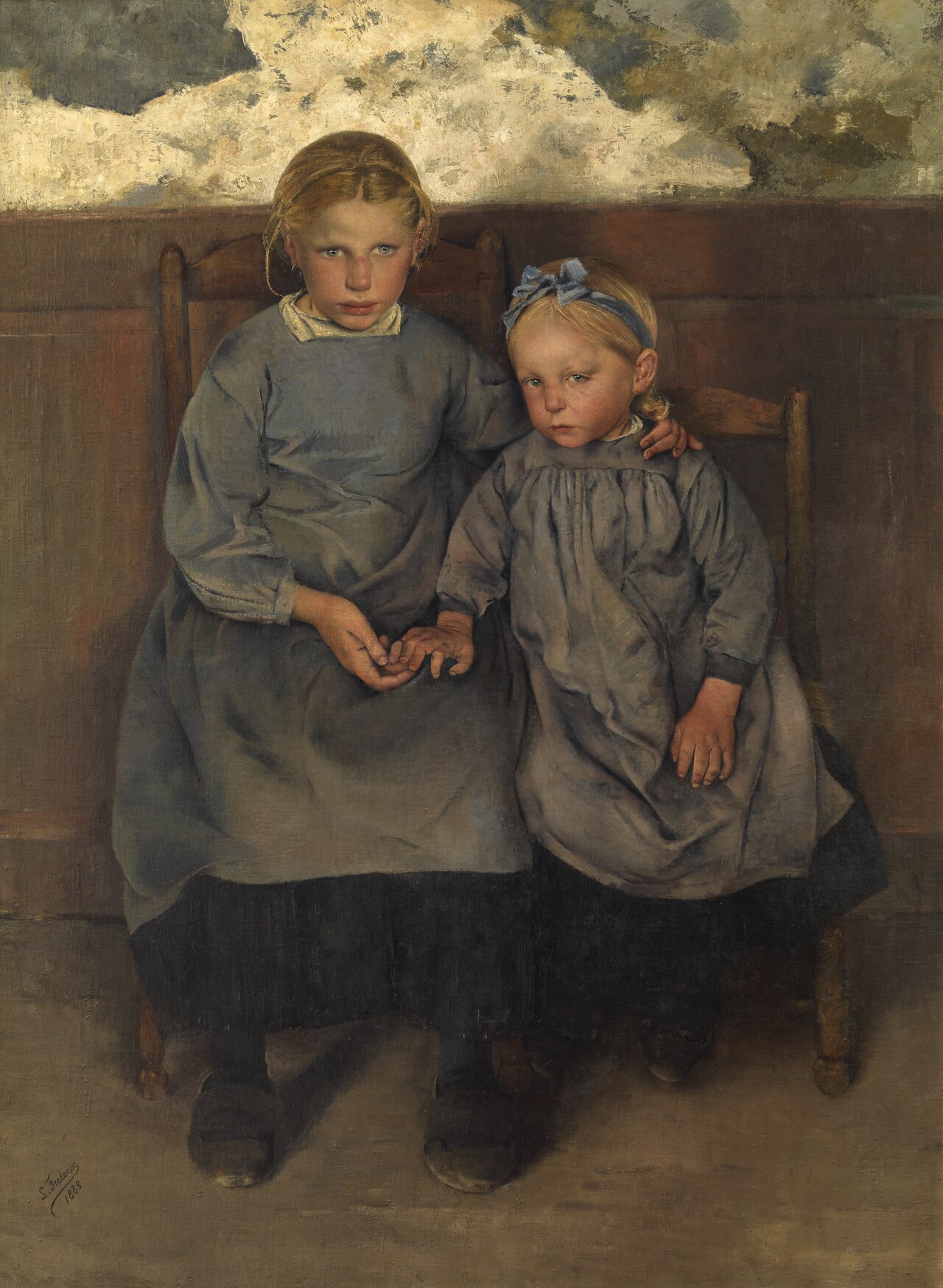
.jpg)
.jpg)


Early life Léon‑Henri‑Marie Frédéric was born in Brussels in 1856 to a modest family. From an early age he displayed a keen interest in drawing, copying illustrations from religious texts and medieval manuscripts. He received his first formal instruction at the Académie Royale des Beaux‑Arts in Brussels, where he was exposed to the academic standards of the time and to the burgeoning ideas of Symbolism that were spreading through Europe. The young Frédéric was also deeply influenced by the rich visual heritage of his native Belgium, especially the meticulous detail of fifteenth‑ and sixteenth‑century Flemish painters.
Career and style After completing his studies, Frédéric settled in Brussels and began exhibiting at the Société des Artistes‑Belgiques. His early oeuvre was characterised by a synthesis of Christian mysticism and pantheistic ideas, reflecting a personal quest for spiritual meaning. This period coincided with the Symbolist movement, and his paintings often employed allegorical subjects, muted palettes, and a contemplative atmosphere.
By the late 1880s, Frédéric’s style evolved toward a more naturalistic representation of everyday life, while retaining an underlying moral or philosophical subtext. He embraced the principles of Naturalism—faithful observation of the world, attention to colour and light, and a focus on the lives of ordinary people. Nevertheless, his work never abandoned the symbolic resonance of his earlier years; instead, it merged the two approaches, creating a distinctive visual language that could convey both social reality and spiritual aspiration.
The turn of the century saw Frédéric increasingly engage with social issues, depicting peasants, labourers, and the hardships of rural Belgium. His later paintings display a heightened empathy for his subjects, often set against expansive, luminous landscapes that echo the atmospheric qualities of the Flemish masters.
Signature techniques Frédéric’s technique is notable for its layered brushwork and subtle modulation of tone. He frequently employed thin glazes to achieve depth, allowing underlying colours to shine through and creating a luminous effect reminiscent of Renaissance oil painting. His compositions often balance a central figure or group with a surrounding environment that acts as a narrative backdrop.
A recurring motif in his work is the use of symbolic objects—such as candles, nocturnal skies, or dying flora—to suggest deeper metaphysical ideas. He also favoured a restrained colour palette punctuated by occasional bursts of saturated hue, a method that draws the viewer’s eye to focal points while preserving an overall harmonious tone.
Major works - **Les Boëchelles. Two Walloon Peasant Children (1888)** – This painting portrays two young rural children standing on a wooden ladder, their faces illuminated by soft daylight. The work exemplifies Frédéric’s blend of naturalistic detail with an underlying allegory of innocence and hope. - **The Funeral Meal (1886)** – A somber scene depicting a modest gathering after a burial, the painting captures the quiet dignity of mourning. Its muted colours and careful rendering of textures convey both the physical reality of the setting and the spiritual contemplation of loss. - **Allegory of the Night (1891)** – In this piece, Frédéric employs a nocturnal landscape populated by symbolic figures, illustrating his continued interest in mysticism. The chiaroscuro treatment of light and shadow heightens the dream‑like quality of the composition. - **The Stream (1890)** – A serene depiction of a flowing watercourse, this work demonstrates his mastery of atmosphere. The gentle ripples and reflective surface are rendered with delicate brushstrokes, creating a sense of calm that contrasts with the more socially charged subjects in his portfolio. - **All Things Die, But All Will Be Resurrected through God's Love (1905)** – A later, overtly spiritual work, it combines allegorical figures with a luminous, almost celestial background. The painting reflects Frédéric’s enduring preoccupation with the cycle of death and renewal, expressed through a synthesis of Symbolist iconography and naturalistic detail.
These works collectively illustrate the evolution of Frédéric’s artistic concerns, from intimate rural scenes to grander metaphysical narratives.
Influence and legacy Léon Frédéric occupies a unique position in Belgian art history, bridging Symbolism and Naturalism at a time when both movements were undergoing significant transformation. His capacity to fuse spiritual allegory with realistic observation influenced younger Belgian painters who sought to address social realities without abandoning a sense of poetic depth.
His paintings were exhibited widely across Europe, and he received several state honours for his contributions to the arts. Although his reputation waned in the mid‑twentieth century as avant‑garde movements took centre stage, recent scholarship has revived interest in his work, recognising its role in the development of Belgian modernism.
Today, Frédéric’s paintings are held in major public collections, including the Royal Museums of Fine Arts of Belgium and the Musée du Luxembourg, and they continue to be studied for their technical virtuosity and thematic complexity. By marrying the meticulous craftsmanship of the Flemish Renaissance with the expressive concerns of Symbolism and Naturalism, Léon Frédéric left a lasting imprint on the visual culture of his country and contributed to the broader narrative of European art at the turn of the century.
Frequently asked questions
Who was Léon Frédéric?
Léon Frédéric (1856–1940) was a Belgian painter known for merging Symbolist spirituality with Naturalist realism, often drawing on Flemish Renaissance influences.
What artistic movement is he associated with?
He is primarily linked to Naturalism, though his early work reflects Symbolist ideas and he incorporated both approaches throughout his career.
What are his most famous works?
Key paintings include Les Boëchelles (1888), The Funeral Meal (1886), Allegory of the Night (1891), The Stream (1890), and All Things Die, But All Will Be Resurrected through God's Love (1905).
Why is Léon Frédéric important in art history?
He bridged Symbolist and Naturalist currents in Belgium, influencing later artists by showing how spiritual allegory could coexist with realistic depictions of everyday life.
How can I recognise a Léon Frédéric painting?
Look for finely detailed figures set in natural surroundings, subtle colour modulation, symbolic objects, and a balance between realistic texture and an underlying allegorical or spiritual theme.