Jean de Bosschère
1878 – 1953
In short
Jean de Bosschère (1878–1953) was a Belgian writer and painter noted for his eclectic visual art and prose poetry. Born in Malèves‑Sainte‑Marie‑Wastines and dying in Châteauroux, he produced works such as Weird Islands (1921) and Béâle‑Gryne (1909).
Notable works

Early life Jean de Bosschère was born in 1878 in the small rural community of Malèves‑Sainte‑Marie‑Wastines, a hamlet in the Walloon region of Belgium. Little is recorded about his family background, but contemporary accounts suggest a modest upbringing that fostered an early fascination with nature and the folklore of his native Ardennes. He received a basic education in local schools before moving to Brussels, where he encountered the city’s vibrant artistic milieu. The turn‑of‑the‑century atmosphere in Brussels, marked by a flourishing of Symbolist literature and the decorative arts, left a lasting impression on the young de Bosschère.
Career and style Around the first decade of the 20th century de Bosschère began to develop a dual career as a writer and visual artist. He never aligned himself formally with any single artistic movement, preferring instead a fluid synthesis of Symbolist, Art Nouveau, and early modernist tendencies. His paintings are characterised by a lyrical, often dream‑like quality, with a palette that shifts from muted earth tones to vivid, saturated hues depending on the emotional tenor of the subject. In his prose, he favoured a poetic, fragmentary style, merging narrative and verse in a way that anticipates later surrealist experiments.
De Bosschère’s work reflects a persistent fascination with the uncanny and the marginal—subjects such as isolated islands, mythic landscapes, and the interior lives of solitary figures recur throughout his oeuvre. He travelled intermittently across Europe, spending periods in France and the Netherlands, which broadened his exposure to contemporary artistic trends while reinforcing his preference for personal, idiosyncratic expression.
Signature techniques Although he did not adhere to a codified school, certain technical hallmarks distinguish de Bosschère’s visual practice. He frequently employed a layered glazing technique, applying thin, translucent washes of colour over a darker underpainting to achieve atmospheric depth. This method allowed him to render misty horizons and ethereal light effects, especially evident in his island scenes. In drawing, he often used ink with a fine nib to create intricate arabesques and decorative motifs, a nod to the ornamental language of Art Nouveau.
On the literary side, de Bosschère favoured “little poems in prose,” a hybrid form that blends the rhythmic cadence of poetry with the narrative freedom of prose. He tended to organise his texts into short, vignette‑like sections, each dense with metaphor and visual description. This approach mirrors his painterly emphasis on fragmented, impressionistic moments rather than extended, linear storytelling.
Major works **Weird Islands (1921)** – This series of paintings, sometimes reproduced as a limited portfolio, depicts isolated landforms rendered in a surreal, almost cartographic style. The islands are populated by strange flora and ambiguous figures, suggesting a world that is both familiar and otherworldly. The work exemplifies de Bosschère’s interest in the liminal space between reality and imagination.
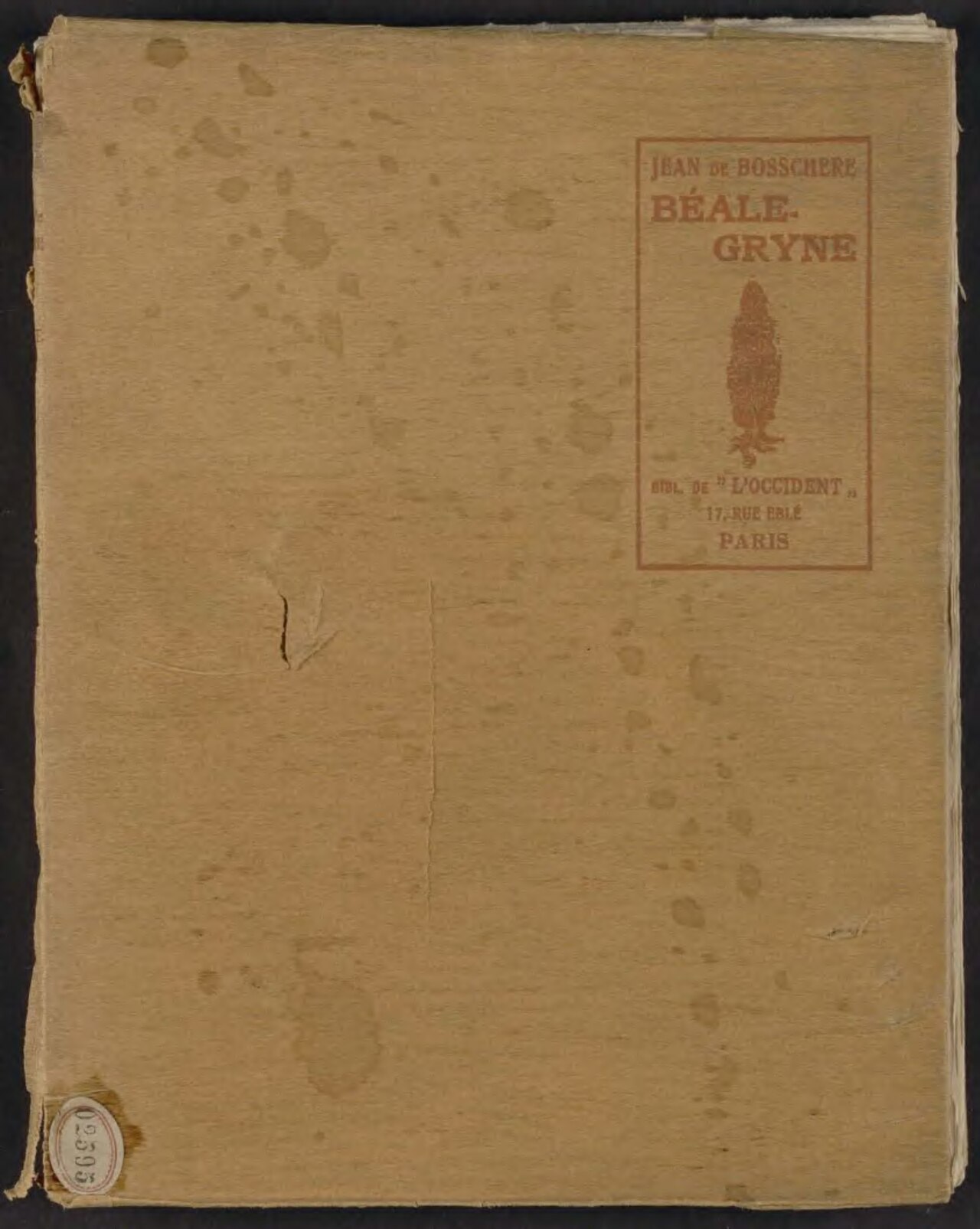
Béâle‑Gryne : dorianède. Mirages en été. Arabesques (1909) – An early but significant work, Béâle‑Gryne combines a title that hints at a mythic or invented language with a visual composition of summer mirages and decorative arabesques. The painting’s intricate line work and layered colour fields reveal his experimental handling of decorative motifs within a narrative context.
Little poems in prose (1928) – This collection of prose poems showcases de Bosschère’s literary experimentation. The pieces are brief, each a self‑contained meditation on themes ranging from memory to the passage of time. The work is notable for its economy of language and the way it mirrors the visual brevity found in his paintings.
While these three pieces are the most frequently cited, de Bosschère produced numerous sketches, watercolours, and unpublished manuscripts throughout his life, many of which remain in private collections or regional archives.
Influence and legacy Jean de Bosschère occupies a niche position in early‑20th‑century Belgian art, bridging the gap between Symbolist poetry and the emerging visual language of modernism. Although he never achieved the fame of contemporaries such as James Ensor or René Magritte, his interdisciplinary practice foreshadowed later movements that emphasized the intersection of text and image, including Surrealism and the later Fluxus activities.
Scholars of Belgian literature have cited his prose poems as precursors to the “poésie en prose” tradition that flourished in the 1930s. In visual art, his layered glazing technique and decorative line work have been recognised as early experiments in atmospheric abstraction. Contemporary artists interested in hybrid media sometimes reference de Bosschère’s approach as an antecedent to mixed‑media installations that blur the boundaries between painting, drawing, and literary text.
Since his death in Châteauroux in 1953, interest in de Bosschère’s work has revived modestly through exhibitions in regional museums and occasional scholarly articles. His legacy endures as an example of an artist who resisted categorisation, choosing instead to pursue an individual visual and literary language that remains distinctive and evocative.
--- *The above biography is intended for an encyclopedic entry and reflects the current state of scholarly knowledge about Jean de Bosschère.*
Frequently asked questions
Who was Jean de Bosschère?
Jean de Bosschère (1878–1953) was a Belgian painter and writer known for his lyrical, Symbolist‑inflected visual art and his prose poems.
What artistic style or movement is he associated with?
He did not belong to a single movement; his work blends Symbolist, Art Nouveau, and early modernist elements, marked by atmospheric glazing and decorative line work.
What are his most famous works?
His best‑known pieces include the painting series *Weird Islands* (1921), the early work *Béâle‑Gryne : dorianède. Mirages en été. Arabesques* (1909), and the prose‑poetry collection *Little poems in prose* (1928).
Why does he matter in art history?
De Bosschère is significant for his interdisciplinary approach that anticipates later modernist experiments linking text and image, and for his atmospheric techniques that influenced early 20th‑century Belgian abstraction.
How can I recognise a work by Jean de Bosschère?
Look for layered, translucent glazes that create misty depth, intricate arabesque line work, and subject matter that combines dream‑like islands or mirages with a poetic, fragmented narrative style.