Jan van Beers
1852 – 1927
In short
Jan van Beers (1852–1927) was a Belgian painter and illustrator noted for his academic‑realist portraits and historical scenes, including works such as "Emperor Charles V as a Child" (1879) and "The Composer Peter Benoit" (1883).
Notable works


Early life
Jan van Beers was born on 30 October 1852 in the Flemish town of Lier, then part of the United Kingdom of the Netherlands. He was the eldest son of the celebrated Belgian poet Jan van Beers (senior), a figure prominent in the literary circles of Brussels. Growing up in a cultured household, young Jan was exposed to poetry, music and the visual arts from an early age. His father’s artistic sensibilities encouraged him to pursue drawing, and by his teenage years he was already producing sketches for his father’s manuscripts.
After completing basic schooling in Lier, van Beers enrolled at the Royal Academy of Fine Arts in Antwerp, the leading training ground for Belgian painters of the period. There he received a traditional academic education, mastering drawing from the antique, life‑study, and the techniques of oil painting. His tutors emphasized precise draftsmanship and an adherence to the standards of the French Academy, a foundation that would shape his later portrait work.
Career and style
Van Beers made his public debut at the Brussels Salon of 1875, where his early genre scenes attracted modest attention. Throughout the 1880s he established a reputation as a portraitist capable of capturing both the likeness and the social standing of his sitters. Though he never aligned himself with a specific avant‑garde movement, his work reflects the prevailing academic realism of late‑nineteenth‑century Belgium. He combined a careful observation of anatomy with a polished finish, favouring muted palettes punctuated by rich, deep tones for clothing and background elements.
In addition to portraiture, van Beers produced historical and literary subjects that appealed to the tastes of the bourgeois clientele. His paintings often display a narrative clarity, with figures placed in carefully composed settings that enhance the story without overwhelming the viewer. The absence of overt experimentation places him alongside contemporaries such as Charles de Groux and Léon Frédéric, who also worked within the academic tradition while responding to the growing demand for private commissions.
Signature techniques
Van Beers’ technical skill is evident in several recurring methods. He employed a fine, layered brushstroke that allowed subtle modelling of skin tones, achieving a lifelike translucency. In his larger oil works he often built the composition in stages: an initial grisaille underpainting to establish light and shadow, followed by successive colour glazes that enriched depth.
His proficiency with pen‑and‑ink is documented in the deluxe edition of his father’s poetry published in 1884. For that project van Beers produced intricate sketches that combined delicate hatching with bold contour lines, demonstrating a versatility that extended beyond oil painting. This illustrative work reveals his command of line, a quality that also informs the crisp outlines seen in his portraits.
Major works
* Emperor Charles V as a Child (1879) – This early historical piece depicts a young Charles V seated in a Renaissance interior, surrounded by symbolic objects such as a globe and a sword. Van Beers renders the boy’s expression with a mixture of innocence and regal destiny, using a subdued colour scheme that highlights the sumptuous fabrics of his attire. The painting reflects his interest in combining portraiture with historical narrative, a common practice among academic painters seeking patronage from aristocratic circles.
* Portrait of a Man – Though the sitter’s identity remains unidentified, the work exemplifies van Beers’ mastery of psychological portraiture. The subject is rendered in a three‑quarter view, with a calm, direct gaze that engages the viewer. The background consists of a muted, darkened drapery that serves to isolate the figure, allowing the subtle gradations of light on the face to become the focal point.
* The Composer Peter Benoit (1883) – In this portrait van Beers captures the celebrated Flemish composer at his piano. The composer is shown mid‑performance, his hands poised over the keys, while a sheet of music rests on the stand. Van Beers uses a warm palette of ochres and browns to convey the intimate atmosphere of a studio, and his attention to the texture of the piano’s wood underscores his commitment to material realism.
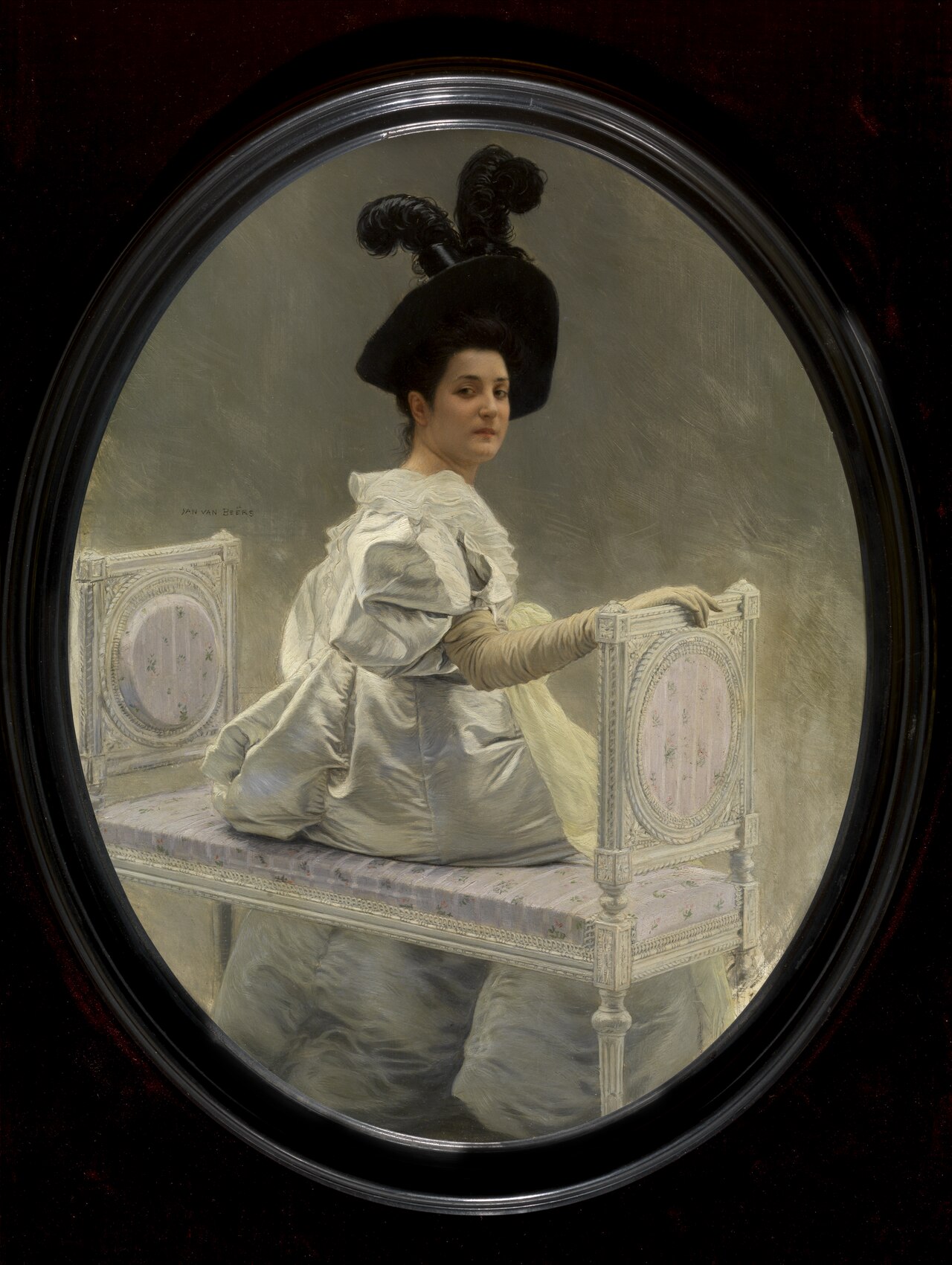
* Woman in White (1883) – This work portrays a young woman clothed in a flowing white dress, standing against a softly illuminated backdrop. The painting is notable for its delicate handling of fabric, where the translucency of the dress is suggested through fine brushwork and subtle shifts in tone. The composition balances the figure’s serene pose with a gentle, almost ethereal lighting that became a hallmark of van Beers’ later portraiture.
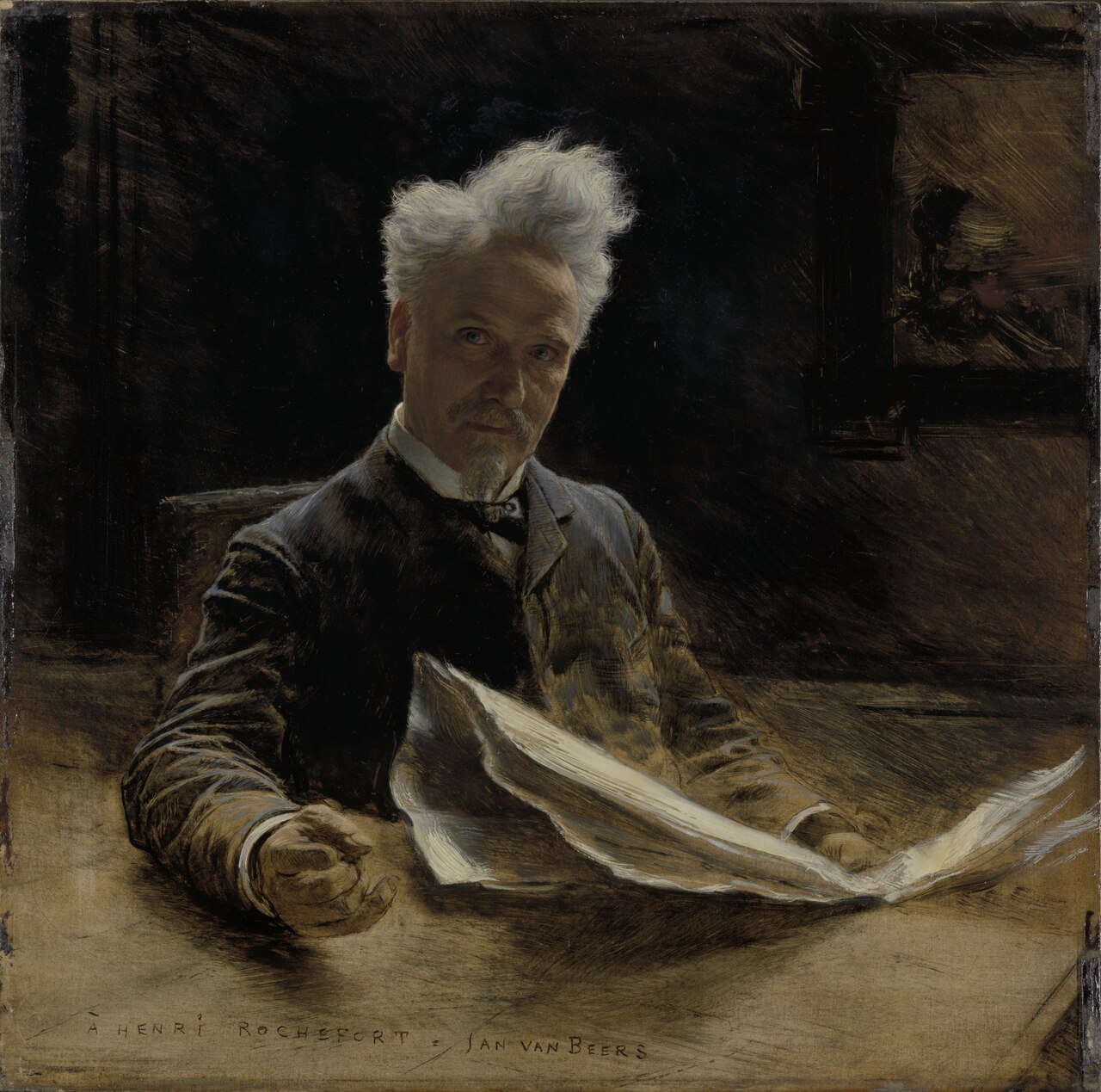
* Henri Rochefort, French Journalist and Politician – Van Beers rendered the outspoken French journalist in a dignified pose, emphasizing Rochefort’s characteristic beard and sharp eyes. The portrait, executed in oil, employs a restrained colour palette of greys and deep blues, allowing the sitter’s facial features to dominate. This work illustrates van Beers’ ability to adapt his style to the personality of his subjects, providing a visual record of a prominent public figure of the era.
Influence and legacy
Jan van Beers never achieved the fame of some of his contemporaries, yet his body of work offers valuable insight into the professional art market of Belgium in the late nineteenth and early twentieth centuries. His portraits were prized by the emerging middle class, who sought to display their cultural refinement through commissioned paintings. By maintaining a high standard of academic technique, van Beers contributed to the continuity of the realist tradition at a time when impressionist and symbolist currents were beginning to dominate the avant‑garde.
His illustrative work for his father’s poetry also demonstrates the fluid boundary between fine art and book illustration in the period, a practice that influenced later Belgian illustrators such as Henri de Staël and Léon Frédéric. Collections of his paintings are held in several regional museums, including the Royal Museums of Fine Arts of Belgium, where they are displayed alongside works by his peers to illustrate the diversity of Belgian art at the turn of the century.
In recent decades, renewed scholarly interest in lesser‑known academic painters has led to a modest re‑evaluation of van Beers’ contribution. Art historians now regard his paintings as exemplars of disciplined portraiture that bridge the gap between the strict classicism of the early nineteenth century and the more personalised, expressive approach that would emerge in the early twentieth century. While his name may not appear in mainstream art narratives, Jan van Beers remains a reliable reference point for researchers exploring the intersection of portraiture, illustration and the commercial art world of his time.
Frequently asked questions
Who was Jan van Beers?
Jan van Beers (1852–1927) was a Belgian painter and illustrator, best known for his academic‑realist portraits and historical scenes.
What artistic style or movement is he associated with?
He worked within the academic realism tradition of late‑19th‑century Belgium and did not belong to a specific avant‑garde movement.
What are his most famous works?
Key works include "Emperor Charles V as a Child" (1879), "The Composer Peter Benoit" (1883), "Woman in White" (1883), a "Portrait of a Man", and a portrait of journalist Henri Rochefort.
Why is Jan van Beers important in art history?
His disciplined portraiture illustrates the commercial art market of his era, bridges academic classicism and early modern approaches, and his illustrations contributed to the crossover between fine art and book design.
How can I recognise a Jan van Beers painting?
Look for meticulous draftsmanship, smooth modelling of skin, a restrained colour palette, crisp outlines, and a focus on realistic detail in clothing and surroundings.