Jacob Jacobs
1812 – 1879
In short
Jacob Jacobs (1812–1879) was a Belgian painter renowned for his Romantic landscapes and seascapes, especially scenes from Northern Europe and the Near East. Working in the Orientalist tradition, he combined meticulous observation with a lyrical atmospheric tone.
Notable works

_-_Cairo_-_RCIN_408943_-_Royal_Collection.jpg)
_-_The_Golden_Horn,_Constantinople_-_RCIN_403661_-_Royal_Collection.jpg)
_-_Hove_down_to_Careen_-_1631-1869_-_Victoria_and_Albert_Museum.jpg)
Early life Jacob Jacobs was born in Antwerp in 1812, the son of a modest merchant family. Growing up in a city that was a hub for art academies and trade, he was exposed early to both the flourishing Flemish artistic heritage and the cosmopolitan currents of the early nineteenth‑century European market. He enrolled at the Royal Academy of Fine Arts in Antwerp, where he received formal training in drawing, composition, and the study of classical sculpture—an education that emphasized the academic rigour of the Dutch and Flemish masters. Jacobs showed a particular affinity for drawing from nature, a habit nurtured by weekend excursions to the surrounding countryside and the nearby coast of the North Sea. These early experiences forged his lifelong fascination with atmospheric effects and the interplay of light on water.
Career and style After completing his studies, Jacobs began exhibiting at the Salon of the Royal Academy in Antwerp and quickly attracted the attention of patrons interested in Romantic depictions of exotic locales. The 1830s and 1840s saw a surge of interest in Orientalism across Europe, and Jacobs capitalised on this trend by travelling to the Ottoman Empire, Egypt, and the Levant. His journeys provided first‑hand visual material that he rendered in a style synthesising the Romantic emphasis on emotion with a meticulous topographical accuracy. Jacobs’ paintings are characterised by a luminous palette, a soft handling of atmospheric perspective, and a compositional balance that often places a solitary figure or vessel against a vast, sweeping landscape. He maintained a consistent Romantic sensibility throughout his career, yet his later works demonstrate a subtle shift toward a more naturalistic rendering of light, likely influenced by contemporaries such as Eugène Delacroix and the emerging Realist movement.
Signature techniques Jacobs employed several technical approaches that distinguish his oeuvre. He favoured a layered glazing technique, applying thin, translucent oil washes over an underpainting to achieve depth and luminosity, particularly in the rendering of water and sky. His brushwork varies between delicate, feathery strokes for distant atmospheric effects and more assertive, impasto passages to convey the texture of rocks or foliage. Jacobs also made extensive use of a limited colour palette when depicting oriental scenes, often employing warm ochres, deep blues, and rich siennas to evoke the exotic ambience of the Near East. In his preparatory sketches, he frequently utilised graphite and watercolor washes, allowing him to capture fleeting light conditions that he later translated into his studio paintings.
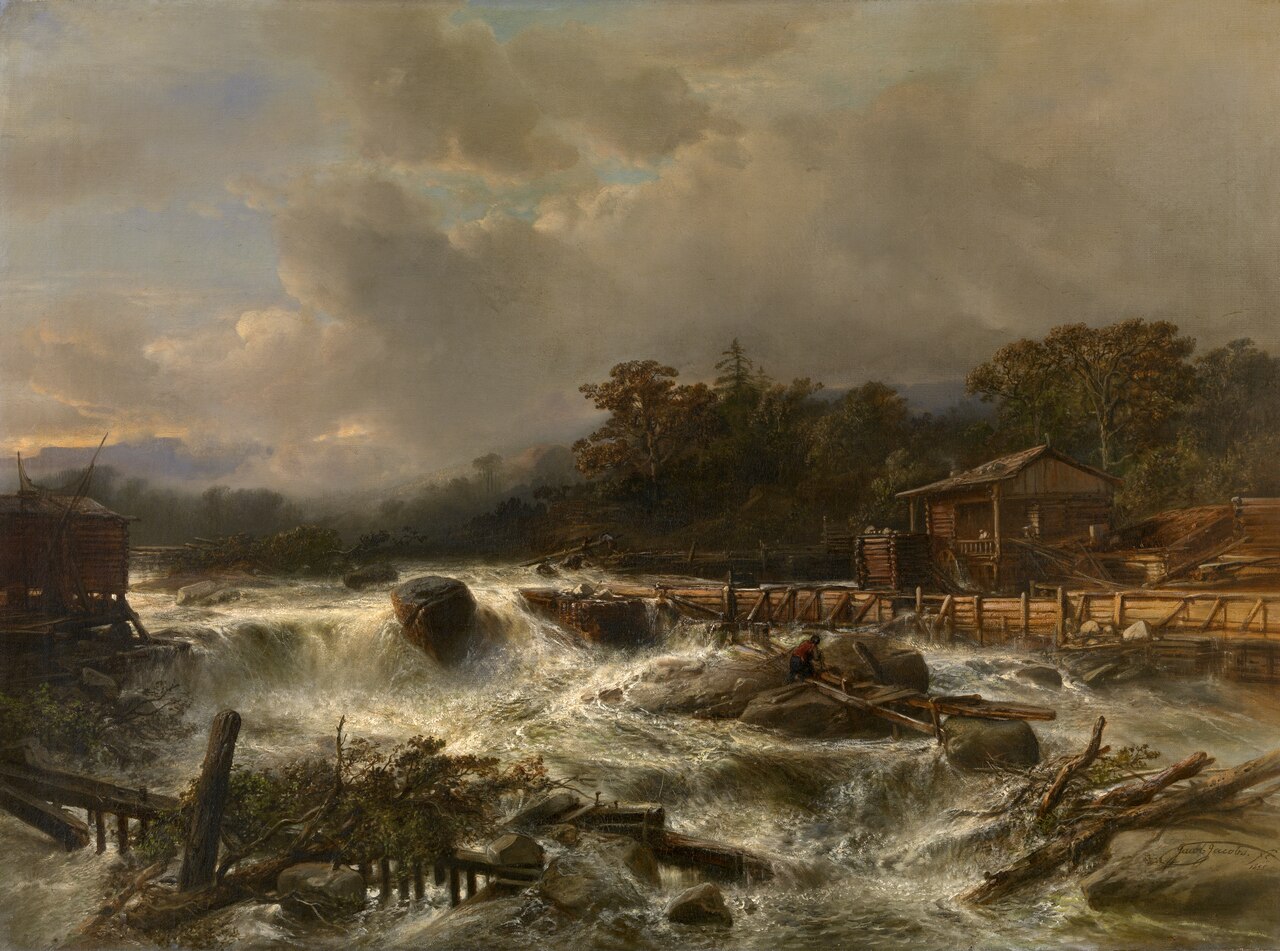
Major works Among Jacobs’ most celebrated pieces is **"Waterfall in Norway" (1855)**, a sweeping panorama that captures the dramatic cascade amidst a mist‑laden valley. The work exemplifies his skill in portraying the power of nature through a delicate balance of light and shadow. **"Porte d' Aval in Etretat" (1876)** showcases his later period, where the rugged cliffs of the French coast are rendered with a heightened realism, yet retain the Romantic aura of awe and solitude. In **"Cairo" (1854)**, Jacobs presents a bustling street scene framed by the towering minarets of the city, employing a warm palette that conveys the heat and vibrancy of the locale. **"The Golden Horn, Constantinople" (1853)** offers a panoramic view of the historic waterway, where Jacobs’ precise rendering of architectural details merges with a poetic atmosphere, reflecting both his topographical interest and his Romantic imagination. Finally, **"Hove down to Careen" (1845)**—a seascape depicting a small vessel navigating a calm harbor—demonstrates his early mastery of marine subjects, highlighting his ability to convey the subtle movement of water and the interplay of sky and sea.
Influence and legacy Jacob Jacobs occupies a notable position within the Belgian Romantic tradition and the broader European Orientalist movement. His works contributed to the popularisation of exotic subjects among Belgian collectors, and his meticulous approach to landscape set a benchmark for later Belgian painters such as Henri Van Dyck and Emile Claus. Although he never achieved the fame of some of his French contemporaries, Jacobs’ paintings remain valued for their combination of technical finesse and emotive power. Today, his works are held in several European museums, including the Royal Museum of Fine Arts Antwerp, where they continue to inform studies of 19th‑century Romanticism and the visual construction of the 'Orient' in Western art. Jacobs’ legacy endures in the way he bridged the academic rigour of his Flemish training with the imaginative allure of distant lands, offering a nuanced perspective on the artistic currents of his time.
Frequently asked questions
Who was Jacob Jacobs?
Jacob Jacobs (1812–1879) was a Belgian painter known for Romantic landscapes and seascapes, especially scenes from Northern Europe and the Near East.
What artistic movement is he associated with?
He worked within the Romantic tradition and is particularly linked to Orientalism, a movement that depicted exotic Eastern subjects for Western audiences.
What are his most famous works?
His most celebrated paintings include "Waterfall in Norway" (1855), "Porte d' Aval in Etretat" (1876), "Cairo" (1854), "The Golden Horn, Constantinople" (1853) and "Hove down to Careen" (1845).
Why is Jacob Jacobs important in art history?
Jacobs helped popularise Orientalist themes in Belgium, combined rigorous topographical detail with Romantic atmosphere, and influenced later Belgian landscape painters.
How can I recognise a Jacob Jacobs painting?
Look for luminous, layered glazes, a balanced composition of water or sky with a solitary focal point, and a warm, atmospheric palette that conveys both detail and poetic mood.