Gustave Boulanger
1824 – 1888
In short
Gustave Boulanger (1824–1888) was a French academic painter who specialised in classical and Orientalist subjects. Based in Paris, he taught at the École des Beaux‑Arts and produced works that combined rigorous draftsmanship with exotic narrative detail.
Notable works



Early life Gustave Clarence Rodolphe Boulanger was born in Paris on 15 February 1824 into a modest middle‑class family. His early education was typical of the Parisian bourgeoisie, with a strong emphasis on the classics and the visual arts. Showing an aptitude for drawing, he enrolled at the École des Beaux‑Arts in his late teens, where he studied under the influential academic masters of the time. The rigorous training emphasized life drawing, anatomy, and the study of antiquity, laying the foundation for Boulanger’s lifelong fascination with classical themes.
Career and style After completing his studies, Boulanger quickly entered the competitive world of the Paris Salon. His early submissions demonstrated a mastery of the academic language—precise contours, harmonious composition, and a polished finish. Throughout the 1850s and 1860s he built a reputation as a reliable painter of historical and mythological subjects, often depicting scenes from ancient Greece and Rome with a meticulous eye for costume and architecture.
Parallel to his classical output, Boulanger developed an interest in Orientalism, a movement that sought to portray the cultures of the Near and Middle East through a European lens. This dual focus placed him at the intersection of two dominant currents in nineteenth‑century French art: the reverence for antiquity inherited from the Academy and the exotic allure of Orientalist imagination. While his Orientalist works retain the same technical rigor as his classical pieces, they also incorporate richer colour palettes and more sensual detail, reflecting the contemporary fascination with ‘the other.’
In addition to his painting practice, Boulanger became a respected professor at the École des Beaux‑Arts. His teaching emphasized the importance of drawing from live models and studying classical sculpture, values that he believed were essential for any serious artist. Many of his students went on to successful careers, perpetuating the academic tradition well into the early twentieth century.
Signature techniques Boulanger’s technique is characterised by several recurring elements:
* Linear clarity – He employed a tight, controlled line to define forms, a hallmark of academic drawing. This approach ensured that the narrative content remained legible even in complex compositions. * Layered glazing – Like many of his contemporaries, Boulanger applied thin layers of oil glaze to achieve depth of colour while preserving the luminosity of the underpainting. This method contributed to the subtle modelling of flesh and drapery. * Historical accuracy – Whether depicting a Roman poet’s house or a North‑African bazaar, he researched costumes, architecture, and objects with scholarly diligence, lending his scenes an air of authenticity. * Balanced composition – His canvases often centre around a focal group, with secondary figures arranged in pyramidal or diagonal structures that guide the viewer’s eye through the narrative.
These techniques combined to produce works that were both technically accomplished and narratively engaging.
Major works Boulanger’s oeuvre includes a number of paintings that have become reference points for his style:
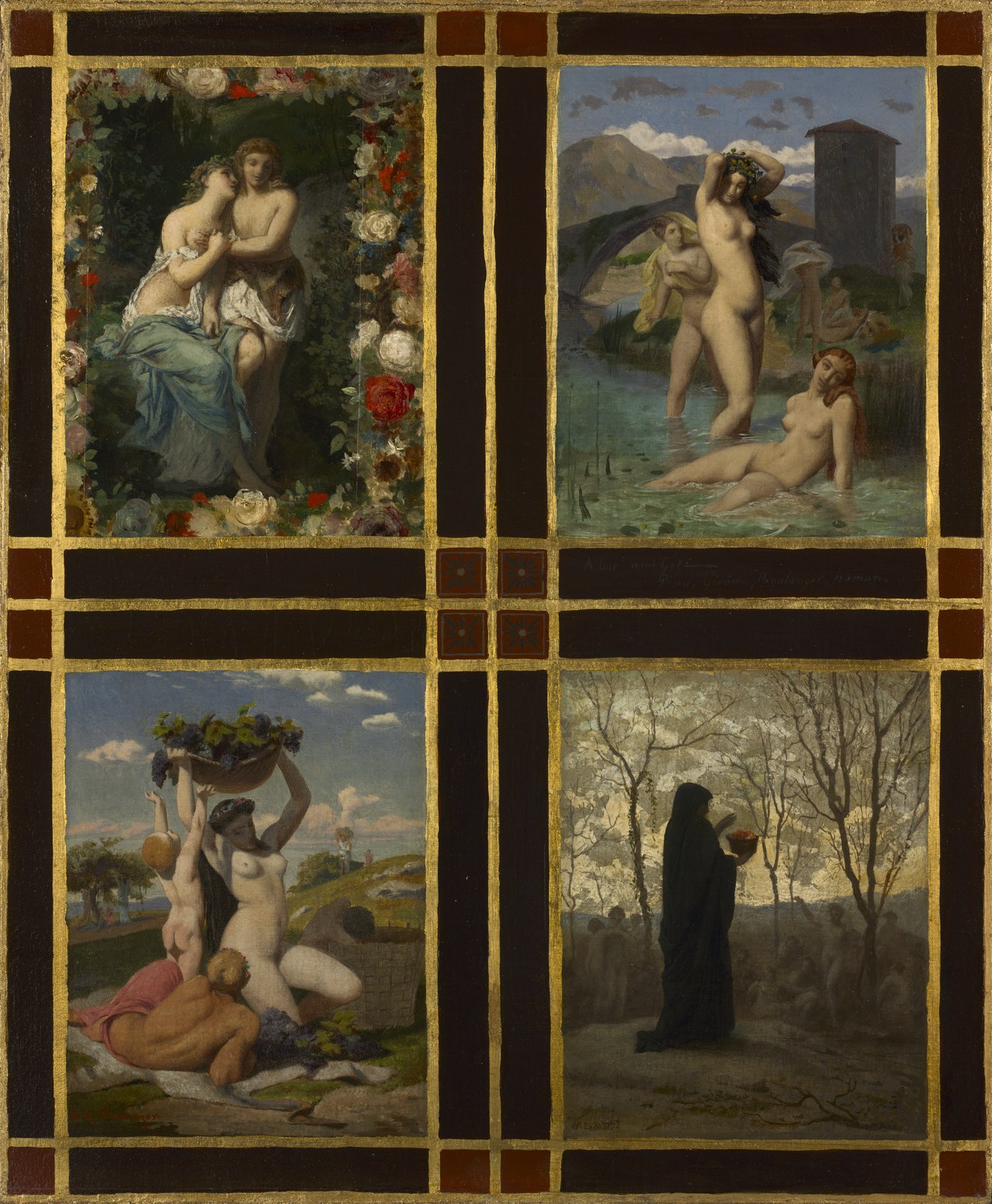
* The Four Seasons (1850) – A series of allegorical canvases that depict the four seasons as classical figures. Each painting showcases his skill in rendering idealised human forms against a backdrop of mythic landscape, underscoring his command of the academic tradition.
* Theatrical Rehearsal in the House of an Ancient Rome Poet (1855) – This work captures a scene of actors preparing a play in a historically accurate Roman interior. The painting is notable for its meticulous attention to architectural detail and the subtle interplay of light across marble and fabric.
* Répétition du "Joueur de flûte" et de "La femme de Diomède" chez le prince Napoléon (1861) – A large‑scale composition that records a rehearsal for two classical plays commissioned by Prince Napoleon. The painting merges portraiture with theatrical spectacle, illustrating Boulanger’s ability to blend personal likeness with narrative drama.
* The Slave Market (1882) – Perhaps his most overtly Orientalist piece, this canvas portrays a bustling market scene where enslaved individuals are displayed for sale. The work combines a vivid colour scheme with a careful rendering of textiles and facial expressions, highlighting the tension between exotic fascination and moral commentary.
These works collectively demonstrate Boulanger’s versatility: from allegorical personifications to vivid Orientalist tableaux, each painting reflects his commitment to academic technique and his capacity to adapt that language to diverse subject matter.
Influence and legacy Gustave Boulanger’s influence persisted long after his death in Paris on 8 May 1888. As a professor at the École des Beaux‑Arts, he helped shape a generation of artists who continued to value rigorous draughtsmanship and historical accuracy. His paintings, widely reproduced in 19th‑century art journals, contributed to the visual vocabulary of both classicism and Orientalism, reinforcing the popular imagination of antiquity and the exotic.
While the rise of Impressionism and later modernist movements eventually eclipsed academic painting in critical discourse, Boulanger’s works remain valuable for scholars studying the interplay between European academic standards and the burgeoning interest in non‑Western subjects. Modern exhibitions of Orientalist art frequently include his pieces as exemplars of the genre’s technical excellence and its complex cultural implications.
In contemporary art history curricula, Boulanger is cited as a representative figure of a transitional period: one in which the rigid conventions of the Academy began to accommodate a broader, more global visual language. His legacy endures in the continued appreciation of his meticulously crafted canvases, which offer insight into the aesthetic ideals and social attitudes of late‑19th‑century France.
Frequently asked questions
Who was Gustave Boulanger?
Gustave Boulanger (1824–1888) was a French academic painter known for his classical and Orientalist subjects, and he taught at the École des Beaux‑Arts in Paris.
What style or movement is he associated with?
He worked within the academic tradition while also embracing Orientalism, blending precise draftsmanship with exotic narrative themes.
What are his most famous works?
His best‑known paintings include *The Four Seasons* (1850), *Theatrical Rehearsal in the House of an Ancient Rome Poet* (1855), *Répétition du "Joueur de flûte" et de "La femme de Diomède" chez le prince Napoléon* (1861), and the Orientalist canvas *The Slave Market* (1882).
Why does he matter in art history?
Boulanger exemplifies the late‑19th‑century academic painter who bridged classical rigor with Orientalist imagination, influencing both his contemporaries and later scholars of academic and exotic art.
How can you recognise a Boulanger painting?
Look for tight linear drawing, layered glazing, historically accurate details, and a balanced composition that often places idealised figures in meticulously rendered classical or exotic settings.