Ignacio Pinazo Camarlench
1849 – 1916
In short
Ignacio Pinazo Camarlench (1849–1916) was a Spanish painter from Valencia, recognised as a leading figure of Romanticism in late‑19th‑century Spain. He is noted for his emotive figural works and a handful of celebrated paintings such as Anochecer en la escollera III and his self‑portrait Young Man with a Hat.
Notable works


Early life Ignacio Pinazo Camarlench was born in 1849 in the coastal city of Valencia, a region with a strong artistic tradition and a vibrant cultural life. His family was modest but supportive of his early interest in drawing. As a child he spent considerable time observing the bustling markets and the Mediterranean light that would later become a hallmark of his palette. He received his first formal instruction at the local academy, where he was introduced to the fundamentals of drawing, anatomy, and the classical canon. The academy’s curriculum, steeped in the academic traditions of the Spanish Royal Academy, provided Pinazo with a solid technical foundation, while the surrounding urban environment exposed him to the burgeoning Romantic sensibility that was reshaping Spanish art in the mid‑nineteenth century.
Career and style After completing his studies, Pinazo moved to Madrid to further his training, where he encountered a circle of artists who were experimenting with more expressive, emotionally charged subjects. The Romantic movement, with its emphasis on individual feeling, dramatic narratives, and a heightened sense of atmosphere, resonated deeply with his own sensibilities. Pinazo’s mature style combined these Romantic ideals with a nuanced handling of light and colour that foreshadowed the later Impressionist tendencies seen in Spain. His canvases frequently depict intimate domestic scenes, solitary figures, and dramatic historical moments, all rendered with a soft, almost luminous brushwork.
Throughout the 1880s and 1890s Pinazo exhibited regularly at the annual Salones de Arte in Madrid and Barcelona, gaining critical acclaim for his ability to fuse narrative intensity with a delicate visual language. Critics praised his capacity to convey psychological depth without sacrificing formal elegance. By the turn of the century, his reputation had spread beyond Spain, and his works were shown alongside those of contemporary European Romantics, positioning him as a bridge between Spanish Romanticism and the broader continental developments in art.
Signature techniques Pinazo’s technique is distinguished by several recurring elements:
* Atmospheric light: He often employed a diffused, golden light that bathes his subjects, creating a sense of temporal transition—dawn, dusk, or interior twilight. This approach lends his paintings a lyrical quality that aligns with Romantic ideals of fleeting emotion. * Loose yet controlled brushwork: While his strokes appear spontaneous, they are carefully modulated to suggest form without harsh outlines. This balance allows the viewer to sense the underlying structure of the composition while experiencing the immediacy of the moment. * Palette of muted earth tones with occasional vivid accents: Predominant hues include warm ochres, soft blues, and subdued greens, punctuated by brighter reds or yellows to draw attention to focal points, such as a garment or a weapon. * Emphasis on narrative gestures: Figures are often captured in a moment of contemplation or action, their gestures and gazes guiding the viewer’s interpretation of the scene.
These techniques collectively produce works that are both visually appealing and emotionally resonant, embodying the core tenets of Romanticism while hinting at the later Impressionist emphasis on perception.
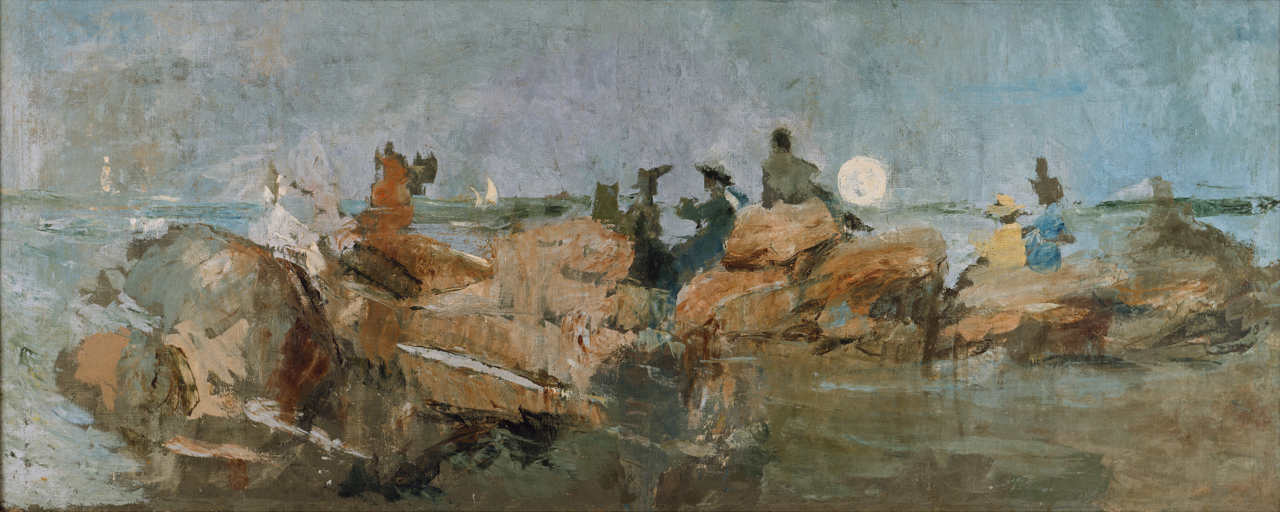
Major works - **Anochecer en la escollera III (1899):** This painting portrays a twilight seascape where the low sun casts a muted glow over a rocky shoreline. The composition balances the darkened rocks with a reflective sea surface, showcasing Pinazo’s mastery of atmospheric light and his ability to evoke a contemplative mood. - **Lápida conmemorativa del Maestro Guerrero, Madrid (1957):** Although the date post‑dates Pinazo’s death, the work is a posthumous commission that replicates his original design for a commemorative stone. It reflects his interest in historical commemoration and his skill in rendering stone textures and solemn inscriptions. - **Desnudo de frente (1880):** A striking frontal nude that explores the human form with a delicate, almost ethereal quality. The figure is illuminated by a soft, natural light that emphasizes the curvature of the body while maintaining a respectful distance, characteristic of Pinazo’s Romantic sensibility. - **In his final moments, King Jaime el Conquistador gives his sword to his son, Pedro (1881):** This historical tableau captures a poignant moment of succession. The king’s solemn expression and the son’s reverent posture are rendered with careful attention to costume detail, underscoring Pinazo’s narrative skill. - **Self‑Portrait Painting (Young Man with a Hat) (1895):** In this intimate self‑portrait, Pinazo presents himself as a thoughtful young man wearing a simple hat. The brushwork is loose around the hat and shoulders, while the face is rendered with finer detail, revealing both the artist’s technical versatility and his introspective character.
Each of these works exemplifies Pinazo’s ability to blend narrative depth with an atmospheric visual language, reinforcing his status as a leading Romantic painter in Spain.
Influence and legacy Ignacio Pinazo Camarlench’s contribution to Spanish art lies in his synthesis of Romantic narrative intensity with a refined treatment of light and colour. His approach influenced a generation of Spanish painters who sought to move beyond strict academic conventions while retaining a commitment to emotive storytelling. Artists in the early twentieth century, particularly those aligned with the Generation of ’98, cited Pinazo’s works as exemplars of a distinctly Spanish romanticism that could engage with broader European currents.
After his death in 1916 in the town of Godella, his paintings continued to be exhibited in major Spanish museums, including the Museo del Prado and the Valencian Institute of Modern Art. Retrospectives in the mid‑20th century revived interest in his oeuvre, and contemporary scholars regard his oeuvre as a pivotal link between the Romantic tradition and the nascent modernist movements that followed. Today, Pinazo’s paintings are studied for their nuanced handling of light, their emotive composition, and their role in shaping a uniquely Spanish visual language that balances historical narrative with personal expression.
Overall, Ignacio Pinazo Camarlench remains a vital figure in the story of Spanish Romanticism, remembered for his ability to capture fleeting moments of feeling through a harmonious blend of technique, colour, and narrative depth.
Frequently asked questions
Who was Ignacio Pinazo Camarlench?
Ignacio Pinazo Camarlench (1849–1916) was a Spanish painter from Valencia, celebrated as a leading Romantic artist in late‑19th‑century Spain.
What artistic movement is he associated with?
He is primarily linked to Romanticism, where he combined dramatic narrative with an atmospheric handling of light.
What are his most famous works?
Key paintings include Anochecer en la escollera III (1899), Desnudo de frente (1880), In his final moments, King Jaime el Conquistador gives his sword to his son, Pedro (1881), and his self‑portrait Young Man with a Hat (1895).
Why is Pinazo important in art history?
He bridged traditional Spanish Romanticism with emerging modernist tendencies, influencing subsequent generations of Spanish painters and helping define a uniquely emotive visual language.
How can I recognise a Pinazo painting?
Look for soft, diffused lighting, a muted earth‑tone palette with occasional bright accents, loose yet controlled brushwork, and figures captured in introspective or narrative moments.