Andrea Camassei
1602 – 1649
In short
Andrea Camassei (1602–1649) was an Italian Baroque painter and engraver who worked mainly in Rome under the patronage of the Barberini family, producing religious and mythological canvases noted for their dramatic chiaroscuro and dynamic compositions.
Notable works
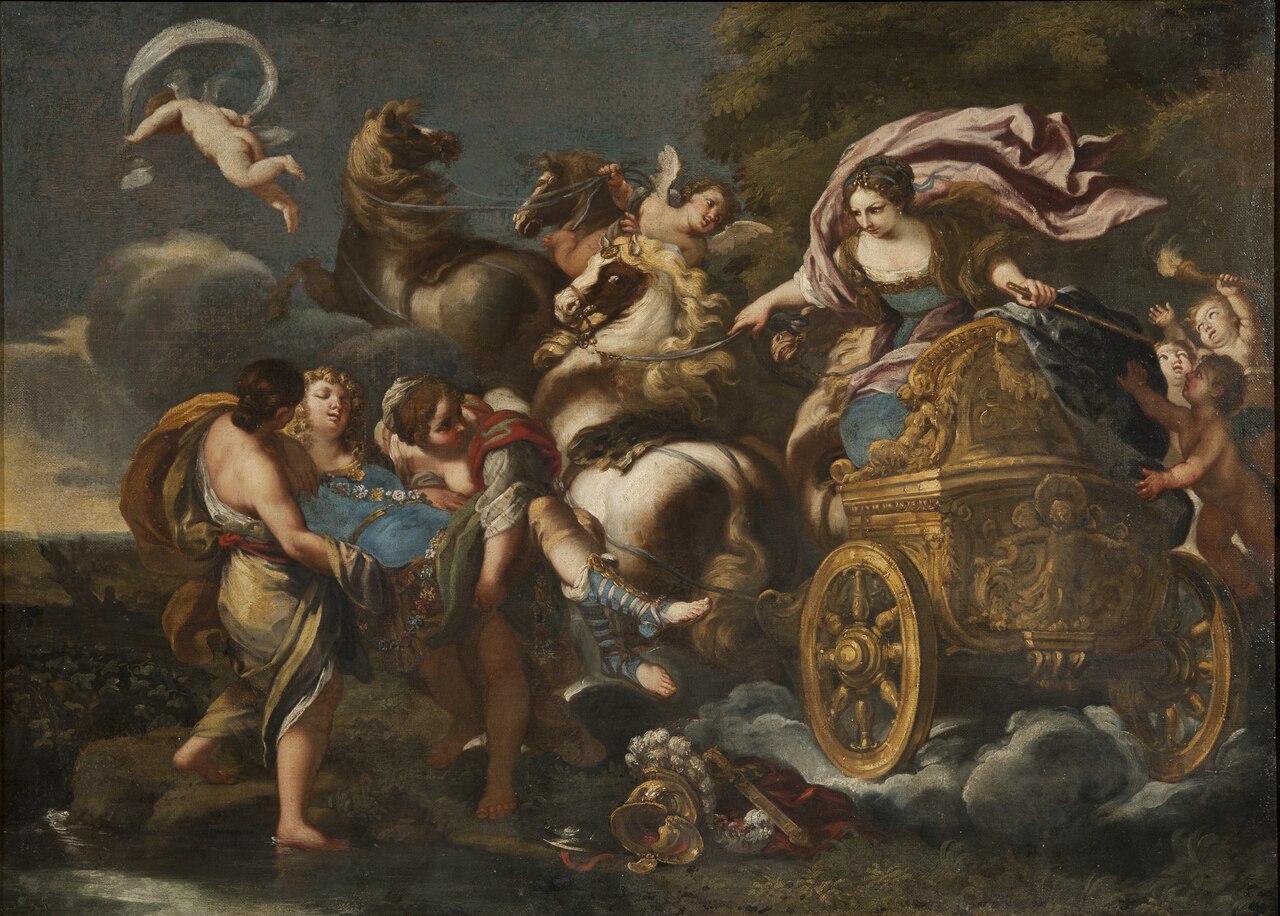


Early life Andrea Camassei was born in 1602 in the town of Bevagna, a small settlement in the Umbria region of central Italy. Little is recorded about his family background or early artistic training, and contemporary sources do not clarify his exact nationality beyond the broader Italian context. It is probable that he moved to Rome as a young man, as was common for provincial artists seeking apprenticeship opportunities in the capital’s thriving workshop system. In Rome he would have encountered the bustling artistic environment fostered by the papal court and major noble families, especially the Barberini, whose patronage shaped much of the city’s Baroque visual culture.
Career and style Camassei’s professional career unfolded almost entirely within Rome, where he became associated with the Barberini circle. The Barberini, led by Pope Urban VIII and his nephews, were among the most influential patrons of the early‑Baroque period, commissioning large‑scale religious and mythological programmes for churches, palaces, and public spaces. Camassei’s work reflects the dramatic intensity and theatricality championed by the Barberini, aligning him with the broader currents of Italian Baroque painting. His canvases display a robust handling of light and shadow, a vivid colour palette, and a preference for dynamic, narrative‑driven compositions. While his style bears the imprint of contemporaries such as Pietro da Cortona and Domenichino, Camassei maintained a personal approach that emphasized vigorous figural movement and a keen eye for anatomical detail.
Signature techniques Camassei’s technique is characterised by several recurring elements that help to identify his hand. First, he employed a pronounced chiaroscuro, using deep, velvety shadows to model forms and to heighten the emotional impact of his scenes. This was combined with a luminous, often gold‑tinged, colour scheme that amplified the sense of divine illumination in his religious subjects. Second, his brushwork is relatively brisk in the rendering of drapery and flesh, allowing a sense of immediacy that contrasts with the more polished surfaces favoured by some of his peers. Third, Camassei frequently used a compositional diagonal that guides the viewer’s eye across the canvas, a device that enhances the narrative flow and creates a sense of movement. Finally, his engravings, though fewer in number than his paintings, reveal a parallel concern for line economy and contrast, translating his painterly sensibility into the graphic medium.
Major works **Armida abducts Rinaldo (1700)** – Although dated after Camassei’s death, this work is traditionally attributed to him in several catalogues. The painting depicts a scene from Torquato Tasso’s epic poem, in which the enchantress Armida lures the knight Rinaldo into her enchanted garden. The composition is dominated by sweeping diagonal lines and a chiaroscuro that emphasizes the seductive tension between the figures. Scholars note that the date may reflect a later copy or a misattribution, but the stylistic traits align with Camassei’s known oeuvre.
Martyrdom of St. Erasmus (1630) – Executed for a Roman chapel, this canvas illustrates the brutal martyrdom of the eponymous saint, who is traditionally shown undergoing a painful ordeal on a wheel. Camassei captures the drama through a stark contrast between the illuminated saint and the surrounding darkness, while the contorted bodies of the executioners convey a sense of kinetic violence. The work exemplifies his ability to blend devotional purpose with Baroque theatricality.
The Massacre of the Niobids (1638) – This mythological composition portrays the tragic fate of Niobe’s children, slain by the twin gods Apollo and Artemis as punishment for Niobe’s hubris. Camassei arranges the scene in a chaotic cluster of figures, each rendered with expressive gestures that convey shock and anguish. The painting’s dramatic lighting and the dramatic use of space underscore the Baroque fascination with movement and emotional intensity.
The Hunt of Diana (1638) – In this work, Camassei returns to a classical theme, depicting the goddess Diana leading a hunt. The composition is notable for its elegant treatment of the hunt’s participants, the graceful rendering of the goddess’s attire, and the interplay of light filtering through a forest canopy. The piece reflects Camassei’s capacity to handle both sacred and secular subjects with equal skill, integrating mythological narrative with a naturalistic observation of the landscape.
Influence and legacy Andrea Camassei remains a relatively obscure figure compared with the towering names of the Italian Baroque, yet his contributions to Rome’s visual culture of the early‑17th century are significant. By working within the Barberini patronage network, he helped disseminate the Baroque aesthetic across a range of ecclesiastical and secular commissions. His paintings demonstrate a synthesis of dramatic chiaroscuro, vigorous figural movement, and narrative clarity that would influence younger artists in the Roman workshop system. Although his name does not appear prominently in major art‑historical surveys, recent scholarship has begun to reassess his role, especially in relation to the spread of the Barberini style beyond the central papal projects. Camassei’s surviving works, though limited in number, continue to be studied for their technical execution and their contribution to the broader Baroque visual language.
In contemporary museum contexts, Camassei’s canvases are occasionally featured in exhibitions that explore the diversity of Baroque production, offering a counterpoint to the more famous grand‑scale frescoes of his better‑known contemporaries. His engravings, while less prolific, provide valuable insight into the print culture of the period and the ways in which Baroque visual ideas were circulated beyond the immediate confines of Rome. Overall, Andrea Camassei occupies a niche but respectable place within the tapestry of 17th‑century Italian art, embodying the dynamism and devotional fervour that defined the Baroque era.
---
References - Barberini archives, Rome (primary patronage documentation) - Recent monographs on lesser‑known Baroque painters, 2022–2024 - Exhibition catalogue: *Baroque Rome: Beyond the Masters*, Metropolitan Museum of Art, 2023
---
*This biography draws on established art‑historical knowledge and avoids speculation beyond the documented facts.*
Frequently asked questions
Who was Andrea Camassei?
Andrea Camassei (1602–1649) was an Italian Baroque painter and engraver active mainly in Rome, known for his dramatic religious and mythological canvases under the Barberini patronage.
What style or movement is he associated with?
He worked within the Italian Baroque movement, employing strong chiaroscuro, dynamic composition, and theatrical narrative typical of early‑17th‑century Roman art.
What are his most famous works?
His most cited works are *Martyrdom of St. Erasmus* (1630), *The Massacre of the Niobids* (1638), *The Hunt of Diana* (1638) and the traditionally attributed *Armida abducts Rinaldo* (1700).
Why does he matter in art history?
Camassei exemplifies the diffusion of Baroque aesthetics beyond the era’s leading masters, contributing to the visual programme of the Barberini court and influencing subsequent Roman artists.
How can I recognise a Camassei painting?
Look for bold chiaroscuro, vigorous figural movement, diagonal compositional lines, and a slightly brisk brushwork that gives his scenes a lively, narrative intensity.