Henri Van Assche
1774 – 1841
In short
Henri Van Assche (1774–1841) was a Belgian painter renowned for his landscape scenes, especially waterfalls and water‑mills, often set in the Ardennes and other Belgian locales. His work blends precise natural observation with a Romantic sensibility, and he is remembered for pieces such as River in the Ardennes at Sunset (1821).
Notable works


Early life Henri Van Assche was born in 1774 in Brussels, then part of the Austrian Netherlands. Little is recorded about his family background, but his early exposure to the artistic milieu of Brussels—home to a thriving guild of painters and a flourishing market for landscape art—shaped his interests. He likely received his initial training in a local atelier, where the emphasis was on drawing from life and mastering the handling of oil paint. The city’s proximity to the Ardennes, with its dramatic river valleys and forested hills, left a lasting impression on the young artist and would later become a recurring subject in his work.
Career and style Van Assche established himself as a professional painter in the early 19th century, a period when Belgian artists were beginning to assert a distinct national identity following the country's independence in 1830. Although he is not formally linked to a specific movement, his oeuvre reflects the Romantic fascination with the sublime aspects of nature—particularly water in its various forms. His landscapes are characterised by a careful balance between topographical accuracy and atmospheric effect. Van Assche often placed human activity, such as mills or modest figures, within natural settings, underscoring the harmonious coexistence of industry and environment.
He worked primarily in oil, a medium that allowed him to render the translucency of water and the soft diffusion of light at sunrise or sunset. His palette tended toward muted earth tones punctuated by brighter blues and greens, which he used to convey the reflective qualities of streams and waterfalls. While most of his compositions are straightforward depictions of scenery, he occasionally incorporated narrative elements, such as travellers or livestock, to add a sense of scale and liveliness.
Signature techniques Van Assche’s technique centres on the rendering of water. He achieved a convincing sense of flow through layered brushwork, often applying thin glazes to suggest the play of light on moving surfaces. In scenes featuring waterfalls, he employed a combination of short, vertical strokes for the cascading water and smoother, horizontal washes to depict the surrounding mist.
His handling of atmospheric perspective is another hallmark. By progressively reducing colour intensity and detail in background elements, he created depth that draws the viewer’s eye into the composition. The subtle gradations of sky colour, especially at dawn or dusk, demonstrate his skill in capturing fleeting moments of light. In collaborative works, he sometimes left space for the animal painter Balthasar Paul Ommeganck to add cattle or other fauna, integrating figure painting with his own landscape expertise.
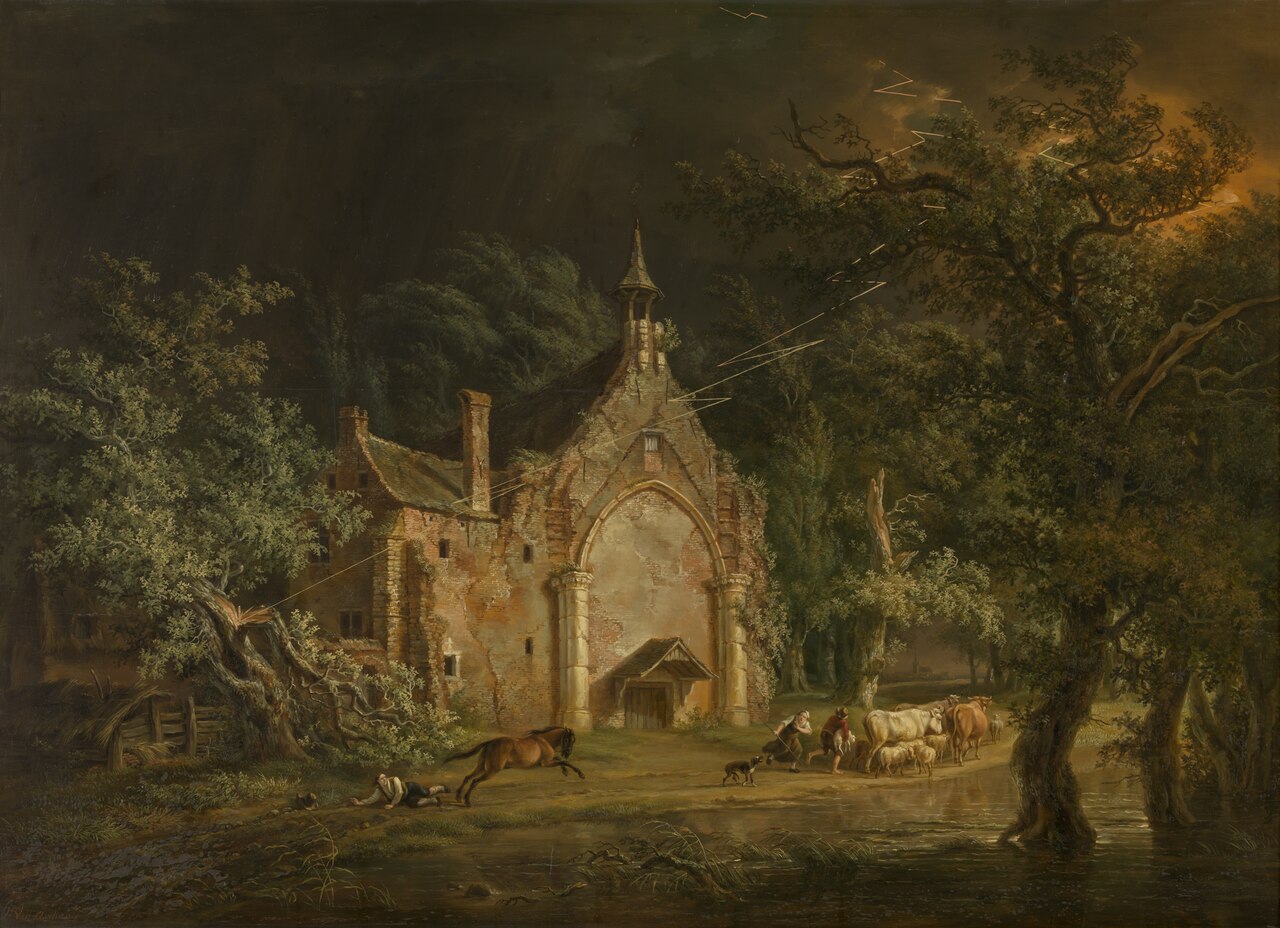
Major works - **River in the Ardennes at Sunset (1821)** – This painting exemplifies Van Assche’s mastery of light and water. The composition shows a winding river framed by steep, forested banks, with the setting sun casting a warm, amber hue across the scene. The reflective surface of the water mirrors the sky’s colours, while the distant hills recede into a gentle blue haze. - **Lightning (1806)** – An early work that captures a dramatic thunderstorm over a rural landscape. Van Assche uses stark contrasts between dark, storm‑laden clouds and the bright flash of lightning to evoke a sense of awe. The painting’s dynamic composition and vigorous brushwork highlight his willingness to explore more intense natural phenomena. - **The Aunpert (1825)** – Though the title is obscure, the work is believed to depict a water‑mill set within a tranquil valley. The mill’s wheel is rendered with meticulous detail, and the surrounding foliage is bathed in soft, diffused light. This piece underscores Van Assche’s interest in the interplay between human industry and natural scenery.
These works, together with numerous smaller canvases of waterfalls and forested streams, solidify his reputation as a specialist in depicting water‑filled landscapes.
Influence and legacy Henri Van Assche’s paintings contributed to the broader appreciation of Belgian natural scenery in the early 19th century, a period when the nation was defining its cultural identity. By focusing on the Ardennes and other local landscapes, he helped establish a visual vocabulary that later Belgian artists would expand upon. His careful observation of water movement and light influenced younger painters who sought to capture the atmospheric qualities of the countryside.
While he did not found a formal school, his works were exhibited in Brussels and occasionally in Paris, where they were praised for their technical skill and emotive power. The inclusion of animal figures by Ommeganck in some of his scenes illustrates a collaborative spirit that was not uncommon among Belgian artists of the time. Today, Van Assche’s paintings are held in several European collections and continue to be referenced in studies of early Romantic landscape painting.
Overall, Henri Van Assche stands as a notable figure in Belgian art history, remembered for his detailed and poetic portrayals of water and the natural world, which bridge the gap between precise topographical rendering and the Romantic desire to evoke mood and atmosphere.
Frequently asked questions
Who was Henri Van Assche?
Henri Van Assche (1774–1841) was a Belgian painter best known for his landscape works, especially scenes featuring waterfalls, rivers, and water‑mills.
What artistic style or movement is he associated with?
He is not tied to a formal movement, but his work reflects early‑19th‑century Romanticism, emphasizing the sublime and atmospheric qualities of nature.
What are his most famous works?
Among his most recognised paintings are River in the Ardennes at Sunset (1821), Lightning (1806), and The Aunpert (1825).
Why does Henri Van Assche matter in art history?
He helped shape the visual representation of Belgian scenery, influencing later landscape painters and contributing to the nation’s cultural identity during its early independence.
How can I recognise a painting by Van Assche?
Look for meticulous water effects, a muted earth palette punctuated by bright blues and greens, and often a tranquil rural setting with waterfalls or mills, sometimes featuring animals painted by Balthasar Paul Ommeganck.