Alphonse Asselbergs
1839 – 1916
In short
Alphonse Asselbergs (1839–1916) was a Belgian painter specialised in landscapes and forest scenes. He is best known for works such as Sunset in the Campine (1872) and La mare aux Fées in Fontainebleau (1876).
Notable works


.jpg)
Early life Alphonse Asselbergs was born in Brussels in 1839. Little is recorded about his family background, but contemporary accounts suggest that he grew up in a milieu that valued the visual arts, a common feature of middle‑class Brussels households of the period. He received his initial artistic training in the capital, where the burgeoning Belgian art academies offered a curriculum grounded in drawing, anatomy, and the study of nature. The vibrant urban environment of Brussels, coupled with easy access to the surrounding countryside, provided Asselbergs with early exposure to both the architectural grandeur of the city and the rustic charm of the Flemish landscape.
Career and style After completing his formal studies, Asselbergs embarked on a career that centred on landscape painting, a genre that enjoyed renewed popularity in Belgium during the second half of the 19th century. He was loosely associated with the broader European movement towards naturalism, yet he never aligned himself formally with any specific school or manifesto. His work reflects a measured synthesis of academic technique and an observational approach to light and atmosphere. By the 1860s, Asselbergs was exhibiting regularly at the Brussels Salon, where his paintings were noted for their calm compositional balance and a subdued palette that favoured earth tones and muted greens.
The artist travelled intermittently to the Campine (Kempen) region, a sparsely populated area of heathland and pine forests. These trips informed his most celebrated works, which depict the subtle interplay of sky, foliage, and open ground. Asselbergs’ approach was less about dramatic narrative and more about capturing a fleeting moment of tranquillity, a quality that aligns him with the tradition of the Dutch Golden Age landscape painters while also anticipating the tonal subtlety of later Impressionist work.
Signature techniques Asselbergs employed a restrained brushwork that allowed atmospheric effects to emerge through layered glazes rather than overt texture. He often began with a thin underpainting in a limited tonal range, establishing the overall light direction before adding colour in successive washes. This method produced a luminous depth, particularly evident in his depictions of sunrise and sunset. The artist favoured a muted palette dominated by ochres, siennas, and soft blues, reserving brighter accents for focal points such as a solitary tree or a reflective water surface.
Another notable technique was his handling of foliage. Rather than rendering each leaf individually, Asselbergs suggested the presence of trees and shrubs through swift, almost calligraphic strokes that hinted at form while preserving the overall atmospheric mood. This economical approach contributed to the sense of immediacy in his scenes, allowing viewers to feel present within the landscape without the distraction of excessive detail.
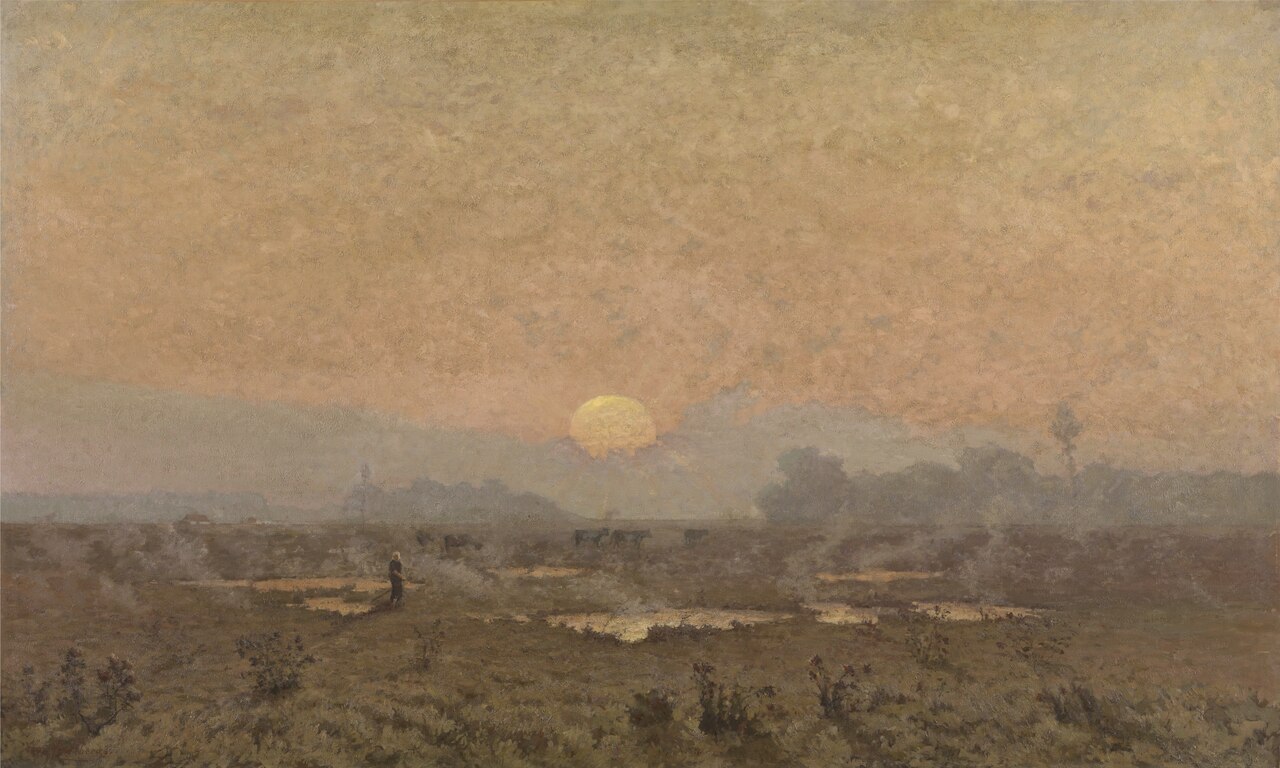
Major works - **Sunset in the Campine, Belgium (1872)** – This painting captures the expansive heath of the Campine bathed in the warm glow of an evening sun. The composition is anchored by a low horizon, allowing the sky to dominate the canvas with bands of amber and violet. The subtle gradation of colour demonstrates Asselbergs’ skill with glazing techniques.
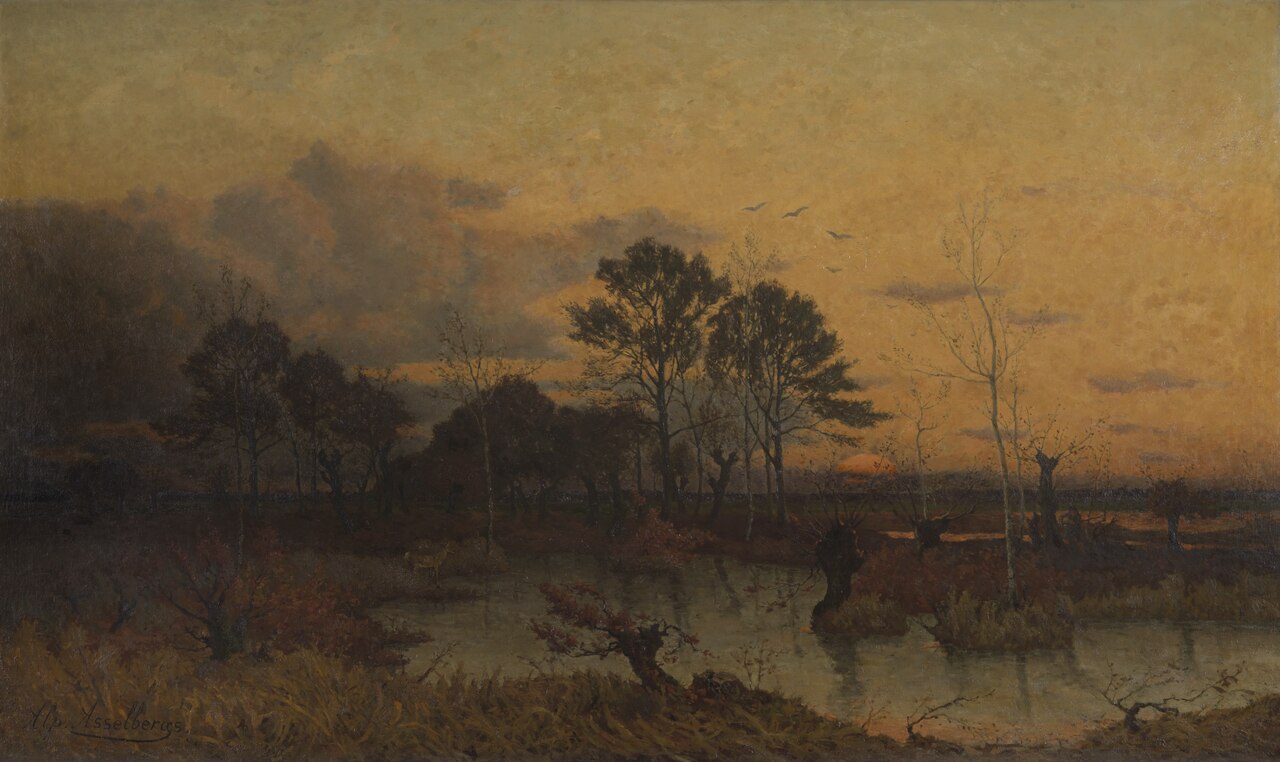
- Fen in the Kempen (1878) – In this later work, Asselbergs turns his attention to a marshy area within the same region. The fen’s reflective surface mirrors the sky, creating a double‑image effect that heightens the sense of stillness. The muted greens and browns of the surrounding vegetation are rendered with the same economical brushwork that characterises his oeuvre.
- The Heath – Though undated, this piece exemplifies Asselbergs’ recurring fascination with open, uncultivated land. A solitary figure, often a shepherd or a traveler, may be included to provide scale, but the primary focus remains the interplay of light across the heath’s grasses.
- La mare aux Fées in Fontainebleau (1876) – Departing from the Flemish countryside, Asselbergs visited the forest of Fontainebleau in France, a popular destination for artists seeking inspiration from its dense woods and rocky outcrops. This work portrays a small, myth‑infused pond (‘mare aux fées’ translates as ‘fairy pond’) surrounded by towering trees. The composition balances the darkness of the canopy with the luminous surface of the water, illustrating Asselbergs’ adaptability to differing natural environments.
- The Porte du Rivage in Brussels (1877) – This urban‑landscape piece depicts a gateway or entrance (‘porte’) leading to a riverside promenade. While less strictly a landscape than his other works, it demonstrates Asselbergs’ ability to integrate architectural elements within his atmospheric style, using the same soft palette and layered glazing to unify the built and natural worlds.
Influence and legacy Alphonse Asselbergs remained a relatively modest figure within the Belgian art world, never attaining the fame of contemporaries such as James Ensor or Fernand Khnopff. Nevertheless, his dedication to portraying the Belgian countryside contributed to a growing appreciation for native scenery at a time when industrialisation was reshaping the nation’s visual identity. His work provided a visual record of the Campine and Kempen regions before extensive agricultural development altered their character.
Later generations of Belgian landscape painters referenced Asselbergs’ restrained palette and atmospheric glazing, finding in his canvases a model for balancing realism with poetic mood. While he did not found a formal school, his paintings continue to be exhibited in regional museums and are occasionally featured in thematic exhibitions exploring 19th‑century European landscape art. Scholars regard his oeuvre as an authentic representation of the quiet, contemplative strand of Belgian painting, offering a counterpoint to the more overtly symbolic or avant‑garde movements that emerged at the turn of the century.
Asselbergs died in Uccle, a suburb of Brussels, in 1916. His legacy endures through the continued study of his works, which remain valuable for understanding the evolution of landscape painting in Belgium and the broader European context of the late 19th century.
Frequently asked questions
Who was Alphonse Asselbergs?
Alphonse Asselbergs (1839–1916) was a Belgian painter renowned for his quiet, atmospheric landscapes and forest scenes.
What artistic style or movement is he associated with?
He worked within a naturalistic tradition, employing academic techniques while focusing on the subtle effects of light and colour rather than aligning with a specific avant‑garde movement.
What are his most famous works?
His best‑known paintings include Sunset in the Campine (1872), La mare aux Fées in Fontainebleau (1876), Fen in the Kempen (1878), The Heath, and The Porte du Rivage in Brussels (1877).
Why is Alphonse Asselbergs significant in art history?
He documented the Belgian countryside at a time of rapid industrial change, influencing later landscape painters with his restrained palette and atmospheric glazing.
How can I recognise an Alphonse Asselbergs painting?
Look for a muted colour scheme, soft layered glazes, economical brushwork that suggests foliage, and a calm, contemplative mood that emphasizes light over detailed narrative.