Harald Jerichau
1851 – 1878
In short
Harald Jerichau (1851–1878) was a Danish landscape painter from Copenhagen, known for his short but productive career in Italy, where he created works such as The Lydian Plain near Sardis and scenes of Rome and Capri. He died in Rome at the age of 27, leaving a modest legacy within the 19th‑century European landscape tradition.
Notable works
_-_KMS1107_-_Statens_Museum_for_Kunst.jpg)

Early life Harald Adolf Nikolaj Jerichau was born in Copenhagen in 1851 into a family already steeped in artistic practice. His father, Jens Jerichau, was an established Danish landscape painter, and the household was a frequent gathering place for artists and intellectuals of the period. Growing up surrounded by canvases, sketches and the discussions of his father's peers, Harald developed an early fascination with the natural world and its representation on paper. His formative years were spent in the bustling cultural milieu of Copenhagen, where he received his initial artistic instruction and became familiar with the academic conventions that dominated Danish art education in the mid‑nineteenth century.
Career and style Harald’s professional trajectory was marked by a swift relocation to Italy, a destination that attracted many Northern European painters seeking the clarity of Mediterranean light and the antiquities of the classical world. Settling in Rome, he joined a community of expatriate artists who shared an interest in plein‑air painting and the study of ancient ruins. Jerichau’s work reflects a synthesis of Romantic sensibility and emerging Realist tendencies: his landscapes are imbued with a lyrical appreciation for the sublime, yet they retain a meticulous observation of topography and atmospheric effects. The artist’s colour palette favoured warm ochres, muted greens and the soft blues of the Italian sky, creating a harmonious balance between earth and atmosphere.
Signature techniques Jerichau’s technique was characterised by a restrained yet expressive brushwork that captured the transient qualities of light and weather. He often employed a layered approach, building thin glazes of colour over a more solid underpainting to achieve depth and luminosity. His compositions typically placed a foreground element—such as a winding path, a stand of trees or a ruin—against a broader vista, guiding the viewer’s eye through the landscape. The artist also made frequent use of atmospheric perspective, subtly diminishing colour saturation and contrast in distant forms to convey depth. These methods, combined with a disciplined observational practice, allowed him to render the nuanced interplay of natural and historic elements that defined his subject matter.
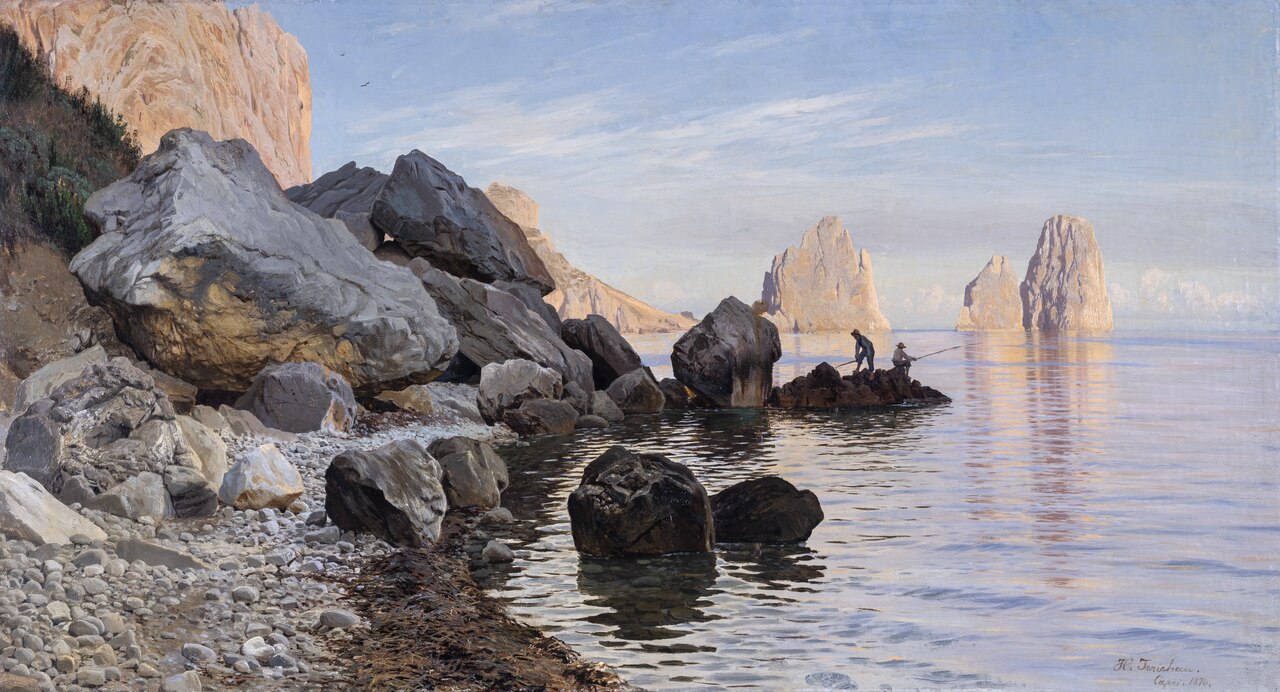
Major works Jerichau’s oeuvre, though limited by his early death, includes several notable pieces that illustrate his engagement with the Italian and Anatolian landscape. *Landscape from Rome, Villa dei Quintili near Via Appia* (1870) captures the ancient villa’s ruins set against the rolling hills south of the city, highlighting the juxtaposition of human history and natural scenery. In *Coast Scene, Capri* (1876), the artist portrays the island’s rugged shoreline, employing a bright, sun‑lit palette that emphasizes the crystalline sea and the stark cliffs. His final known work, *The Lydian Plain near Sardis, Asia Minor* (1878), reflects a departure from his Italian subjects, depicting the expansive Anatolian plain with a sense of openness and quiet grandeur. Each painting demonstrates Jerichau’s ability to convey both the specific character of a locale and the universal qualities of landscape.
Influence and legacy Harald Jerichau’s career was cut short when he died in Rome in 1878, at the age of twenty‑seven. Despite his brief lifespan, his paintings contribute to the broader narrative of 19th‑century European landscape art, particularly the exchange of ideas between Northern and Southern artistic traditions. Within Denmark, his work is recognised as part of the Jerichau family’s artistic lineage, complementing the contributions of his father and other relatives. Though he did not establish a distinct school or movement, his paintings are valued for their technical proficiency and evocative representation of Mediterranean scenery, offering insight into the artistic ambitions of young Danish painters abroad during a period of intense cultural mobility.
Frequently asked questions
Who was Harald Jerichau?
Harald Jerichau was a Danish landscape painter (1851–1878) who worked primarily in Italy and is known for a small body of paintings depicting Roman and Mediterranean scenes.
What style or movement is his work associated with?
His work blends Romantic appreciation of nature with emerging Realist techniques, reflecting the 19th‑century European landscape tradition rather than belonging to a specific movement.
What are his most famous works?
His best‑known paintings include *Landscape from Rome, Villa dei Quintili near Via Appia* (1870), *Coast Scene, Capri* (1876) and *The Lydian Plain near Sardis, Asia Minor* (1878).
Why is Harald Jerichau important in art history?
He exemplifies the cross‑cultural artistic exchange of his era, illustrating how Danish painters adopted Mediterranean light and subjects, and he contributes to the legacy of the Jerichau family of artists.
How can I recognise a painting by Harald Jerichau?
Look for carefully composed landscapes that combine ancient ruins or coastal features with a warm, atmospheric palette, soft brushwork and a clear sense of depth created through atmospheric perspective.