Hans von Bartels
1856 – 1913
In short
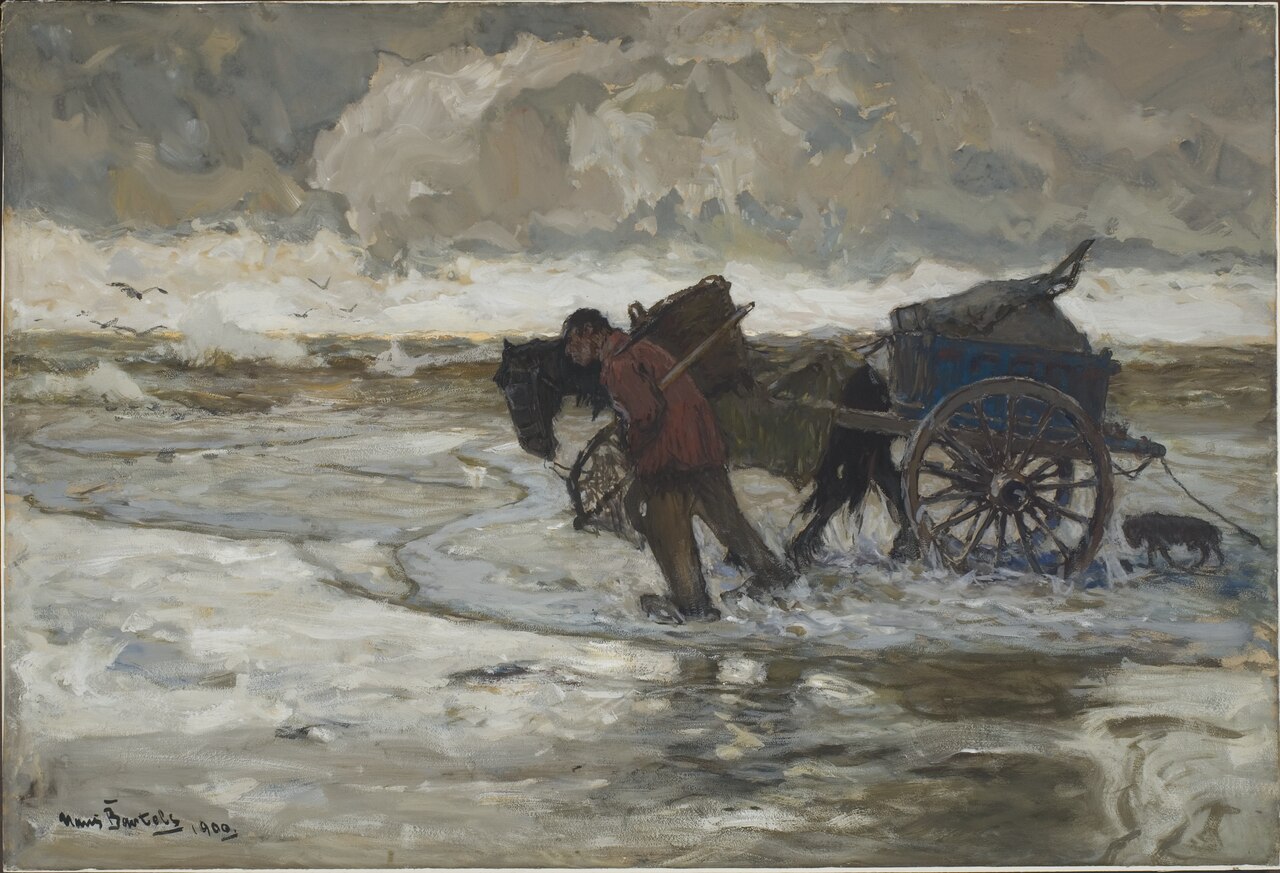
Hans von Bartels (1856–1913) was a German painter born in Hamburg and active primarily in the late 19th and early 20th centuries. He is best known for atmospheric coastal scenes such as At the Dunes (1900), Three Dutch Fishergirls and The Morning Bathe, and he spent his final years in Munich.
Notable works
_-_Three_Dutch_Fishergirls_-_1990-3_-_Ben_Uri_Gallery.jpg)
_-_The_Morning_Bathe_-_A0262_-_Paisley_Museum.jpg)
Early life Hans von Bartels was born in 1856 in the bustling port city of Hamburg, a centre of trade and maritime culture that would later inform much of his artistic subject matter. Little is recorded about his family background, but contemporary accounts suggest a middle‑class upbringing that afforded him the opportunity to pursue formal training in the visual arts. Hamburg’s art institutions of the period, notably the Kunstgewerbeschule and the Academy of Fine Arts, provided a foundation in drawing, composition and the study of light – skills that would become hallmarks of his mature work.
Career and style After completing his studies, von Bartels embarked on a journeyman’s tour of the North Sea coast, a common practice among German painters seeking authentic material for marine and genre scenes. The experience deepened his fascination with the interplay of water, sky and shore, and he began to exhibit regularly at venues in Hamburg and later in Munich, where he eventually settled. While his oeuvre does not fit neatly within a single avant‑garde movement, his style reflects a synthesis of realism, naturalism and a subtle impressionistic sensitivity to atmosphere. His canvases are characterised by restrained colour palettes, careful observation of weathered light, and a focus on everyday labour rather than heroic or mythic narratives.
Signature techniques Von Bartels employed a meticulous underdrawing to establish the structural integrity of his compositions before applying thin, layered glazes of oil. This glazing technique enabled him to render the translucency of sea mist and the soft diffusion of early‑morning light with a luminous quality. He favoured a limited range of earth tones – ochres, muted greens and greys – punctuated by occasional highlights of warm ochre or pale blue to suggest the sun’s reflection on water. Brushwork varies from fine, almost stippled passages in distant backgrounds to broader, more expressive strokes in foreground figures, creating a sense of depth while preserving the immediacy of the scene.
Major works Among his most celebrated pieces is **At the Dunes (1900)**, a large‑scale canvas that captures a windswept shoreline populated by solitary figures gathering seaweed. The work exemplifies von Bartels’s capacity to convey both the physicality of the landscape and the quiet endurance of its inhabitants. **Three Dutch Fishergirls** portrays a trio of young women on a shallow beach, their garments rendered with delicate folds that catch the subtle play of light. This painting underscores his interest in the lives of coastal communities beyond his native Germany, reflecting a broader North‑European sensibility. **The Morning Bathe** offers a more intimate glimpse of daily routine, depicting a woman immersed in a shallow pool of seawater at dawn. The composition’s calm, reflective surface and the soft, diffused illumination demonstrate von Bartels’s mastery of light as a narrative device.
Influence and legacy Although Hans von Bartels never achieved the renown of some of his contemporaries, his work contributed to the visual documentation of maritime life at a time of rapid industrial change. His paintings were exhibited in the major German art societies of the late 19th century and were acquired by private collectors who valued their truthful representation of coastal labour. In the decades following his death in Munich in 1913, his oeuvre was rediscovered by regional museums seeking to illustrate the artistic heritage of northern Germany. Today, von Bartels is recognised for his nuanced treatment of atmosphere and his ability to render the ordinary with quiet dignity, influencing later German landscape painters who pursued a similar balance of realism and lyrical mood.
Frequently asked questions
Who was Hans von Bartels?
Hans von Bartels was a German painter (1856–1913) born in Hamburg who specialised in coastal and genre scenes, later working from Munich.
What style or movement is he associated with?
He is not linked to a single movement; his work blends realism, naturalism and an impressionistic sensitivity to light and atmosphere.
What are his most famous works?
His best‑known paintings include At the Dunes (1900), Three Dutch Fishergirls and The Morning Bathe.
Why is Hans von Bartels important in art history?
He documented the everyday lives of North‑Sea coastal communities with technical skill, influencing later German landscape painters and enriching the visual record of a changing maritime world.
How can I recognise a painting by Hans von Bartels?
Look for muted coastal palettes, careful glazing to capture mist and water, finely drawn figures engaged in labour, and a calm, atmospheric mood that emphasizes light over dramatic action.