Ferdinand Heilbuth
1826 – 1889
In short
Ferdinand Heilbuth (1826–1889) was a German‑born painter who spent most of his career in France, dying in Paris. He is noted for genre scenes and portrait studies such as Study of a Head (1850) and Rowing on the Seine (1870).
Notable works


Early life Ferdinand Heilbuth was born in 1826 in Hamburg, then a thriving port city of the German Confederation. Little is recorded about his family background, but the artistic milieu of Hamburg in the early nineteenth century offered a range of apprenticeships and drawing schools. Heilbuth likely received his initial training at a local drawing academy, where the emphasis was on rigorous drawing from life and classical principles. By his early twenties he had developed sufficient skill to contemplate a career beyond his native city.
In the 1840s, a wave of German artists migrated to Paris, attracted by its reputation as the centre of the art world. Heilbuth joined this movement, relocating to the French capital where he could study at the École des Beaux‑Arts and mingle with contemporary painters. The experience broadened his exposure to French academic traditions while retaining the disciplined approach of his German training.
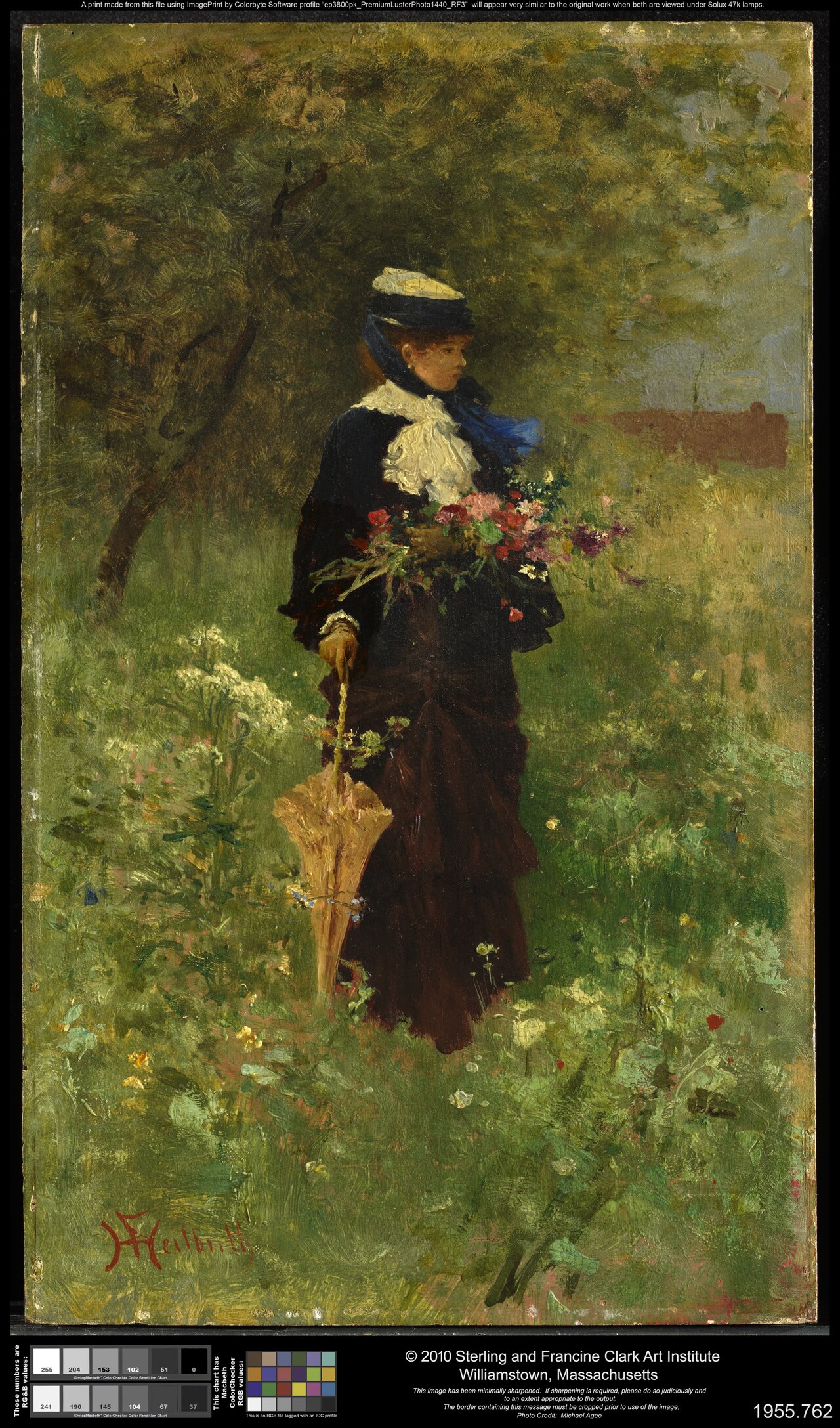
Career and style Heilbuth’s professional activity in Paris spanned several decades, during which he exhibited at the Salon and secured commissions from private patrons. His oeuvre does not fit neatly into a single recognised movement; rather, it reflects a synthesis of academic realism and the emerging interest in everyday subjects that characterised mid‑nineteenth‑century French painting. He favoured modest genre scenes, intimate portraits, and occasional landscape studies, often set along the Seine or in the woodlands surrounding Paris.
The artist’s style is marked by a sober palette, careful modelling of forms, and an emphasis on narrative clarity. He avoided the theatrical excesses of Romanticism, instead opting for a restrained, observational approach that highlighted the dignity of ordinary moments. This balance of academic technique with a modest, almost journalistic subject matter positioned him as a competent, if not avant‑garde, figure within the Parisian art market.
Signature techniques Heilbuth’s technique rested on a solid foundation in drawing, a skill honed during his early training in Hamburg. He employed a layered oil method, beginning with a monochrome underpainting (grisaille) to establish tonal relationships before applying colour washes. This allowed him to achieve subtle gradations of light and shadow, particularly evident in his portraiture.
In his landscape and river scenes, Heilbuth favoured a limited colour range, often using muted greens, browns, and blues to convey atmosphere. He applied paint with a fine brush for delicate details—such as the texture of a dog’s fur in *Woman with Dog*—while broader strokes rendered foliage and water surfaces. His handling of water, especially in *Rowing on the Seine*, displays a controlled use of reflected light, creating a calm yet dynamic surface.
Major works Heilbuth’s catalogue, though not extensive, includes several works that illustrate his range:
- Study of a Head (1850) – An early portrait study, this work demonstrates his command of anatomical accuracy and subtle chiaroscuro. The subject’s direct gaze and the restrained background underscore his focus on the individual’s character.
- Scene in the Bois de Boulogne (1860) – Set in the popular Parisian park, the painting captures a leisurely promenade, with figures rendered in soft light. The composition balances foreground activity with a tranquil background, reflecting the artist’s ability to convey narrative within a natural setting.
- Rowing on the Seine (1870) – Perhaps his most celebrated landscape, this piece depicts a solitary rowboat gliding along the river. The muted palette and precise rendering of water surface convey a serene atmosphere, while the distant Parisian skyline situates the scene within a recognizable urban context.
- Woman with Flowers (1877) – A portrait of a young woman holding a bouquet, this work highlights Heilbuth’s sensitivity to feminine subjects. The delicate treatment of the flowers and the soft modelling of the figure’s features reveal his continued interest in texture and light.
- Woman with Dog (1880) – In this later work, the artist presents a domestic scene, with the woman’s calm demeanor complemented by the attentive dog. The composition is balanced, and the interplay of fur and fabric showcases his refined brushwork.
These paintings, while not groundbreaking, exemplify Heilbuth’s consistent quality and his capacity to render everyday life with dignity and technical skill.
Influence and legacy Ferdinand Heilbuth did not found a school nor spearhead a movement; nevertheless, his work contributes to the broader understanding of mid‑nineteenth‑century French genre painting. By maintaining a disciplined academic approach while embracing contemporary subjects, he bridged the gap between traditional academic art and the more socially conscious realism that would later emerge.
His paintings were collected by middle‑class patrons who appreciated their modest elegance, and they continued to appear in auction houses into the early twentieth century. Although he remains a relatively obscure figure today, scholars of the period cite Heilbuth as an example of the many competent artists who populated the Parisian Salon system, providing a counterweight to the more celebrated names of the era.
Heilbuth’s legacy endures mainly through the surviving works that illustrate the everyday visual culture of his time. For students of art history, his paintings offer insight into the techniques, market conditions, and aesthetic preferences that shaped the careers of numerous working artists in nineteenth‑century Paris.
---
*Ferdinand Heilbuth died in Paris in 1889, leaving behind a modest but respectable body of work that continues to inform the study of genre painting in the late nineteenth century.*
Frequently asked questions
Who was Ferdinand Heilbuth?
Ferdinand Heilbuth (1826–1889) was a German‑born painter who spent most of his career in Paris, producing genre scenes and portraits.
What style or movement is he associated with?
He is not linked to a single movement; his work blends academic realism with the modest, everyday subjects typical of mid‑nineteenth‑century French genre painting.
What are his most famous works?
Key paintings include *Study of a Head* (1850), *Scene in the Bois de Boulogne* (1860), *Rowing on the Seine* (1870), *Woman with Flowers* (1877) and *Woman with Dog* (1880).
Why does he matter in art history?
He illustrates the role of competent, academically trained artists who catered to middle‑class patrons, helping to map the broader landscape of nineteenth‑century French art beyond the famous avant‑garde figures.
How can I recognise a Heilbuth painting?
Look for a restrained palette, careful modelling of figures, a focus on everyday scenes, and a polished, layered oil technique that emphasises subtle light and texture.