Georg Flegel
1566 – 1638
In short
Georg Flegel (1566–1638) was a German painter born in Olomouc who worked most of his career in Frankfurt. He is recognised as one of the earliest German artists to specialise in still‑life painting, producing meticulously detailed works that blend naturalistic observation with symbolic nuance.
Notable works
.jpg)
.jpg)


Early life Georg Flegel was born in 1566 in the Moravian town of Olomouc, then part of the Habsburg lands. Although his family background is not extensively documented, the city’s position on trade routes exposed him early to a variety of imported goods – spices, exotic fruits and fine ceramics – that later appeared in his paintings. By the late 1580s he had moved to Frankfurt, a thriving commercial centre in the Holy Roman Empire, where he would spend the majority of his professional life.
Career and style In Frankfurt, Flegel entered the workshop of the Flemish painter Joris Hoefnagel, a master known for his intricate natural studies and decorative motifs. Working alongside Hoefnagel provided Flegel with a solid grounding in the Northern European tradition of detailed observation, especially the meticulous rendering of flora, fauna and everyday objects. By the turn of the 17th century he had established himself as an independent painter, securing commissions from wealthy merchants and civic patrons who valued the moral and decorative potential of still‑life imagery.
Flegel’s style reflects a synthesis of Flemish naturalism and a nascent German sensibility. His compositions are generally modest in scale, allowing viewers to examine each element closely. He favoured a restrained colour palette – muted earth tones punctuated by the vivid reds of apples or the deep greens of leaves – and employed a controlled, almost scientific lighting that highlighted texture without dramatic chiaroscuro. While his work predates the full flowering of the Baroque, it anticipates the genre’s later emphasis on abundance and the fleeting nature of material wealth.
Signature techniques Flegel’s technical hallmark is his extraordinary attention to surface detail. He painted the skin of fruit, the grain of wood and the iridescence of beetle shells with a precision that suggests the use of fine brushes and perhaps even magnifying tools. In several works he includes insects – most famously a stag beetle in the 1635 *Still Life with Stag Beetle* – to underscore the theme of transience (a nod to the vanitas tradition). His handling of light is subtle: a single, diffused source creates gentle shadows that model objects while preserving a sense of stillness. The painter also employed layered glazing to achieve depth in transparent materials such as wine and glass, a technique that required careful control of pigment and drying times.
Major works *Still Life with Stag Beetle* (1635) showcases a neatly arranged banquet table laden with cheese, fruit and a prominent stag beetle perched on a leaf. The beetle, rendered in exacting detail, serves as a visual reminder of mortality amidst the abundance.
*The Apricot Branch* (1630) presents a single branch bearing apricot blossoms and ripe fruit. The work’s simplicity highlights Flegel’s skill in rendering botanical forms, with each blossom delicately painted against a neutral background.
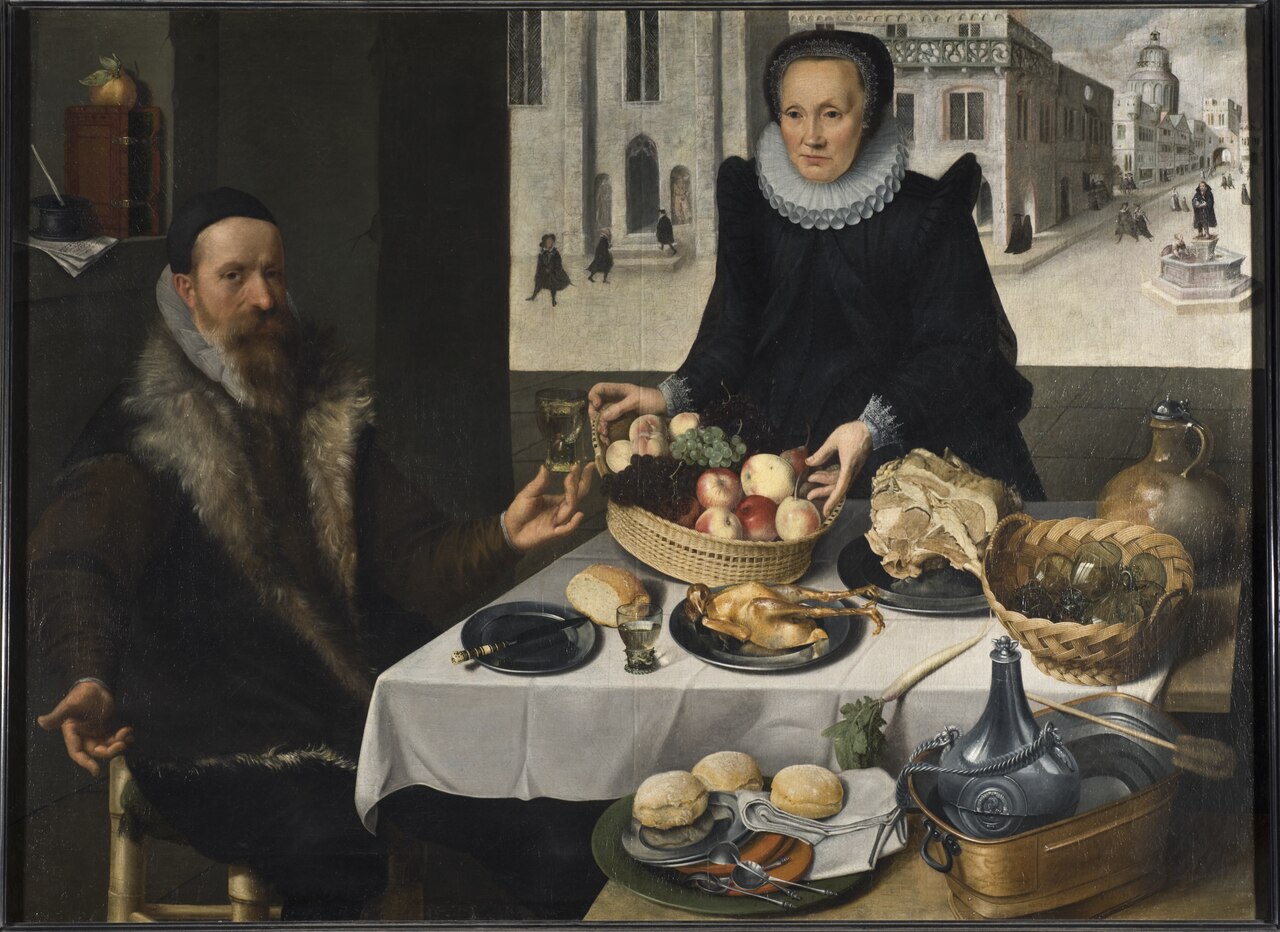
*Double Portrait of an Elderly Couple* (1600) diverges from his usual genre, depicting an aged pair seated together. Though not a still‑life, the painting retains Flegel’s characteristic focus on texture – the wrinkles of skin, the sheen of clothing and the subtle play of light across the couple’s faces.
*Still Life* (1627) is an expansive composition of game, bread, cheese, and a selection of fruits. The arrangement balances richness with restraint, and the inclusion of a small bird perched on a branch adds a narrative element that hints at the fleeting nature of life’s pleasures.
*Still Life with Cheese and Cherries* (1635) features a polished wooden board bearing a wedge of cheese, a cluster of cherries, and a glass of wine. The composition’s careful balance of colour – the deep red of the cherries against the creamy cheese – exemplifies Flegel’s mastery of colour harmony.
These works collectively illustrate Flegel’s commitment to realism, his interest in the symbolic potential of everyday objects and his ability to infuse ordinary subjects with a quiet, contemplative dignity.
Influence and legacy Georg Flegel’s legacy lies in his role as a pioneer of German still‑life painting. By establishing a market for detailed, naturalistic depictions of food and objects, he paved the way for later German artists such as Joachim von Sandrart and the members of the Frankfurt school of still‑life painters. His meticulous technique influenced the development of the vanitas genre in northern Europe, where the juxtaposition of luxury items with symbols of decay became a moralising visual language.
Beyond his immediate circle, Flegel’s work contributed to a broader appreciation for the scientific observation of nature within art, a trend that would later flourish in the work of Dutch Golden Age painters. Although he did not belong to a formally recognised movement, his paintings exemplify the early Baroque shift toward realism and the celebration of material culture that characterised the period.
Today, Flegel’s paintings are held in major museum collections, including the Städel Museum in Frankfurt and the Kunsthistorisches Museum in Vienna. They continue to be studied for their technical brilliance and for the way they bridge the gap between decorative art and moral commentary, confirming his place as a foundational figure in the history of European still‑life painting.
Frequently asked questions
Who was Georg Flegel?
Georg Flegel was a German painter (1566–1638) who became one of the earliest specialists in still‑life painting, working mainly in Frankfurt.
What style or movement is he associated with?
Flegel is linked to the early Baroque naturalist tradition, drawing on Flemish and Netherlandish still‑life models while developing a distinct German approach.
What are his most famous works?
His most cited works include *Still Life with Stag Beetle* (1635), *The Apricot Branch* (1630), *Double Portrait of an Elderly Couple* (1600), *Still Life* (1627) and *Still Life with Cheese and Cherries* (1635).
Why is Georg Flegel important in art history?
He helped establish the still‑life genre in German art, influencing later painters and contributing to the wider European appreciation of detailed naturalistic representation.
How can I recognise a painting by Georg Flegel?
His paintings are characterised by meticulous, close‑up depictions of food and objects, a restrained colour palette, precise lighting, and occasional inclusion of insects or symbolic motifs that underscore the transience of material wealth.