Camille Flers
1802 – 1868
In short
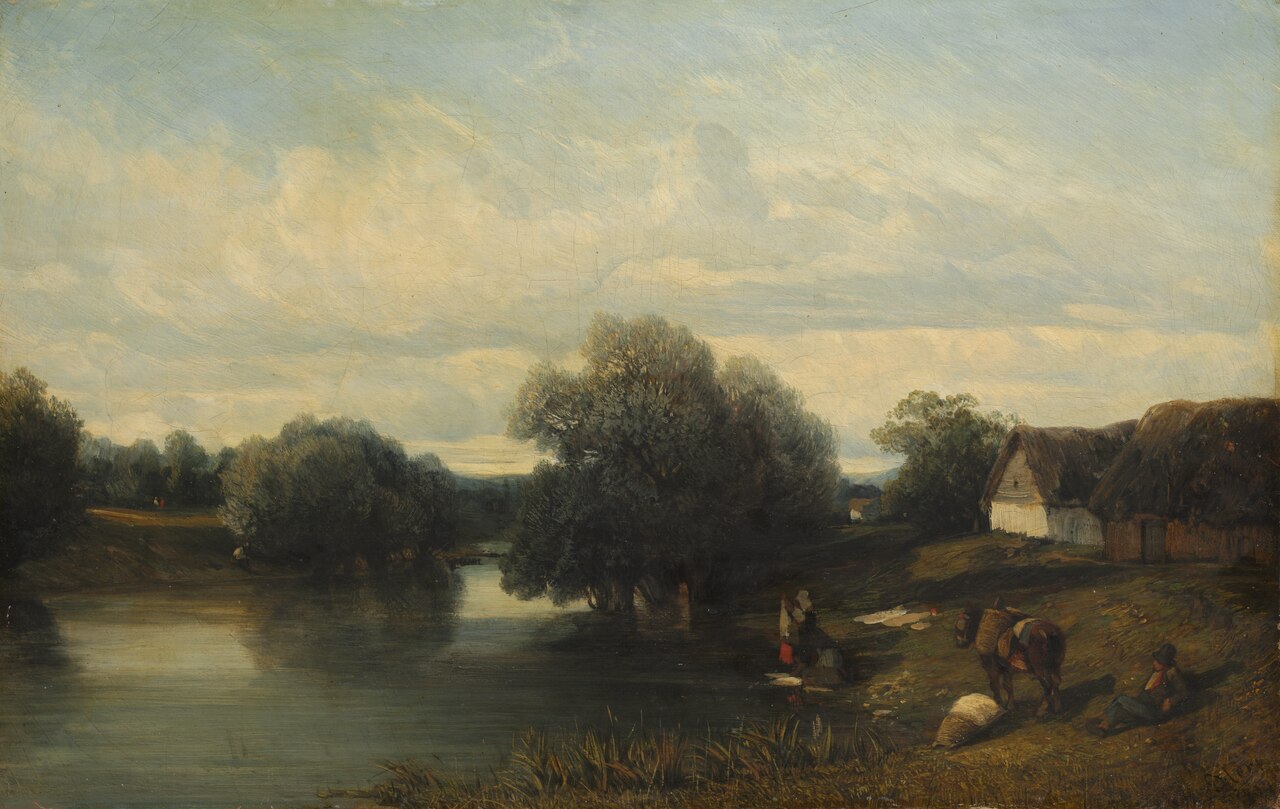
Camille Flers (1802–1868) was a French landscape painter associated with Realism. He is best known for atmospheric river scenes such as *Cottage by the River with Washerwomen* (1835) and taught a generation of French landscape artists.
Notable works
.jpg)
_-_Landscape_near_Annet-sur-Marne,_France_-_B.M.327_-_Bowes_Museum.jpg)

Early life Camille Flers was born in Paris in 1802, a period when the city was a bustling centre for artistic training and exhibition. Little is recorded about his family background, but his formative years coincided with the rise of the French Academy and the burgeoning interest in depicting everyday life and nature. Flers entered the Parisian art world as a pupil of the academic tradition, yet he gravitated early towards the study of landscape, a genre that was gaining legitimacy thanks to artists such as Théodore Rousseau and the Barbizon School.
Career and style Flers established his reputation in the 1820s and 1830s as a painter of rural scenes that combined meticulous observation with a subtle emotional tone. He was part of the French Realist movement, which sought to represent nature and society without idealisation. Unlike the dramatic, heroic landscapes of earlier Romantic painters, Flers favoured modest, quiet settings – riverbanks, willow groves, and small villages – rendered with a restrained palette and careful handling of light.
A significant influence on his development was the work of Joseph François Pâris, a scholar‑artist whose writings on colour theory and natural observation Flers studied closely. This intellectual engagement is evident in Flers’s own emphasis on the interplay of colour and atmosphere. Throughout his career he travelled to Normandy and the banks of the Marne and Eure, producing series of studies that displayed a “great amount of study and power of feeling in the colouring,” as contemporary critics noted.
By the 1840s Flers had secured regular exhibition slots at the Salon, where his works were praised for their sincerity and technical competence. He also began to teach, passing his knowledge of plein‑air practice to younger artists, among them members of the Cabat family, who would later become noted landscape painters themselves.
Signature techniques Flers’s technique rested on three pillars:
1. Atmospheric colour modulation – Drawing on Pâris’s colour theories, Flers layered thin glazes to capture the shifting tones of sky and water. This gave his river scenes a luminous depth that suggested the passage of time. 2. Controlled brushwork – He employed a restrained, almost stippled brushstroke for foliage, allowing leaves and reeds to dissolve into the surrounding air while retaining enough definition to convey texture. 3. Balanced composition – Flers often placed a modest human element – a cottage, a washerwoman, a distant figure – off‑centre, using the natural line of the river or a row of willows to guide the eye toward the horizon. This compositional restraint reinforced the quiet, contemplative mood of his paintings.
Major works Flers’s oeuvre includes several works that exemplify his Realist sensibility:
- Cottage by the River with Washerwomen (1835) – This painting captures a modest rural dwelling beside a gentle river, where women are engaged in washing. The soft brown and green tones, coupled with the reflective water surface, create a sense of timeless labour. - On a Quiet River (1841) – Here Flers presents a solitary stretch of river bordered by willows. The muted sky and subtle ripples convey an atmosphere of stillness, inviting the viewer to contemplate the scene’s quietude. - Landscape near Annet‑sur‑Marne, France – Produced later in his career, this work reflects Flers’s personal connection to his place of death. The composition centres on the gentle slope of the Marne valley, with a delicate handling of light that hints at the approaching evening. - Willows near the Sluice – In this piece Flers focuses on the interaction between human engineering and natural growth. The sluice’s stonework is rendered with precise linearity, while the surrounding willows are softened through his characteristic glazing technique.
In addition to these, Flers painted a view of the environs of Paris that now hangs in the Louvre, a testament to his acceptance by the French artistic establishment.
Influence and legacy Camille Flers occupies a modest but distinct niche in 19th‑century French art. His dedication to portraying the ordinary landscape with respect and technical finesse helped lay groundwork for later Realist and Impressionist painters who would further explore light and atmosphere. By mentoring younger artists such as the Cabats, he contributed to the diffusion of plein‑air methods beyond the Barbizon circle.
Although his name is not as widely recognised as some of his contemporaries, Flers’s works remain in public collections across France and continue to be exhibited in thematic shows on French Realism. Scholars cite his paintings as early examples of a disciplined approach to colour that pre‑figures the more radical experiments of the Impressionists. His legacy endures in the quiet, contemplative quality that his river scenes impart, reminding viewers of the enduring allure of the French countryside.
Flers died in Annet‑sur‑Marne in 1868, leaving behind a body of work that reflects both a scholarly commitment to observation and a poetic sensitivity to the French landscape.
Frequently asked questions
Who was Camille Flers?
Camille Flers (1802–1868) was a French painter renowned for his realistic landscapes, especially river and countryside scenes.
What artistic movement did he belong to?
He worked within the French Realist movement, favouring truthful, unidealised depictions of nature.
What are his most famous works?
His best‑known paintings include *Cottage by the River with Washerwomen* (1835), *On a Quiet River* (1841), *Landscape near Annet‑sur‑Marne*, and *Willows near the Sluice*.
Why is Camille Flers important in art history?
Flers helped establish a disciplined, colour‑focused approach to landscape painting that influenced later Realist and Impressionist artists, and he taught a generation of French landscape painters.
How can I recognise a painting by Camille Flers?
Look for calm river settings, muted earth tones, subtle glazes that create atmospheric light, and a balanced composition that often includes modest human activity such as cottages or washerwomen.