Fritz Syberg
1862 – 1939
In short
Fritz Syberg (1862–1939) was a Danish painter and illustrator associated with the Funen Painters, known for his rural scenes and sensitive portrayals of everyday life on the island of Funen.
Notable works



Early life Fritz Syberg was born on 8 February 1862 in the coastal town of Faaborg on the island of Funen, Denmark. He grew up in a modest family that was closely tied to the agricultural rhythms of the region. From an early age, Syberg displayed a keen interest in drawing, sketching the harbour, the surrounding countryside, and the people who worked the land. His formative education was a combination of local school lessons and informal apprenticeship with a decorative painter, a common pathway for aspiring artists in late‑19th‑century Denmark.
In his teenage years Syberg attended the Royal Danish Academy of Fine Arts in Copenhagen, where he was exposed to the academic conventions of the time while also encountering the more progressive ideas circulating in the capital. Though his training was grounded in traditional techniques, he was drawn to the emerging interest in naturalistic representation and the depiction of everyday life, themes that would later define his oeuvre.
Career and style After completing his studies, Syberg returned to Funen and settled in the village of Svanninge. It was here that he joined a loosely organised group of artists later known as the Funen Painters (Fynboerne). The group, which also included artists such as Johannes Larsen and Peter Hansen, shared a commitment to portraying the simple, unadorned beauty of the island’s rural environment. Their work was characterised by a restrained colour palette, an emphasis on atmospheric light, and an intimate connection with the landscape.
Syberg’s style evolved from the academic realism of his academy training to a more lyrical naturalism. He favoured a muted tonal range, often employing earth tones and soft greens that echoed the fields, hedgerows and sea‑air of Funen. His brushwork was careful yet expressive, allowing the texture of foliage, the sheen of water, and the subtle play of shadow to emerge without overt dramatization. Throughout his career Syberg remained committed to representing ordinary people – farmhands, fishermen, and domestic figures – in moments of quiet activity or contemplation.
Signature techniques Syberg’s paintings are distinguished by several recurring technical choices:
1. Layered glazing – He often applied thin layers of translucent colour over a darker underpainting, creating depth and a luminous quality that gives his skies and water a soft glow. 2. Modulated light – A hallmark of the Funen Painters, Syberg rendered light as a diffuse, almost tactile element, allowing it to define form rather than merely illuminate it. 3. Simplified composition – While his works contain narrative detail, the overall arrangement tends toward balance and restraint, avoiding clutter and directing the viewer’s eye toward focal points such as a lone figure or a distant hill. 4. Pencil‑like detail – In his illustrations and smaller works, Syberg employed fine, linear marks that echo the precision of his early decorative training, lending a graphic quality to his renderings of tools, clothing and architecture.
These techniques combined to produce images that feel both observational and poetic, capturing the rhythm of daily life while preserving an underlying sense of timelessness.
Major works Syberg’s most frequently cited works illustrate his preoccupation with rural scenes and his mastery of atmosphere:
- Evening Play in Svanninge Hills (1900) – This canvas depicts children at play against the rolling hills of Svanninge at dusk. The muted palette and the soft, amber light create a nostalgic mood, while the composition balances the figures with the sweeping landscape.
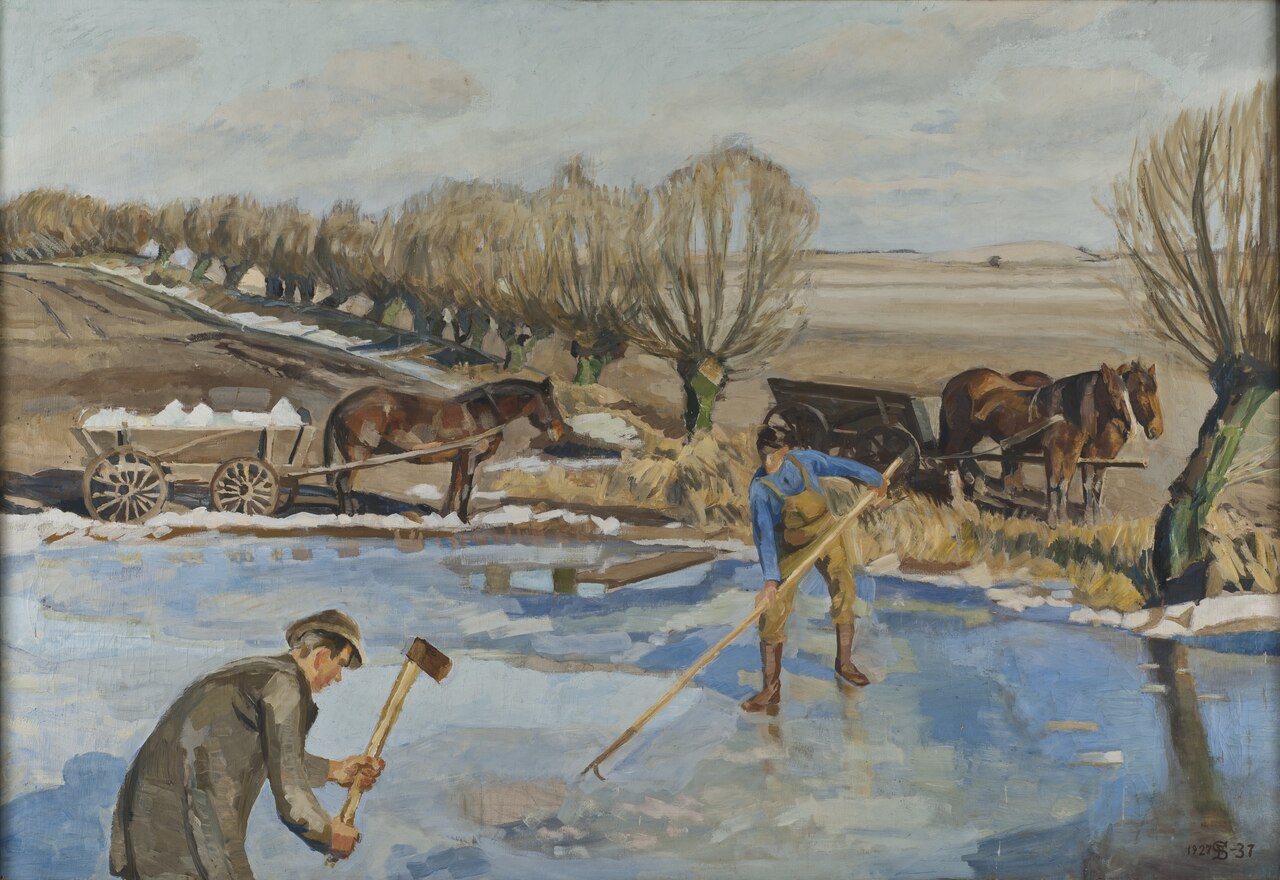
- Farmhands fetching Ice (1927) – In this later work Syberg portrays a group of labourers carrying blocks of ice across a frozen pond. The painting’s cool blues and stark whites contrast with the warm earth tones of the workers’ clothing, emphasizing the harshness of winter labour while retaining a gentle, almost lyrical quality.
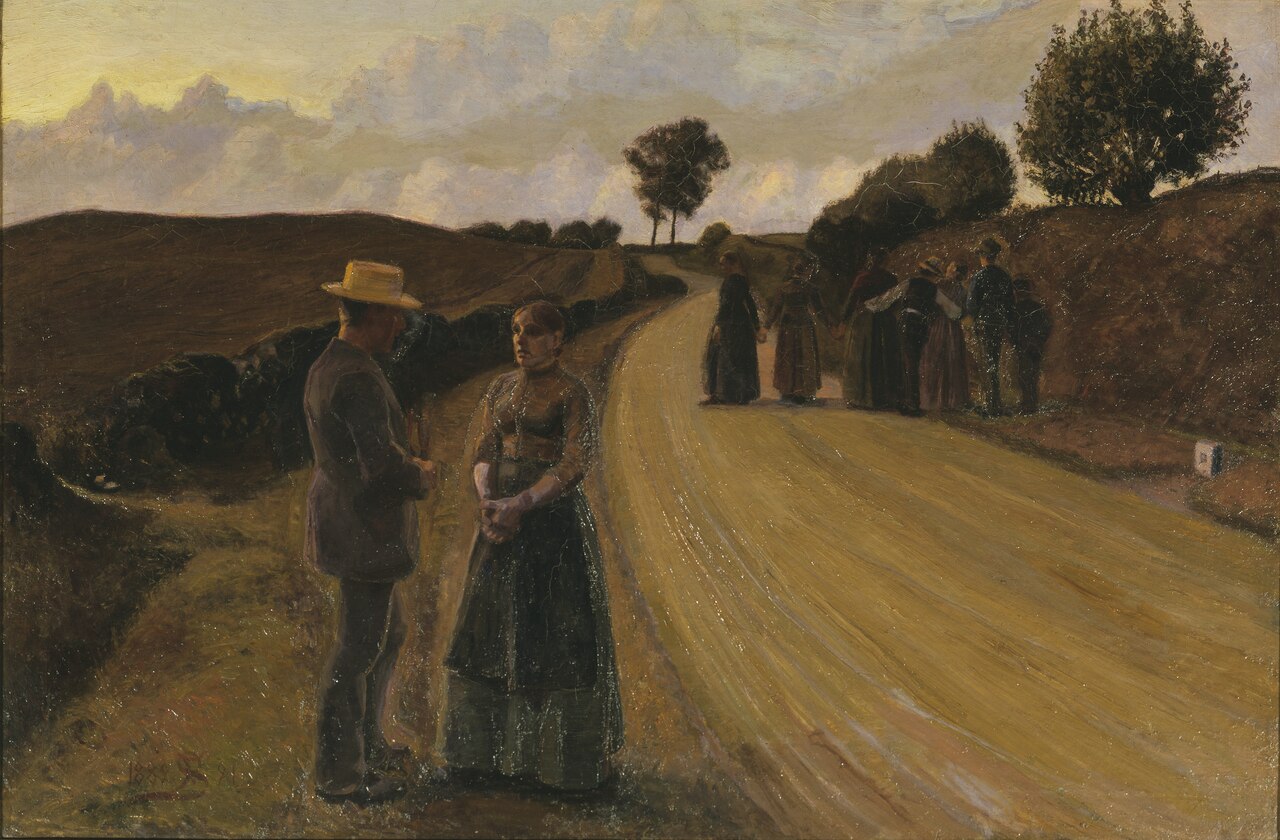
- Meeting an Evening on a Road (1889) – An early piece, it shows a solitary traveller encountering the glow of an evening sky along a country road. The work demonstrates Syberg’s early interest in the interplay of light and shadow, as well as his ability to convey narrative through minimal detail.
- At a Deathbed (1892) – This interior scene captures a solemn moment of familial grief. Though the subject is more intimate than his typical open‑air landscapes, Syberg’s handling of muted colour and careful modelling of light remains consistent with his broader style.
- A Rye Field near Svanninge (1887) – One of his earliest landscapes, the painting offers a panoramic view of a golden rye field swaying under a soft sky. The work’s restrained brushwork and harmonious colour balance foreshadow the aesthetic principles that would later define the Funen Painters.
Collectively these works illustrate Syberg’s ability to move fluidly between outdoor and interior subjects, always maintaining a focus on atmosphere and the subtle emotional currents of everyday moments.
Influence and legacy Fritz Syberg’s contribution to Danish art lies in his role as a bridge between academic realism and the more regionally rooted naturalism of the early twentieth century. By foregrounding the lives of ordinary Danes, he helped broaden the thematic scope of Danish painting beyond historical or mythological subjects. His participation in the Funen Painters cemented a regional artistic identity that celebrated the island’s distinct light and landscape.
Later generations of Danish artists have cited Syberg’s restrained palette and his emphasis on mood as influences on their own explorations of the Danish countryside. Moreover, his illustrations for books and periodicals extended his visual language into the realm of print, making his style familiar to a broad audience beyond the gallery context.
Today, Syberg’s paintings are held in the collections of the Funen Art Museum, the National Gallery of Denmark, and several municipal galleries across the country. Scholarly exhibitions continue to reassess his work, highlighting his technical skill, his empathetic portrayal of rural life, and his place within the broader narrative of Scandinavian modernism.
In summary, Fritz Syberg remains a pivotal figure in Denmark’s artistic heritage, remembered for his quiet yet powerful depictions of the everyday, his refined handling of light, and his lasting influence on the visual culture of Funen and beyond.
Frequently asked questions
Who was Fritz Syberg?
Fritz Syberg (1862–1939) was a Danish painter and illustrator, best known as a member of the Funen Painters who depicted rural life on the island of Funen.
What artistic style or movement is he associated with?
He is linked to the Funen Painters (Fynboerne), a regional group that combined naturalistic representation with a lyrical, atmospheric approach to landscape and genre scenes.
What are his most famous works?
Key works include Evening Play in Svanninge Hills (1900), Farmhands fetching Ice (1927), Meeting an Evening on a Road (1889), At a Deathbed (1892) and A Rye Field near Svanninge (1887).
Why does Fritz Syberg matter in art history?
He helped broaden Danish art by focusing on everyday subjects, contributed to the regional identity of Funen, and influenced later Scandinavian artists through his subtle handling of light and colour.
How can I recognise a Fritz Syberg painting?
Look for muted earth tones, soft diffused light, a calm composition centred on rural or domestic scenes, and a gentle, layered glazing that gives the work a luminous, atmospheric quality.