Frans van Leemputten
1850 – 1914
In short
Frans van Leemputten (1850–1914) was a Belgian realist painter renowned for his detailed landscapes and genre scenes of the Campine and Brabantine countryside, often depicting villagers, animals and religious processions.
Notable works


Early life Frans van Leemputten was born in 1850 in the small village of Werchter, situated in the Campine region of Belgium. His family were modest farmers, and the rhythms of rural life – harvests, market days, and village festivals – formed the backdrop of his childhood. Growing up in a landscape of open fields, stone cottages and modest chapels gave him an early appreciation for the visual qualities of the Belgian countryside. From a young age he showed an aptitude for drawing, copying sketches from local religious murals and the occasional illustrated almanac. Recognising his talent, his parents arranged for him to attend a provincial art school in nearby Leuven, where he received basic training in drawing and composition.
In his late teens, van Leemputten secured a place at the Royal Academy of Fine Arts in Antwerp, the principal centre for artistic education in Belgium. There he was exposed to the academic traditions of the time, but also to the burgeoning realist movement that sought to portray everyday life with honesty and technical precision. He studied under teachers who emphasized careful observation of nature, anatomical accuracy, and a disciplined approach to oil painting. Although records of his mentors are sparse, the academy’s curriculum would have provided him with a solid grounding in drawing from life, perspective, and the handling of colour.
Career and style After completing his studies, van Leemputten returned to the Campine and Brabantine regions, where he set up a modest studio in Antwerp while maintaining close ties to his native countryside. He quickly established a reputation as a painter of rural scenes, focusing on the daily activities of peasants, the stark beauty of the landscape, and the rituals that punctuated village life. His work aligns with the broader Belgian realist tradition of the late nineteenth century, which emphasized fidelity to observation and a concern for social realities. While he never joined a formal artistic group, his paintings share affinities with the work of contemporaries such as Charles de Groux and the younger generation of genre painters who documented the transformation of rural Belgium under industrialisation.
Van Leemputten’s style is characterised by a restrained palette, often dominated by earthy ochres, muted greens and soft greys, punctuated by occasional highlights of warm light. He favoured a balanced composition, placing figures and architectural elements in a way that guides the viewer’s eye across the canvas. The narrative quality of his paintings – whether a quiet winter scene or a bustling pilgrimage – reflects his interest in storytelling as well as in the accurate rendering of light, weather and texture.
Signature techniques A hallmark of van Leemputten’s technique is his meticulous rendering of surface detail. He employed thin, layered glazes to achieve depth in sky and foliage, while using more impasto for the textures of stone walls, thatched roofs and animal pelts. His brushwork remains largely invisible, favouring smooth transitions that lend his canvases a photographic clarity. Light is often depicted as diffused, especially in winter scenes, where the subtle interplay of shadows creates a sense of stillness. Van Leemputten worked both from direct observation – taking plein‑air sketches in the fields – and from studio studies, where he refined the compositional elements. He was also adept at capturing the movement of crowds, using slightly elongated figures to convey the flow of processions without sacrificing anatomical correctness.
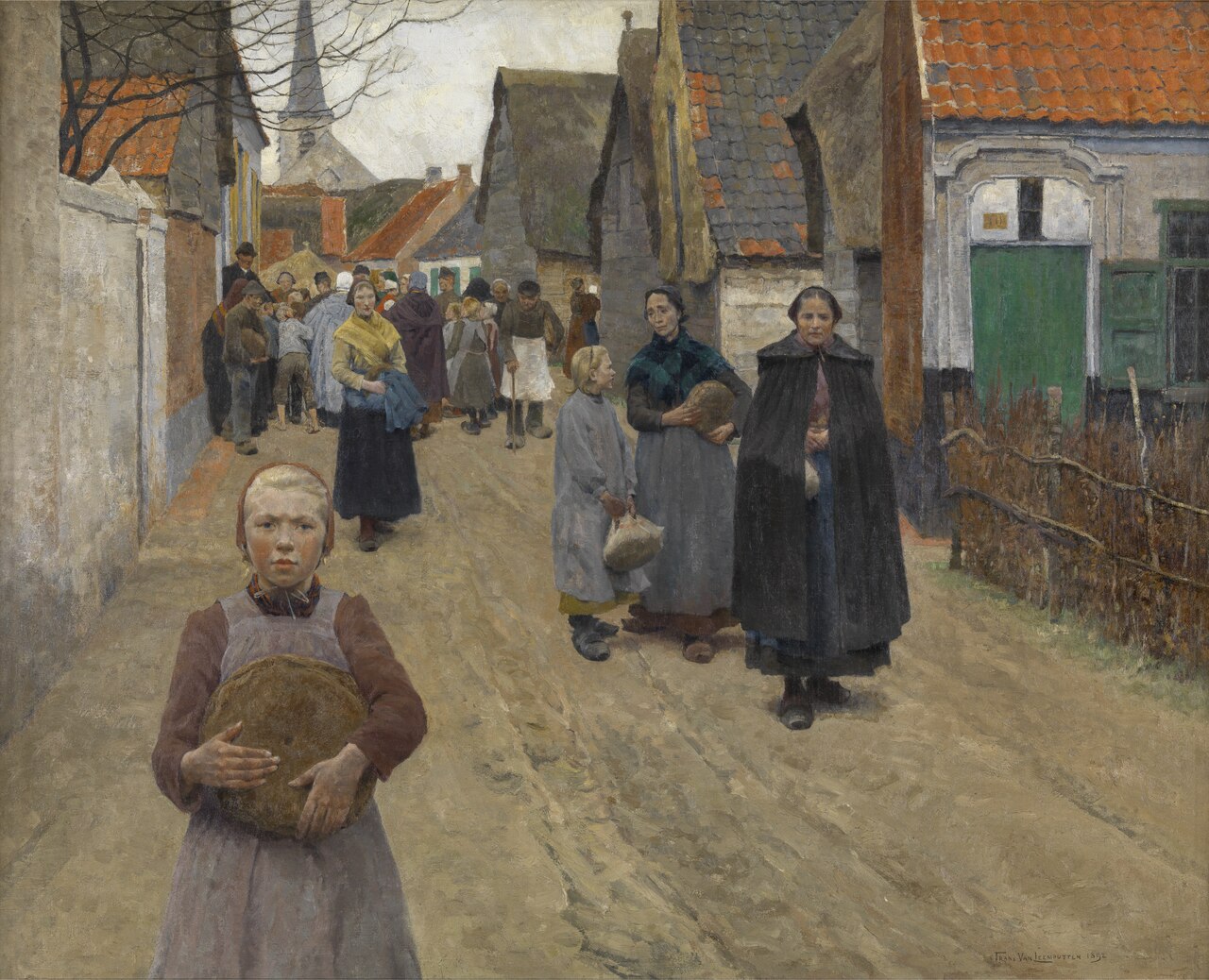
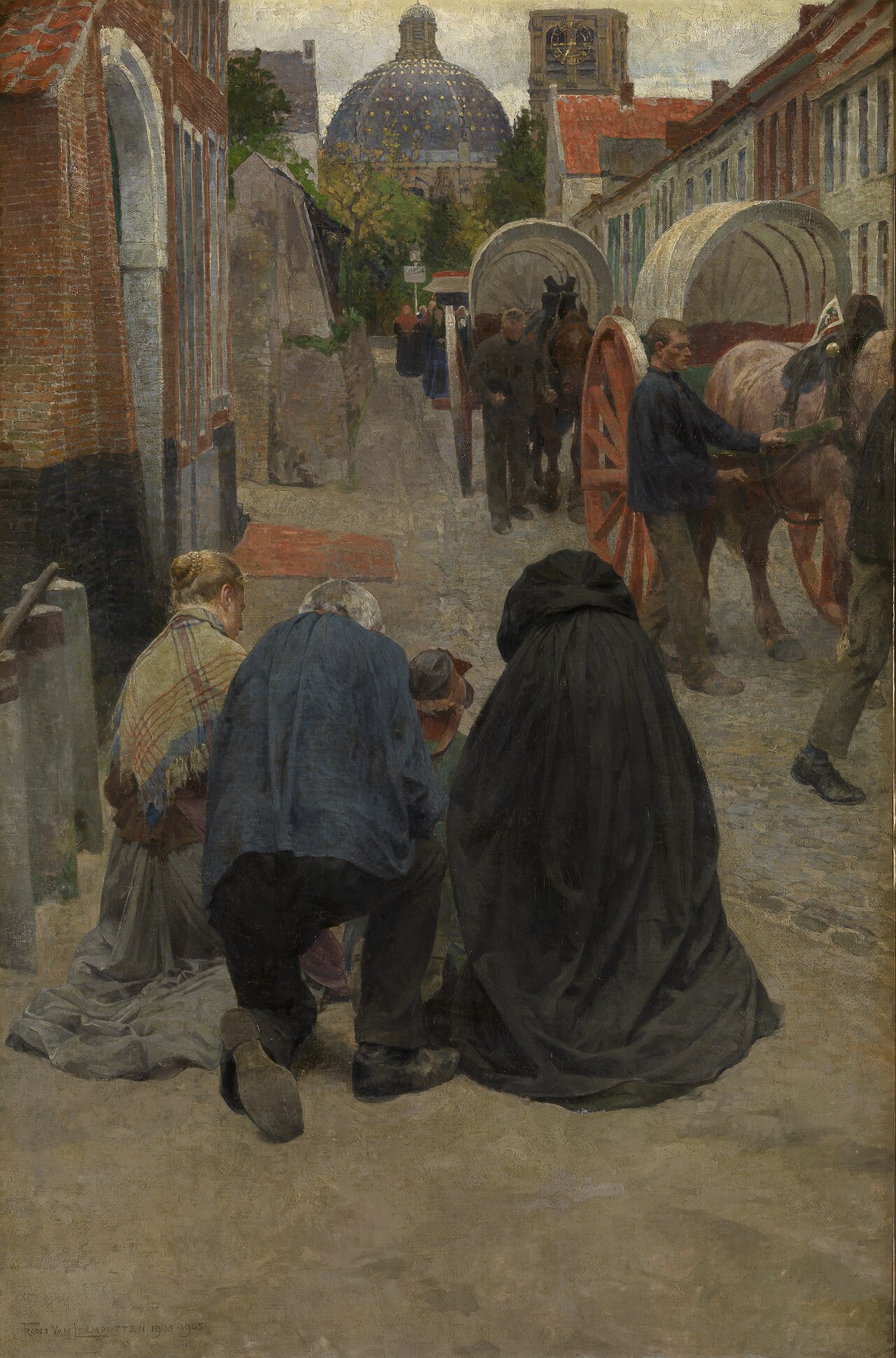
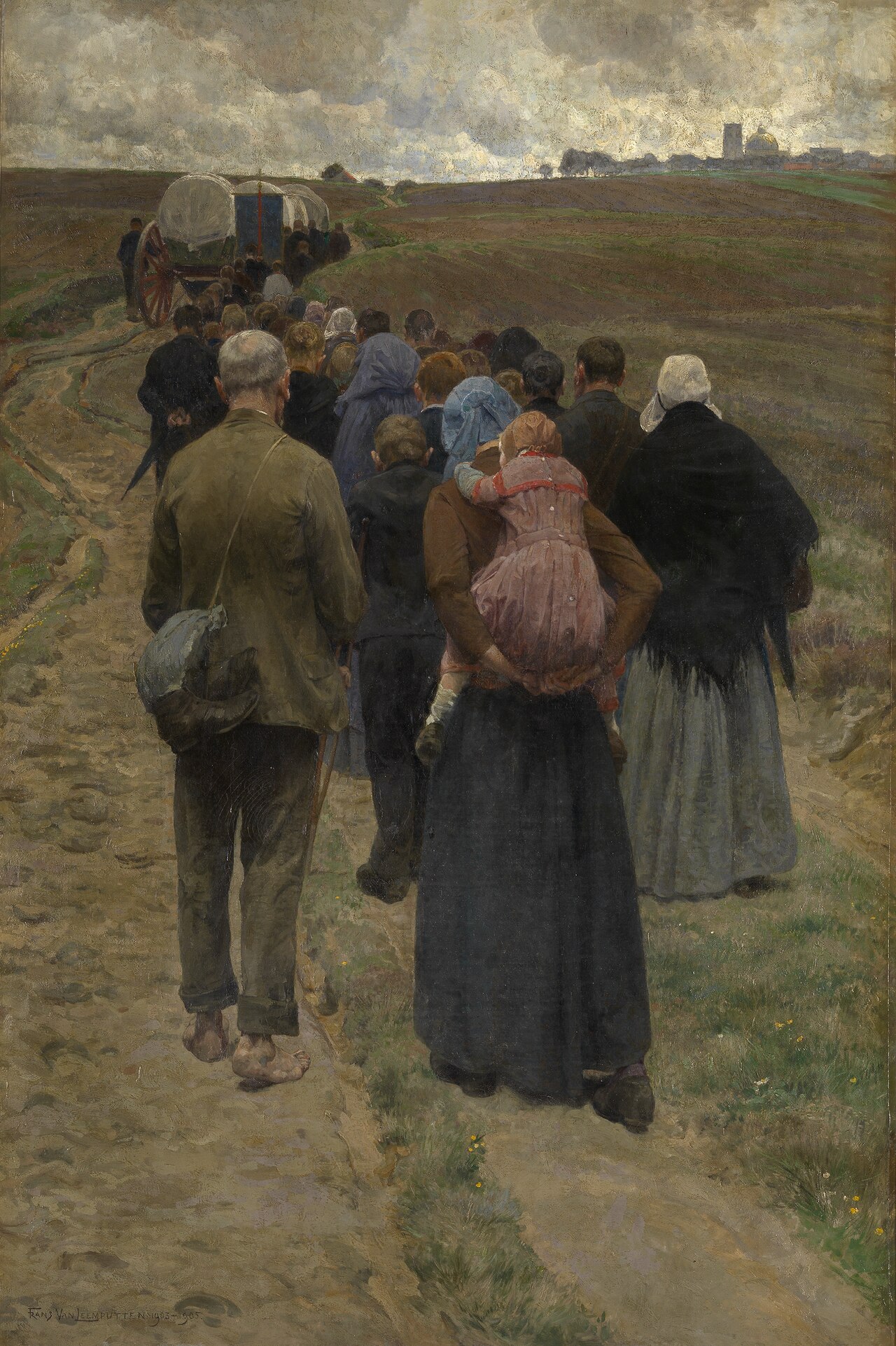
Major works - **The Distribution of Bread in the Village (1892)** – This painting illustrates a charitable act common in Belgian villages, where a benefactor distributes loaves to the poor. Van Leemputten arranges the figures in a semi‑circular formation around a central table, emphasising the communal aspect of the event. The subdued colour scheme underscores the humility of the participants, while the careful rendering of the bread’s crust conveys tactile realism. - **Sunday morning in winter (1896)** – Here the artist captures a quiet, snow‑covered lane lined with leafless trees. A solitary figure, bundled against the cold, walks toward a distant church steeple. The muted blues and greys of the sky are broken by the warm glow of a lantern, a technique that draws the eye to the focal point and conveys the stillness of a winter morning. - **Candle Procession at Scherpenheuvel (1904)** and **Candle procession in Scherpenheuvel (right panel – Pilgrims arrive at the church)** – Both works belong to a series documenting the famous pilgrimage to the Marian shrine at Scherpenheuvel. Van Leemputten renders the procession as a river of candle‑lit figures moving through a dimly lit landscape. The contrast between the flickering candlelight and the surrounding darkness creates a dramatic chiaroscuro effect, highlighting the spiritual fervour of the participants. - **Arrival of the Procession (1904)** – Complementing the candle‑procession series, this canvas shows the moment the pilgrims reach the sanctuary. Van Leemputten places the architectural façade of the church at the centre, with the crowd spilling into the foreground. The composition balances the solemnity of the religious ceremony with the human energy of the crowd.
These works collectively demonstrate van Leemputten’s ability to blend narrative depth with technical precision, offering viewers both a historical record and an evocative visual experience.
Influence and legacy Frans van Leemputten’s oeuvre provides a valuable visual archive of late‑nineteenth‑ and early‑twentieth‑century rural Belgium. By chronicling everyday activities, seasonal labour and religious customs, he preserved aspects of cultural heritage that were rapidly changing due to urbanisation and industrial growth. His paintings were exhibited in Antwerp’s salons and were acquired by regional museums, where they remain part of permanent collections.
Later Belgian artists who turned to genre painting and social realism have cited van Leemputten’s clear compositional logic and his empathetic portrayal of peasant life as an influence. Although his name is not as widely recognised internationally as some of his contemporaries, scholars of Belgian art regard him as a key figure in the realist tradition, bridging the gap between the academic rigour of the Academy and the more emotive narratives of early modernism.
In recent decades, his works have attracted renewed interest from art historians, curators and collectors seeking to understand the visual culture of Belgium’s countryside. Exhibitions focusing on the Campine landscape often include his canvases, and digital archives now make high‑resolution images of his paintings accessible to a global audience. As a result, van Leemputten’s contribution to documenting a pivotal era in Belgian social history continues to be appreciated both within academic circles and among the wider public.
Overall, Frans van Leemputten remains an exemplar of the realist painter who combined technical skill with a compassionate eye for the world around him, leaving a legacy that endures in the visual record of Belgium’s pastoral past.
Frequently asked questions
Who was Frans van Leemputten?
Frans van Leemputten (1850–1914) was a Belgian realist painter known for his detailed landscapes and genre scenes of the Campine and Brabantine countryside.
What artistic style or movement is he associated with?
He worked within the realist tradition, focusing on accurate depictions of rural life, everyday labour and religious processions.
What are his most famous works?
Key paintings include The Distribution of Bread in the Village (1892), Sunday morning in winter (1896), and a series of 1904 works portraying the Candle Procession at Scherpenheuvel.
Why is Frans van Leemputten important in art history?
His paintings document a transformative period in Belgian rural society, offering both artistic merit and valuable historical insight into 19th‑century village life.
How can I recognise a van Leemputten painting?
Look for muted earthy colours, smooth brushwork, careful attention to light and texture, and scenes that centre on peasants, animals or pilgrimage processions in the Belgian countryside.