Cornelius Van Leemputten
1841 – 1902
In short
Cornelius Van Leemputten (1841–1902) was a Belgian painter renowned for his realistic depictions of farmyard scenes, especially sheep, creating tranquil landscapes that captured rural life in 19th‑century Belgium.
Notable works
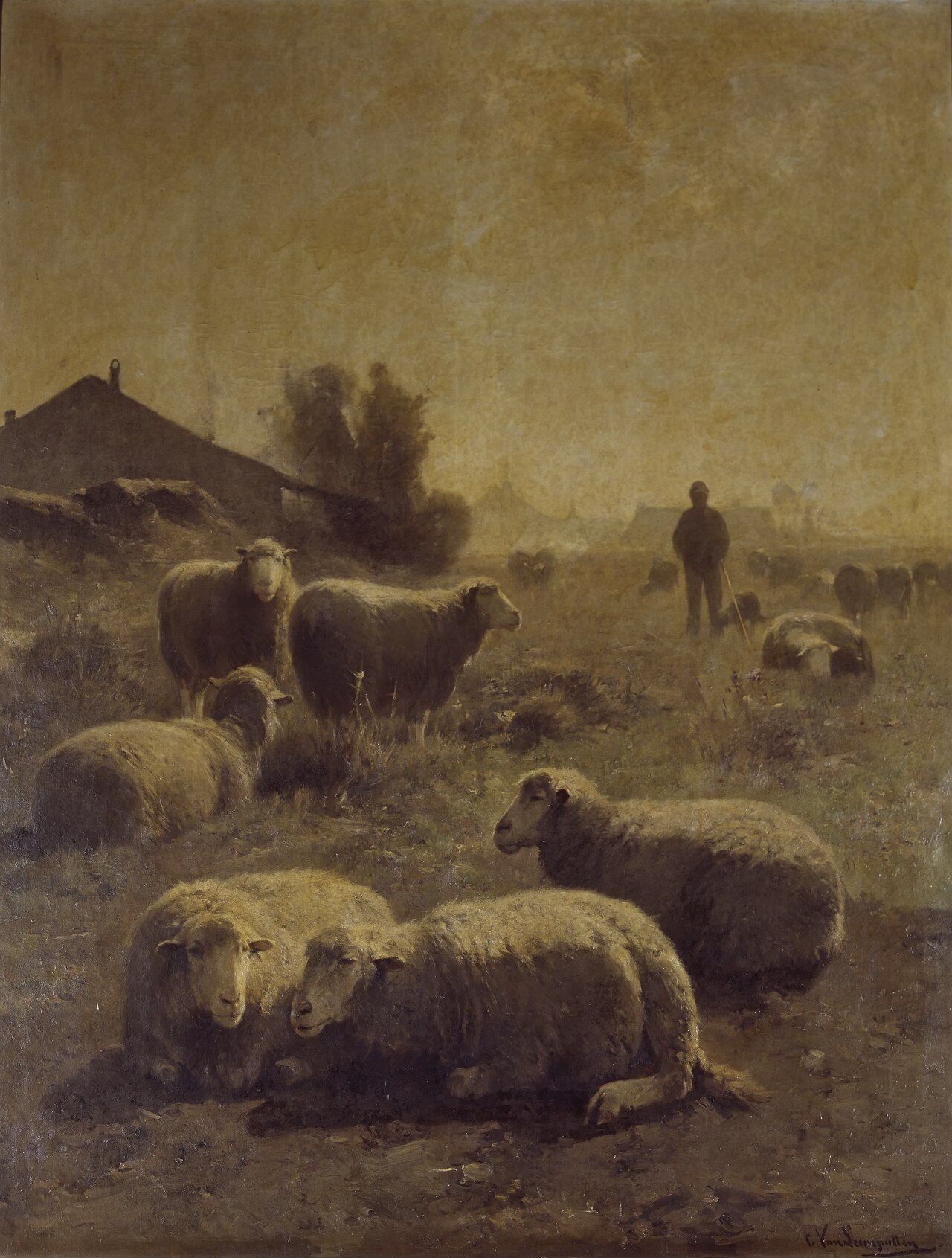
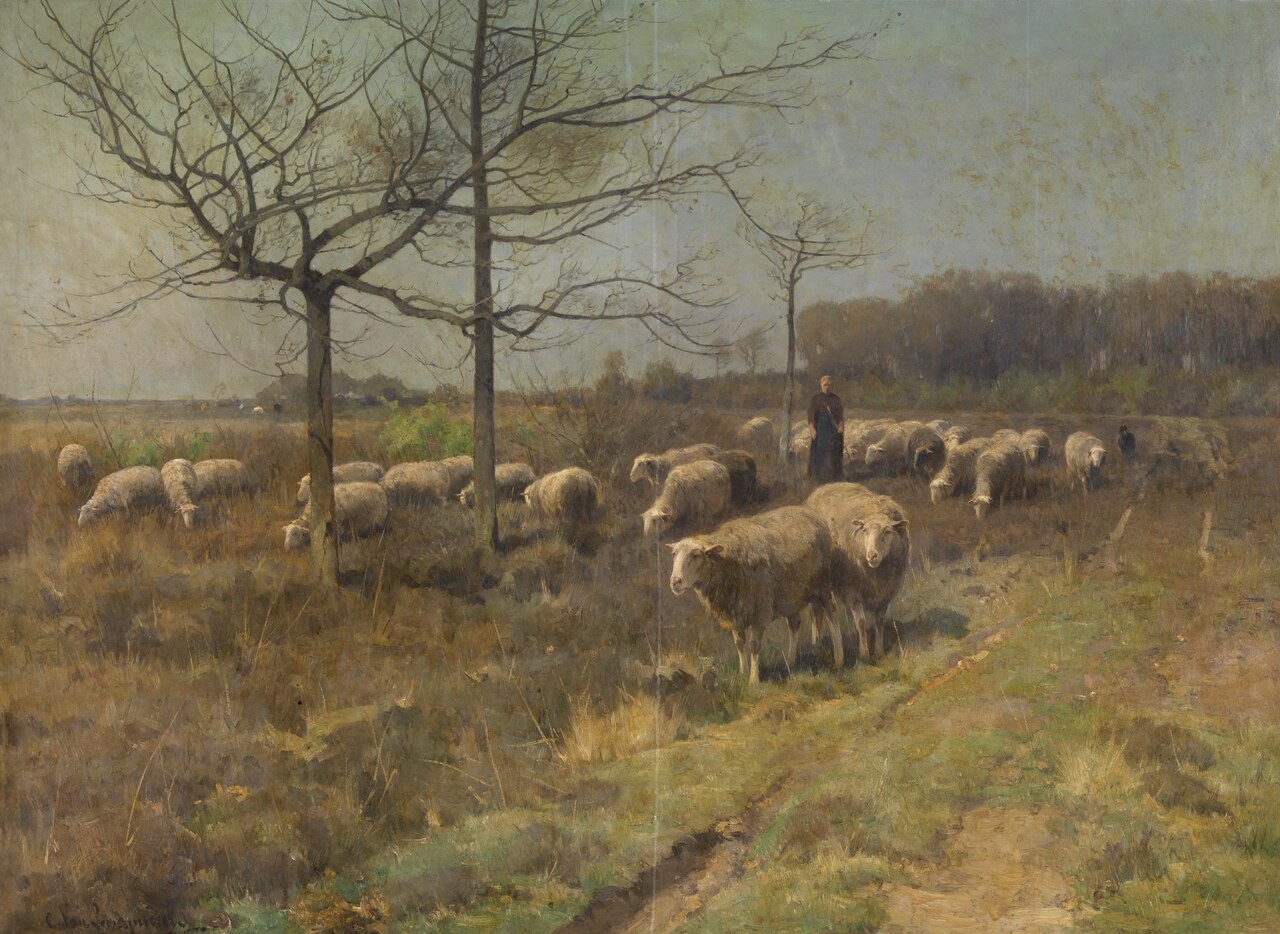
_-_Sheep_and_Poultry_-_VIS.1363_-_Sheffield_Galleries_and_Museums_Trust.jpg)
_-_Woman_with_Sheep_in_a_Barn_-_BIKGM-2855_-_Williamson_Art_Gallery_and_Museum.jpg)
_-_Group_of_Belgian_Sheep_-_CH_1996.30_-_Hackney_Museum.jpg)
Early life Cornelius Van Leemputten was born in 1841 in the small Flemish village of Werchter, a locality whose surrounding fields and livestock would later dominate his artistic output. Growing up in a farming environment, he developed an intimate familiarity with the rhythms of agrarian life, a knowledge that would become the visual vocabulary of his mature work. Details of his formal education are scarce, but it is probable that, like many Belgian artists of his generation, he attended the Royal Academy of Fine Arts in Brussels, where he would have been exposed to the burgeoning realist currents that were reshaping European painting in the mid‑nineteenth century.
Career and style After completing his studies, Van Leemputten settled in Brussels, a hub for artistic exchange and a market for genre painters. He quickly found a niche by concentrating on pastoral subjects—shepherds, flocks of sheep, and bucolic farmyards—rendered with a calm, observational precision. His style aligns with the Belgian Realist tradition, marked by a restrained colour palette and an emphasis on truthful representation rather than romanticisation. While he did not affiliate himself with a specific avant‑garde movement, his work reflects the broader European interest in rural authenticity that was championed by French painters such as Rosa Bonheur and the Dutch Hague School.
Signature techniques Van Leemputten’s paintings are distinguished by a meticulous handling of light and atmosphere. He often employed a soft, diffused illumination that suggests early morning or late afternoon, allowing the textures of wool, stone, and foliage to emerge subtly. His brushwork is fine and controlled, especially when delineating the anatomy of sheep and other livestock, revealing a deep study of animal form. The artist also favoured a limited, earthy palette—ochres, muted greens, and gentle greys—that reinforced the sense of quietude and timelessness in his compositions. Atmospheric perspective is used sparingly but effectively, drawing the viewer’s eye into the depth of the scene without sacrificing the immediacy of the foreground.
Major works - **The Flock** – This canvas portrays a loosely gathered group of sheep grazing on a gentle slope, their heads turned toward a distant horizon. The composition balances the mass of the flock with open sky, illustrating Van Leemputten’s skill in arranging numerous figures without visual clutter. - **A Sunny Day in March** – In this work the artist captures the fleeting brightness of early spring. Light filters through budding trees, casting dappled shadows on a meadow where a few sheep meander. The piece is notable for its nuanced colour shifts that convey the transitional weather. - **Sheep and Poultry (1877)** – Dating from 1877, this painting juxtaposes a flock of sheep with a cluster of chickens, highlighting the coexistence of different farm animals. The careful rendering of feather and wool demonstrates his dedication to anatomical accuracy across species. - **Woman with Sheep in a Barn** – Here a solitary figure tends to a pen of sheep inside a modest barn interior. Van Leemputten’s use of interior lighting creates a warm, intimate atmosphere, while the woman's calm demeanor underscores the harmonious relationship between humans and livestock. - **Group of Belgian Sheep** – This composition presents a larger herd set against a rolling Belgian countryside. The work’s expansive scope showcases the artist’s ability to manage scale, with distant hills fading into a hazy blue, reinforcing the sense of place.
Influence and legacy Cornelius Van Leemputten occupies a respected position within the canon of Belgian genre painting. His meticulous portrayals of rural life provided a visual record of a way of existence that was rapidly changing under industrialisation. Though he never achieved the fame of some contemporaries, his paintings were regularly exhibited in Brussels and purchased by collectors who appreciated their serene realism. Today, his works are held in several Belgian museums and continue to be referenced in studies of nineteenth‑century pastoral art. By preserving the visual language of the Flemish countryside, Van Leemputten has offered subsequent generations a benchmark for the depiction of farm animals, influencing later artists who sought to balance documentary fidelity with aesthetic lyricism.
Frequently asked questions
Who was Cornelius Van Leemputten?
Cornelius Van Leemputten (1841–1902) was a Belgian painter best known for realistic scenes of farm animals and rural landscapes, especially depictions of sheep.
What style or movement is his work associated with?
His work aligns with the Belgian Realist tradition, emphasizing truthful, unidealised representation of everyday rural life.
What are his most famous works?
Key works include *The Flock*, *A Sunny Day in March*, *Sheep and Poultry* (1877), *Woman with Sheep in a Barn* and *Group of Belgian Sheep*.
Why does Van Leemputten matter in art history?
He documented a disappearing agrarian world with technical precision, influencing later genre painters and providing a valuable visual record of 19th‑century Belgian countryside.
How can I recognise a Van Leemputten painting?
Look for calm pastoral scenes featuring sheep, a muted earthy palette, soft diffused light, and meticulous attention to animal anatomy and atmospheric depth.