Ernest Slingeneyer
1820 – 1894
In short
Ernest Slingeneyer (1820–1894) was a Belgian painter of history, portrait and genre scenes, recognised as one of the last exponents of Romanticism and Academic art in Belgium and an early practitioner of Orientalism. He also served as a member of the Belgian Chamber of Representatives, where he championed academic standards and opposed the avant‑garde movements of his time.
Notable works
_-_A_Christian_Martyr_in_the_Reign_of_Diocletian_-_727_-_Guildhall_Art_Gallery.jpg)

Early life Ernest Isidore Hubert Slingeneyer was born in 1820 in the small Flemish village of Lochristi, near Ghent. Little is recorded about his family background, but he showed an early aptitude for drawing and was sent to a local drawing school. By his late teens he had secured a place at the Royal Academy of Fine Arts in Brussels, where the curriculum emphasized rigorous drawing, classical composition and the study of the Old Masters. The academic environment shaped his technical foundation and introduced him to the prevailing Romantic ideals that dominated Belgian art in the first half of the 19th century.
Career and style Slingeneyer emerged on the Belgian art scene in the 1840s, initially focusing on history paintings that combined dramatic narrative with a polished academic finish. His work was firmly rooted in Romanticism, evident in the emotional intensity of his subjects and the theatrical staging of his compositions. Throughout the 1850s and 1860s he received commissions for both public and private patrons, producing large‑scale canvases for churches and municipal buildings.
In the 1870s Slingeneyer’s interests broadened to include genre scenes and portraiture. He became noted for his ability to capture the likeness and character of contemporary figures, ranging from aristocrats to fellow artists. Parallel to his artistic practice, he entered politics, being elected to the Belgian Chamber of Representatives for the Independents of Brussels. In parliament he defended the academic tradition, criticising the emerging avant‑garde groups such as the Société Libre des Beaux‑Arts, which he regarded as a threat to the standards of training and exhibition.
The last decade of his career saw a gradual turn toward Orientalist subjects, a trend fashionable in European art after the opening of the Suez Canal and increased travel to the Near East. Though his Orientalist output is relatively modest, it reflects his willingness to engage with contemporary exotic themes while maintaining his characteristic academic technique.
Signature techniques Slingeneyer’s paintings are distinguished by a meticulous draftsmanship that stems from his academic training. He employed a balanced compositional structure, often arranging figures along a central axis that guides the viewer’s eye to the narrative focal point. Light is used dramatically, with chiaroscuro modelling that accentuates the three‑dimensionality of bodies and fabric.
His palette favours sober, earth‑toned backgrounds punctuated by richer hues on key elements—such as the crimson of a martyr’s robe or the deep blue of a night sky—thereby heightening emotional impact. Brushwork is generally smooth and invisible, aiming for a polished surface that aligns with the ideals of the Academy. In portraiture, he combined precise physiognomic observation with subtle psychological insight, capturing both the external likeness and an inner sense of character.
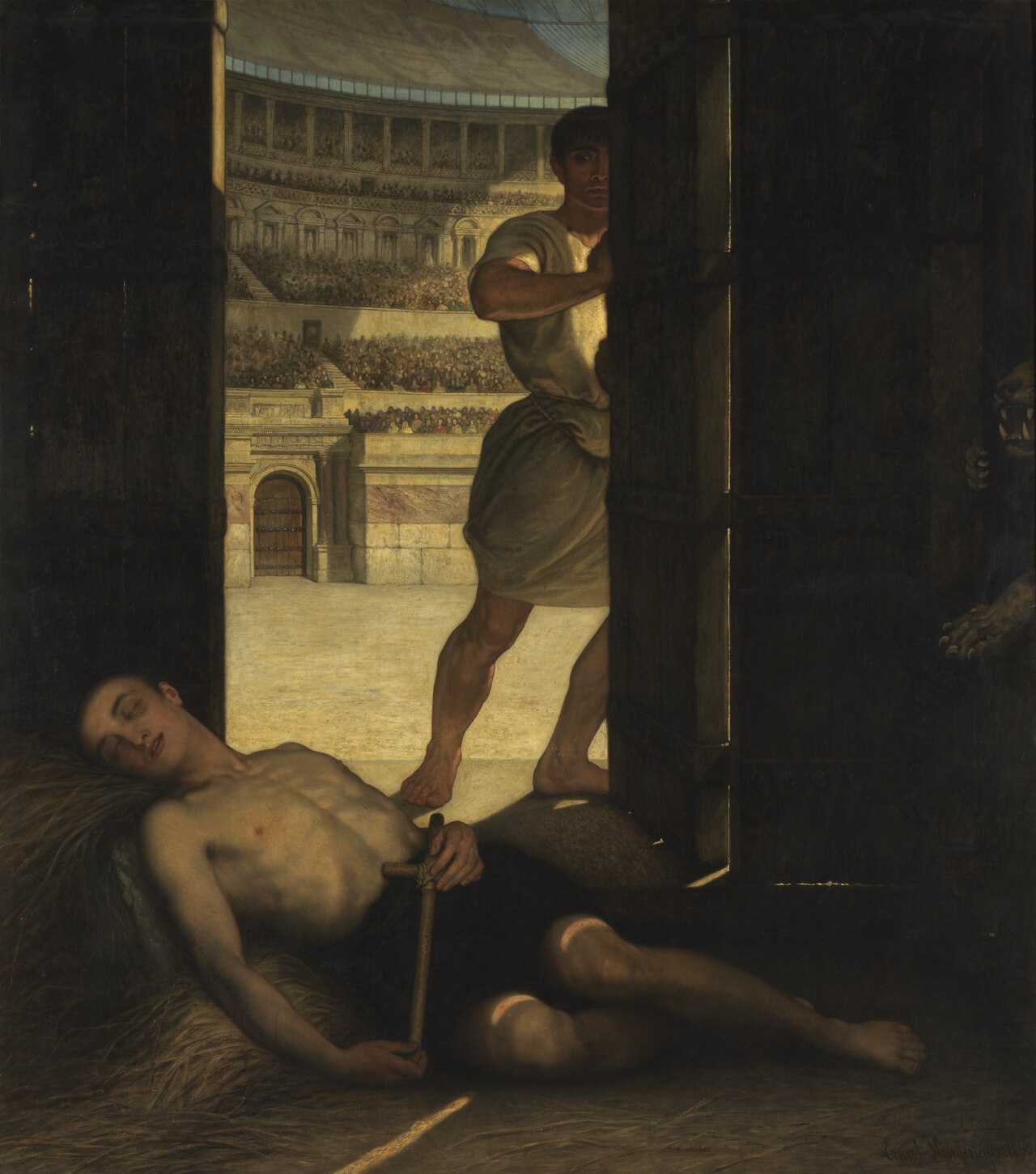
Major works - **A Christian Martyr (1860)** – This early history canvas depicts a youthful martyr tied to a post, his face illuminated by a divine light. The work exemplifies Slingeneyer’s Romantic sensibility: a dramatic narrative, heroic suffering and a clear moral message. The composition’s tight grouping of figures and the use of a strong backlight demonstrate his mastery of chiaroscuro.
- A Christian Martyr in the Reign of Diocletian (1863) – A larger continuation of the martyr theme, this painting places the subject in a more historically specific context, referencing the persecution under Emperor Diocletian. The canvas shows a heightened level of detail in the period costume and architecture, reflecting Slingeneyer’s dedication to historical accuracy while retaining the emotive force of his earlier martyr work.
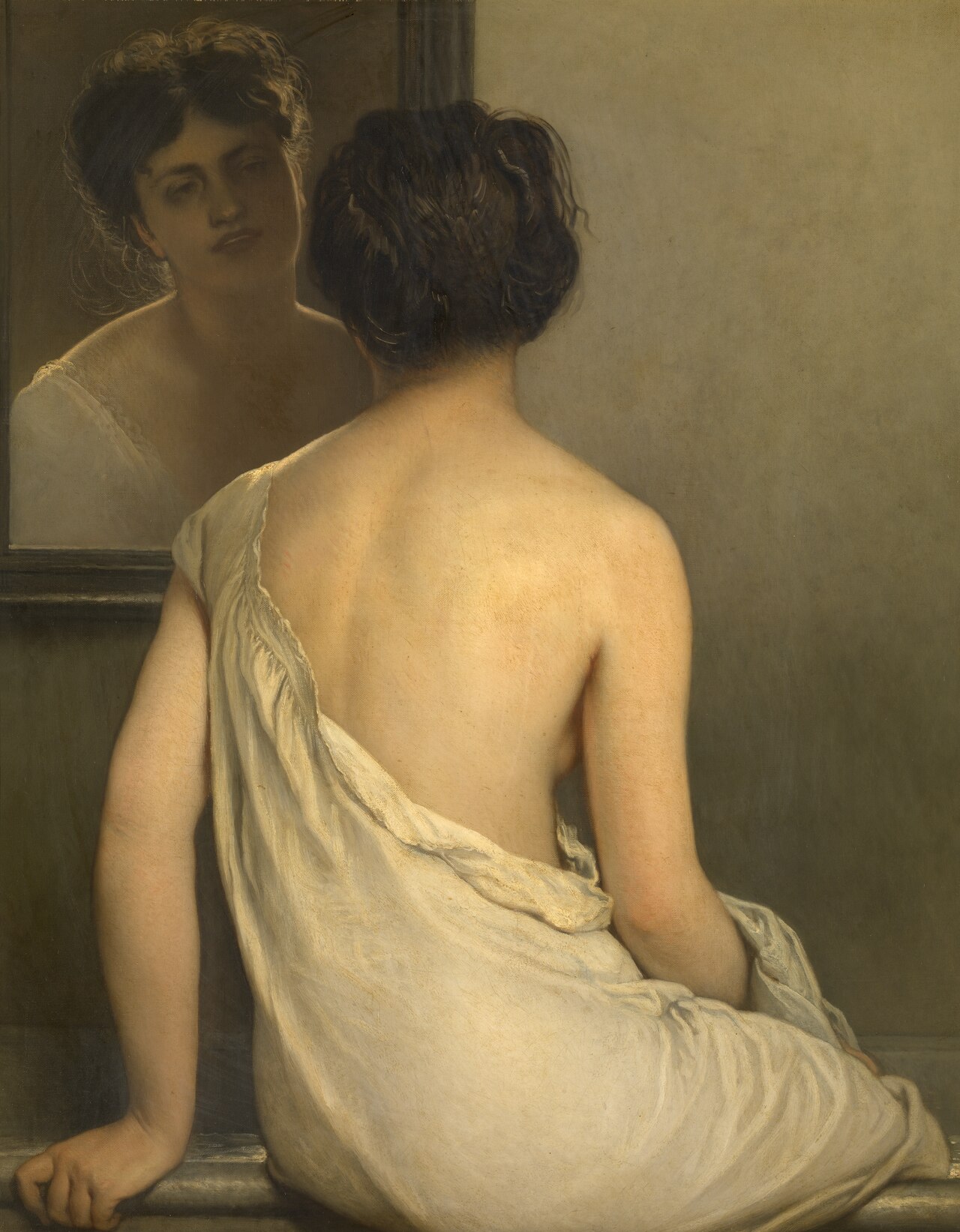
- Woman Bathing (1872) – A departure from his religious subjects, this genre scene portrays a solitary female figure in a modest interior, captured at the moment of bathing. The work displays a softer tonal range and a more intimate atmosphere, yet retains the academic finish and careful modelling of flesh that are hallmarks of his style.
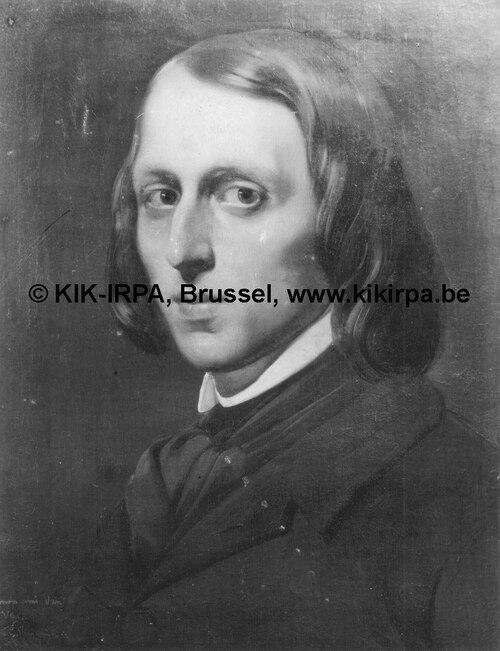
- The Painter Gerardus Van der Ven – In this portrait, Slingeneyer honors a fellow artist, presenting Van der Ven at his easel surrounded by tools of the trade. The composition is straightforward, allowing the sitter’s expression and the surrounding studio objects to convey a sense of professional pride. The portrait underscores Slingeneyer’s reputation as a skilled portraitist capable of rendering both likeness and occupational identity.
- The Flooding (1879) – One of his later works, this painting captures a dramatic natural disaster, with water engulfing a village and figures struggling against the tide. The piece combines Romantic drama with a realistic observation of light on water, illustrating Slingeneyer’s capacity to translate contemporary events into a narrative that aligns with his academic approach.
Influence and legacy Ernest Slingeneyer occupies a transitional position in Belgian art history. As one of the last practitioners of Romanticism and Academic painting, he helped preserve the technical standards of the Academy at a time when modernist currents were gaining momentum. His political advocacy reinforced the visibility of academic art in official exhibitions and education, delaying the full acceptance of avant‑garde movements in Belgium.
Nevertheless, his willingness to explore Orientalist subjects and to depict contemporary events such as floods shows a degree of adaptability. Modern scholarship views Slingeneyer both as a conservative figure—due to his opposition to groups like the Société Libre des Beaux‑Arts—and as a skilled artist whose works provide valuable insight into 19th‑century Belgian cultural identity. His paintings remain in public collections across Belgium, and his portraits continue to be referenced for their technical excellence and historical relevance.
In recent decades, art historians have reassessed his contribution, recognising the quality of his narrative compositions and his role in the broader European Romantic tradition. While his name may not be as widely known as some of his contemporaries, Slingeneyer’s oeuvre offers a clear example of how academic training, political engagement and evolving artistic tastes intersected in the late‑19th‑century Belgian art world.
Frequently asked questions
Who was Ernest Slingeneyer?
Ernest Slingeneyer (1820–1894) was a Belgian painter of history, portrait and genre scenes, and a member of the Belgian Chamber of Representatives who defended academic art.
What style or movement is he associated with?
He is regarded as one of the last representatives of Romanticism and Academic painting in Belgium, and later became an early practitioner of Orientalism.
What are his most famous works?
Key works include *A Christian Martyr* (1860), *A Christian Martyr in the Reign of Diocletian* (1863), *Woman Bathing* (1872), the portrait *The Painter Gerardus Van der Ven*, and the dramatic scene *The Flooding* (1879).
Why does he matter in art history?
Slingeneyer bridges the Romantic‑Academic era and the emerging modernist trends, influencing Belgian art policy, preserving academic standards, and providing high‑quality examples of 19th‑century narrative painting.
How can I recognise an Ernest Slingeneyer painting?
Look for a smooth, polished surface, careful draftsmanship, dramatic chiaroscuro, balanced composition, and subjects that combine historical or moral narrative with a clear, academic finish.