John Sloan
1871 – 1951
In short
John Sloan (1871–1951) was an American painter and etcher, a founding figure of the Ashcan School and a member of The Eight, renowned for realist urban scenes that capture everyday life in early‑20th‑century New York City.
Notable works



Early life John French Sloan was born in 1871 in the small town of Lock Haven, Pennsylvania. He was the eldest of six children in a working‑class family; his father was a machinist and his mother a seamstress. Sloan showed an early aptitude for drawing, sketching street scenes and neighbourhood activities whenever he could. In 1889, after completing his basic education, he moved to Philadelphia to study at the Pennsylvania Academy of the Fine Arts (PAFA). The rigorous academic training at PAFA gave him a solid grounding in drawing, anatomy and composition, while also exposing him to the emerging ideas of American realism.
In 1892, seeking greater artistic opportunities, Sloan relocated to New York City. He enrolled at the Art Students League, where he encountered a younger generation of artists who were dissatisfied with the conservative standards of the Academy. The League’s more liberal atmosphere encouraged him to explore contemporary subject matter and to develop a personal visual language that would later define his career.
Career and style Sloan’s early work reflected the influence of his academic training, but by the turn of the century he had embraced a more direct, observational approach. He began to paint scenes of everyday life—street vendors, children at play, crowded tenements, and the bustling streets of Manhattan. His paintings were characterised by a muted palette, loose brushwork and an emphasis on narrative detail, qualities that aligned him with the Ashcan School, a loosely organised group of artists who sought to depict the unvarnished reality of urban America.
In 1908 Sloan joined The Eight, a coalition of artists who collectively protested the juried exhibition system of the National Academy of Design. The Eight’s landmark exhibition at the Macbeth Gallery introduced a new visual vocabulary to the American public, and Sloan’s contributions—particularly his vivid depictions of New York’s working‑class neighbourhoods—were praised for their honesty and empathy.
Throughout the 1910s and 1920s Sloan maintained a studio on West 10th Street in Chelsea, overlooking a street that became a recurring motif in his work. From this window he observed the rhythm of city life, translating it onto canvas with a blend of social observation and personal sentiment. While his political sympathies leaned towards socialism, Sloan consciously kept his art separate from overt propaganda, preferring instead to let the everyday drama of his subjects speak for itself.
Signature techniques Sloan’s technique combined careful draftsmanship with a painterly looseness that captured movement and atmosphere. He often began with a quick charcoal sketch to lock in composition, then built layers of oil paint using thin glazes to achieve depth of colour. His palette favoured earth tones—ochres, umbers and muted greens—punctuated by occasional bright accents, such as the red kimono in *Red Kimono on the Roof*.
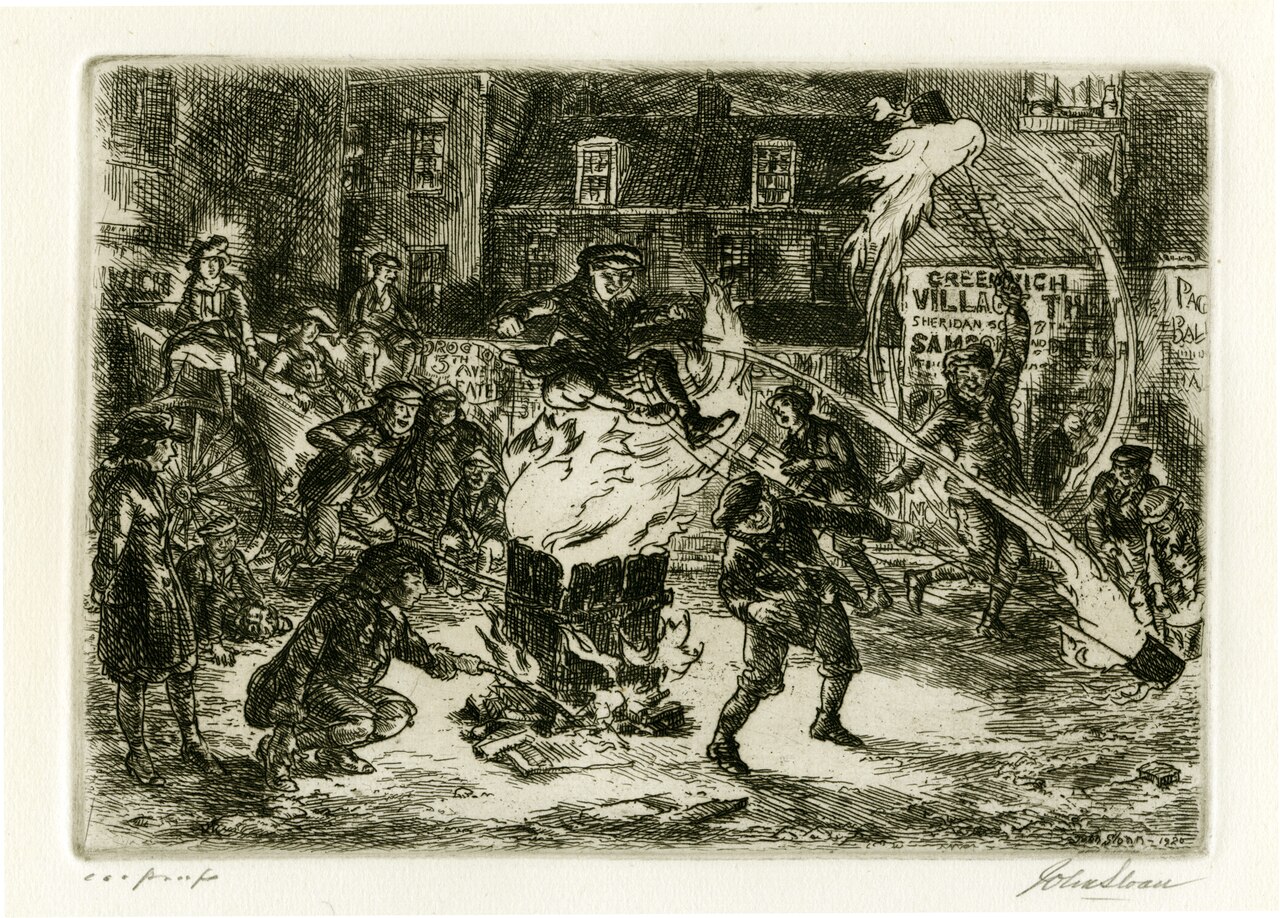
A distinctive feature of Sloan’s work is his handling of light. He employed chiaroscuro not for dramatic effect but to model forms within the crowded urban environment, allowing figures to emerge from illuminated windows or street lamps. In addition to painting, Sloan was an accomplished etcher; his prints often mirrored the same compositional concerns as his canvases, using fine line work to suggest texture and depth.
Major works - **Red Kimono on the Roof (1912)** – This oil painting shows a young woman in a vivid red kimono standing on a rooftop, her figure illuminated against a muted skyline. The work exemplifies Sloan’s skill at juxtaposing bright colour with a subdued background, creating a focal point that draws the viewer’s eye. - **Henrietta with Red Book (1913)** – A portrait of a teenage girl absorbed in reading, rendered with delicate brushwork and a restrained palette. The painting reflects Sloan’s interest in intimate, domestic moments, capturing a quiet concentration that contrasts with his more bustling street scenes. - **Girl in Fur Hat (1909)** – Featuring a fashionable young woman wearing a fur hat, this piece demonstrates Sloan’s ability to portray contemporary fashion while still grounding the figure within an urban setting. The work’s soft lighting and subtle tonal shifts highlight his mastery of texture. - **Bleecker Street, Saturday Night (1918)** – One of Sloan’s most celebrated cityscapes, this painting depicts a lively Saturday evening on Bleecker Street, with figures spilling from cafés, street vendors, and illuminated shop fronts. The composition’s rhythmic arrangement of light and shadow conveys the energy of post‑war New York. - **Bonfire (1920)** – Diverging from his typical city scenes, *Bonfire* portrays a group of workers gathered around a fire in a rural setting. The painting underscores Sloan’s versatility, showing his capacity to render both urban and pastoral subjects with equal empathy.
Each of these works illustrates Sloan’s commitment to portraying ordinary people with dignity, while also experimenting with colour, light and compositional balance.
Influence and legacy John Sloan’s legacy rests on his role as a chronicler of early‑twentieth‑century American life. By documenting the everyday experiences of New Yorkers, he helped to broaden the definition of subject matter deemed appropriate for fine art. His teaching at the Art Students League from the 1920s onward influenced a generation of artists who valued observation over idealisation.
Sloan’s contributions to the Ashcan School paved the way for later American Realist movements, including the Social Realism of the 1930s. Museums worldwide—such as the Metropolitan Museum of Art, the Whitney Museum and the Smithsonian American Art Museum—hold his paintings and prints, ensuring his work remains accessible to scholars and the public alike.
In contemporary art history, Sloan is frequently cited as a bridge between the gritty realism of the early Ashcan painters and the more nuanced, narrative-driven approaches of mid‑century American art. His ability to blend technical proficiency with a compassionate eye for human interaction continues to inspire artists who seek to portray the social fabric of their own times.
--- *Word count: approximately 970*
Frequently asked questions
Who was John Sloan?
John Sloan (1871–1951) was an American painter and etcher, a founding member of the Ashcan School and The Eight, best known for realist depictions of everyday life in early‑20th‑century New York.
What artistic style or movement is he associated with?
Sloan is principally linked to the Ashcan School, a realist movement that portrayed the gritty, unvarnished aspects of urban America.
What are his most famous works?
His best‑known paintings include *Red Kimono on the Roof* (1912), *Henrietta with Red Book* (1913), *Girl in Fur Hat* (1909), *Bleecker Street, Saturday Night* (1918) and *Bonfire* (1920).
Why does John Sloan matter in art history?
He expanded the range of subjects considered worthy of fine art, documented the social life of New York City with empathy, and influenced later American Realist and Social Realist artists.
How can I recognise a John Sloan painting?
Look for urban scenes rendered with muted earth tones, strong narrative detail, loose brushwork, and a focus on ordinary people; often a glimpse of his Chelsea studio window perspective appears in the composition.