Emile Claus
1849 – 1924
In short
Emile Claus (1849–1924) was a Belgian painter best known for his luminous, plein‑air depictions of rural scenes and everyday life. He became a leading figure in the Belgian Luminist movement, influencing a generation of artists with his focus on light and colour.
Notable works
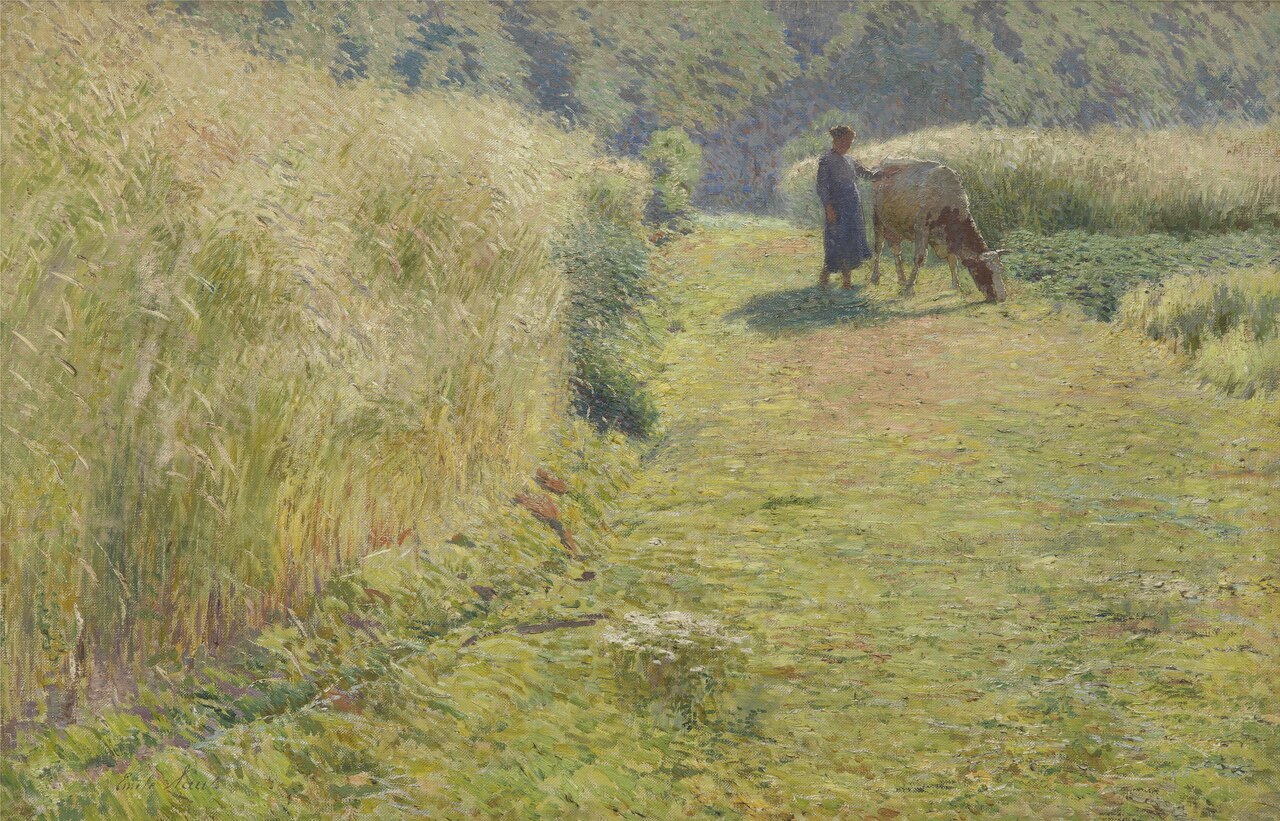

.jpg)
,_Claus_Emile._Galleria_Nazionale_d%27Arte_Moderna.jpg)
.jpg)
Early life Emile Claus was born in 1849 in the small Flemish village of Sint‑Eloois‑Vijve, located in the province of West Flanders. His family were modest farmers, and the surrounding countryside left a lasting impression on his visual sensibility. As a child, Claus showed an early aptitude for drawing, copying sketches from local religious art and the occasional illustration in popular magazines. In his teenage years he moved to the nearby town of Kortrijk to attend a secondary school that offered basic artistic instruction. Recognising his talent, a local patron arranged for Claus to study at the Royal Academy of Fine Arts in Antwerp, where he received formal training in drawing, anatomy, and oil painting techniques. The academic environment exposed him to the prevailing historicist and academic styles, but his personal affinity for the natural world remained a guiding force.
Career and style After completing his studies, Claus returned to the countryside and began to work as a portraitist and decorative painter, earning a modest living from commissions. The turning point in his career came in the mid‑1880s, when he encountered the work of French Impressionists such as Monet and Renoir, as well as the emerging Belgian Luminist school. These influences encouraged him to abandon the studio in favour of painting outdoors, directly observing the interplay of sunlight, atmosphere and colour. Claus’s style evolved into a distinctive blend of Impressionist brushwork and a heightened sensitivity to the quality of light—a hallmark of Luminism. He favoured a bright palette, often employing pure blues, yellows and greens, and he rendered subjects with a shimmering, almost ethereal surface. While his early works retain a degree of academic finish, his later canvases display looser, more spontaneous strokes that convey the fleeting effects of weather and time.
Signature techniques Claus’s technique rested on several recurring practices. First, he worked quickly, applying thin layers of paint to capture the immediate impression of a scene before the light changed. He frequently mixed his own pigments, favouring natural earth colours combined with vivid cadmium and cobalt pigments to achieve a luminous effect. Second, he employed a method of glazing—applying translucent layers of colour over a dry underpainting—to deepen atmospheric depth and enhance the glow of sunlight. Third, he often used a limited colour scheme for each painting, focusing on complementary hues to intensify contrast without sacrificing harmony. Finally, Claus paid meticulous attention to the depiction of reflective surfaces—water, wet foliage, and even the sheen on fabric—using fine, almost pointillist touches that dissolve into the surrounding tones when viewed from a distance.
Major works Among Claus’s most celebrated canvases is **The Picnic (1887)**, which portrays a group of figures enjoying a leisurely meal beneath a canopy of trees. The work exemplifies his early Luminist approach, with dappled sunlight filtering through leaves and a palette of soft greens and warm ochres that convey a serene, pastoral atmosphere. **The Beet Harvest (1890)** captures the vigor of agricultural labour in the Flemish fields. Here Claus combines vigorous brushwork with a bright, earthy colour scheme, highlighting the golden light that bathes the workers and the fertile soil. **Summer (1893)** presents a tranquil riverbank scene bathed in the intense heat of a July afternoon. The painting’s focal point is the sparkling water, rendered with delicate, overlapping strokes that suggest both motion and stillness. In **Portrait of Camille Lemonnier (1903)**, Claus demonstrates his capacity for portraiture, portraying the Belgian writer with a luminous, almost photographic realism. The subtle modelling of the face, coupled with a luminous background, underscores the artist’s skill in integrating figure and environment. Finally, **Dew (1910)** showcases his mature style, where a misty morning landscape is suffused with a soft, pearlescent light. The delicate handling of droplets on grass and the muted colour palette evoke a sense of quiet contemplation, illustrating Claus’s mastery of atmospheric effects.
Influence and legacy Emile Claus’s contribution to Belgian art lies in his synthesis of Impressionist techniques with a uniquely Flemish sensibility toward light and landscape. By championing plein‑air painting and encouraging younger artists to explore the nuances of natural illumination, he helped establish a distinct Belgian Luminist tradition that persisted well into the early twentieth century. His teaching and mentorship of students such as Anna De Weert and Albert Servaes ensured that his aesthetic principles were transmitted to subsequent generations. Moreover, his works have been exhibited internationally, reinforcing Belgium’s reputation as a centre of innovative colourist painting. Today, Claus’s paintings are held in major public collections, and his legacy endures in the continued appreciation of his radiant, atmospheric canvases, which remain a benchmark for artists seeking to capture the fleeting beauty of light.
Frequently asked questions
Who was Emile Claus?
Emile Claus (1849–1924) was a Belgian painter renowned for his luminous depictions of rural life and a leading figure in the Belgian Luminist movement.
What artistic style or movement is he associated with?
He is closely linked to Belgian Luminism, a regional variant of Impressionism that emphasises the effects of natural light.
What are his most famous works?
Key paintings include The Picnic (1887), The Beet Harvest (1890), Summer (1893), Portrait of Camille Lemonnier (1903) and Dew (1910).
Why is Emile Claus important in art history?
Claus helped define a distinct Belgian approach to light and colour, influencing a generation of artists and elevating Belgium’s status in early modern European art.
How can I recognise an Emile Claus painting?
Look for bright, high‑key palettes, meticulous rendering of sunlight on foliage or water, and a loose, atmospheric brushwork that captures fleeting moments of light.