Edouard De Bièfve
1808 – 1882
In short
Édouard De Bièfve (1808–1882) was a Belgian painter known for his Romantic history and portrait works, including The Alliance of the Noblemen in 1566 and The Widow of Lamoral, Count of Egmont. His large‑scale canvases helped shape the development of history painting in Belgium and influenced German artists of the mid‑19th century.
Notable works
.jpg)
.jpg)
Early life Édouard De Bièfve was born in Brussels in 1808, into a family that appreciated the visual arts. From a young age he showed an aptitude for drawing, and his talent was recognised by local teachers who encouraged him to enrol at the Royal Academy of Fine Arts in Brussels. The academy, which followed the French academic tradition, provided a rigorous grounding in drawing from the nude, perspective, and the study of classical sculpture. De Bièfve’s early training therefore combined the technical discipline of academic art with exposure to the emerging Romantic ideas that were circulating in Europe during the 1820s.
Career and style After completing his studies, De Bièfve established himself as a history painter, a genre that was regarded as the highest form of academic art. He quickly adopted the Romantic emphasis on dramatic narrative, emotional intensity, and vivid colour, while retaining the compositional clarity demanded by academic standards. His works often depict pivotal moments from Belgian and European history, rendered with a keen sense of theatricality. De Bièfve also produced portraiture, capturing the likeness and character of contemporary figures with a subtle blend of realism and idealisation. Throughout his career he exhibited regularly at the Brussels Salon, where his large canvases attracted both public admiration and official commissions.
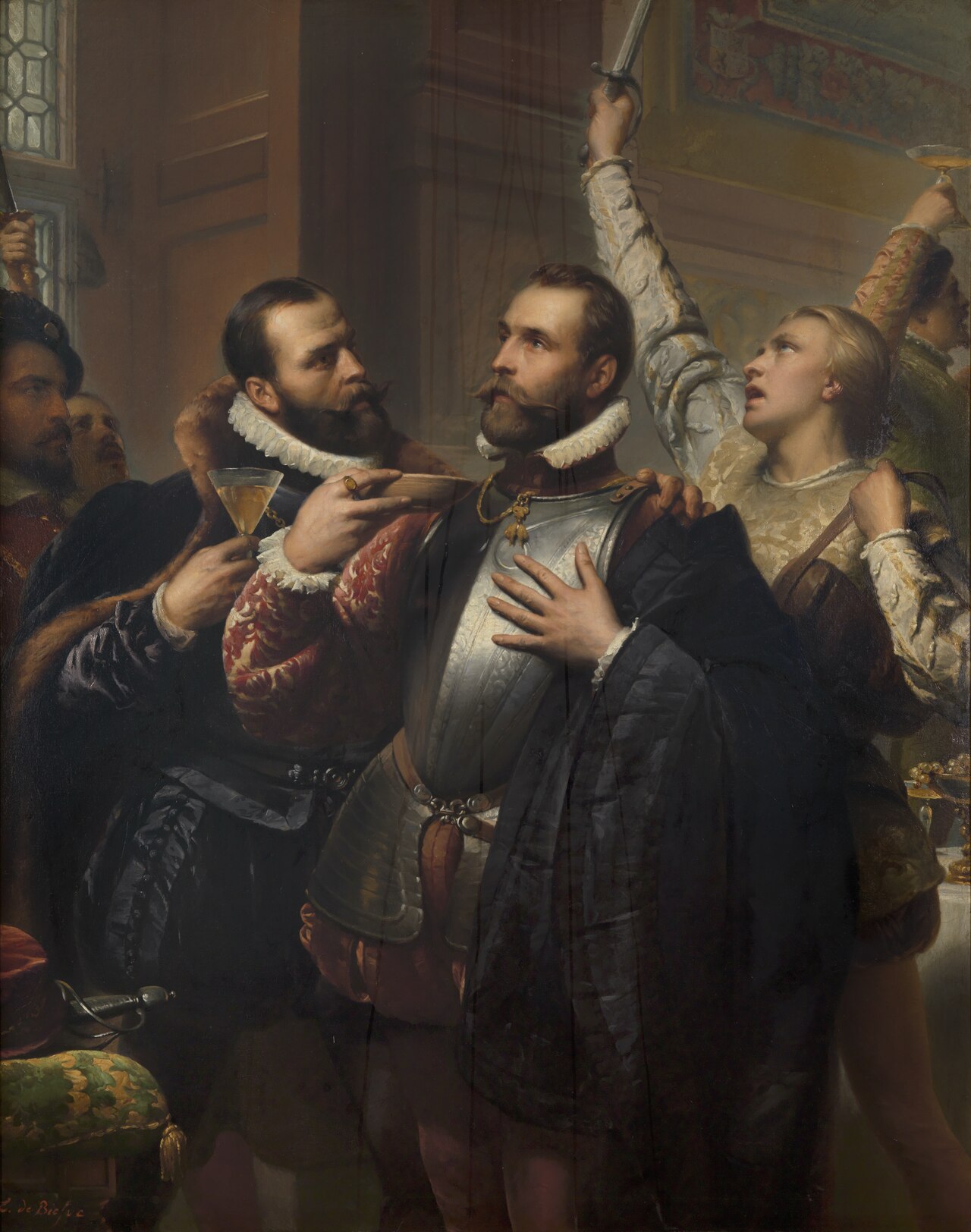
Signature techniques De Bièfve’s paintings are distinguished by several recurring technical approaches. First, he employed a luminous palette, favouring warm ochres, deep blues, and rich reds that heightened the emotional impact of his scenes. Second, his handling of light often creates a chiaroscuro effect that draws the viewer’s eye to the central action, a technique he adapted from French Romantic masters such as Delacroix. Third, he used meticulous underdrawing to define complex groupings of figures, ensuring that each character occupies a clear narrative role. Finally, his brushwork varies between tight, almost invisible strokes in the foreground figures and looser, atmospheric passages in the background, a contrast that reinforces the sense of depth and drama.
Major works ### The Alliance of the Noblemen in 1566 This monumental canvas portrays the historic gathering of Flemish nobles who pledged to defend their liberties against Spanish oppression. De Bièfve arranges the participants around a central table, each figure illuminated by a dramatic light source that highlights their solemn expressions. The composition combines meticulous costume detail with a sweeping architectural setting, underscoring the political gravity of the moment. The work was praised for its ability to convey both the collective resolve of the nobles and the individual personalities within the assembly.
### The Widow of Lamoral, Count of Egmont In this painting De Bièfve captures the grief of Lamoral, Count of Egmont’s widow after her husband’s execution in 1568. The composition centres on the bereaved woman seated before an empty chair, her hands clasped in prayer. The painter’s use of muted tonal values and soft lighting conveys a sense of quiet sorrow, while the richly rendered fabrics and interior décor reflect the aristocratic status of the subject. The work exemplifies De Bièfve’s skill in rendering intimate, emotive moments within a historically charged context.
### Odalisque (The Almeh) (1842) Departing from his usual historical subjects, De Bièfve explored Orientalist themes in Odalisque, also known as The Almeh. The painting depicts a seated female figure in a sumptuous exotic interior, her gaze directed toward the viewer. The artist’s treatment of the figure’s skin tones, the intricate patterns of the textiles, and the subtle play of light across the space demonstrate his technical virtuosity. While the subject matter aligns with the 19th‑century fascination with the East, De Bièfve’s approach remains rooted in the Romantic emphasis on sensuality and atmospheric depth.
Influence and legacy Édouard De Bièfve’s contribution to Belgian art lies in his successful synthesis of Romantic narrative vigor with the disciplined structure of academic history painting. His large‑scale historical canvases set a precedent for subsequent Belgian artists who sought to depict national subjects with both grandeur and emotional resonance. Moreover, his work reached beyond Belgium; German painters such as Wilhelm von Kaulbach and Peter von Cornelius drew inspiration from De Bièfve’s compositional strategies and his handling of dramatic light, helping to shape the German school of history painting in the mid‑19th century. Today, his paintings are held in major Belgian museums, and they continue to be studied as exemplars of Romantic historicism and as a bridge between Belgian and German artistic traditions.
Frequently asked questions
Who was Édouard De Bièfve?
Édouard De Bièfve (1808–1882) was a Belgian painter renowned for his Romantic history and portrait works, particularly large‑scale canvases that dramatise key events from Belgian and European history.
What artistic style or movement is he associated with?
He is closely linked to the Romantic movement, combining its emotional intensity and dramatic storytelling with the formal rigour of academic history painting.
What are his most famous works?
His best‑known paintings include *The Alliance of the Noblemen in 1566*, *The Widow of Lamoral, Count of Egmont*, and the Orientalist piece *Odalisque (The Almeh)* (1842).
Why does he matter in art history?
De Bièfve helped define Belgian Romantic historicism and his compositional and lighting techniques influenced the development of history painting in Germany, making him a pivotal figure in 19th‑century European art.
How can I recognise an authentic De Bièfve painting?
Look for a luminous colour palette, strong chiaroscuro, meticulous underdrawing, and a blend of tight foreground brushwork with looser atmospheric background – features that consistently appear across his historic and portrait works.