Cornelius Hoeyer
1741 – 1804
In short
Cornelius Hoeyer (1741–1804) was a Danish miniaturist renowned for his virtuoso portraiture, achieving an international reputation for his finely detailed miniature paintings in the late 18th century.
Notable works



Early life Cornelius Hoeyer was born in 1741 in the small town of Hellebæk, located in the Kingdom of Denmark. Little is recorded about his family background, but the region’s proximity to the royal court and its artistic workshops provided a fertile environment for a budding talent. Hoeyer displayed an early aptitude for drawing, and it is likely that his initial training took place under the guidance of local artisans who specialised in decorative arts and miniature painting—a highly prized skill in the courts of Northern Europe.
In his adolescence, Hoeyer moved to Copenhagen, the cultural hub of Denmark, where he could access more formal instruction. The capital’s artistic community was heavily influenced by the French Rococo style and the emerging Neoclassicism, both of which left an imprint on his developing aesthetic sensibility.
Career and style By the early 1760s Hoeyer had established himself as a professional miniature painter. Miniature portraiture was a fashionable medium among aristocratic patrons, who commissioned small, portable works to exchange as diplomatic gifts or to keep personal likenesses of loved ones. Hoeyer quickly distinguished himself through a delicate handling of colour, a refined modelling of facial features, and an ability to capture the psychological presence of his sitters within a constrained format.
Although he never formally aligned himself with a particular artistic movement, his work reflects the transitional period between Rococo’s ornamental lightness and the more restrained, classical ideals that dominated the later part of the 18th century. The subtle tonal harmonies and precise brushwork of his miniatures echo the influence of French portrait miniaturists such as Jean-Baptiste Isabey, while his compositional choices show an awareness of the emerging Neoclassical emphasis on clarity and proportion.
Hoeyer’s reputation extended beyond Denmark. He received commissions from foreign courts, most notably from Sweden and Russia, indicating the high regard in which his skill was held across the Baltic region. This international demand contributed to his status as one of the leading miniaturists of his generation.
Signature techniques Hoeyer’s technical mastery rested on several distinctive practices. He worked primarily on ivory or vellum, substrates that allowed for a luminous background against which the delicate pigments could shine. Using a fine sable brush, he applied layers of water‑soluble pigments, building up colour through successive glazes to achieve depth and realism.
His approach to skin tones was particularly noteworthy: by mixing subtle variations of ochre, red lake, and white lead, he rendered flesh that appears both translucent and three‑dimensional. Hoeyer also employed a technique known as *camaïeu*, where he rendered the portrait in a limited colour palette—often a single hue with tonal variations—to accentuate the sitter’s features without the distraction of elaborate background details.
Another hallmark of his work is the meticulous attention to costume and jewellery. Hoeyer rendered fabrics with precise hatching to suggest texture, and he painted metallic elements with reflective highlights that convey a sense of materiality despite the miniature scale.
Major works - **Portrait of an Unknown Man** – This miniature exemplifies Hoeyer’s ability to convey personality through minimal narrative context. The sitter’s composed expression, rendered in muted tones, demonstrates the artist’s skill in capturing inner life within a compact format.
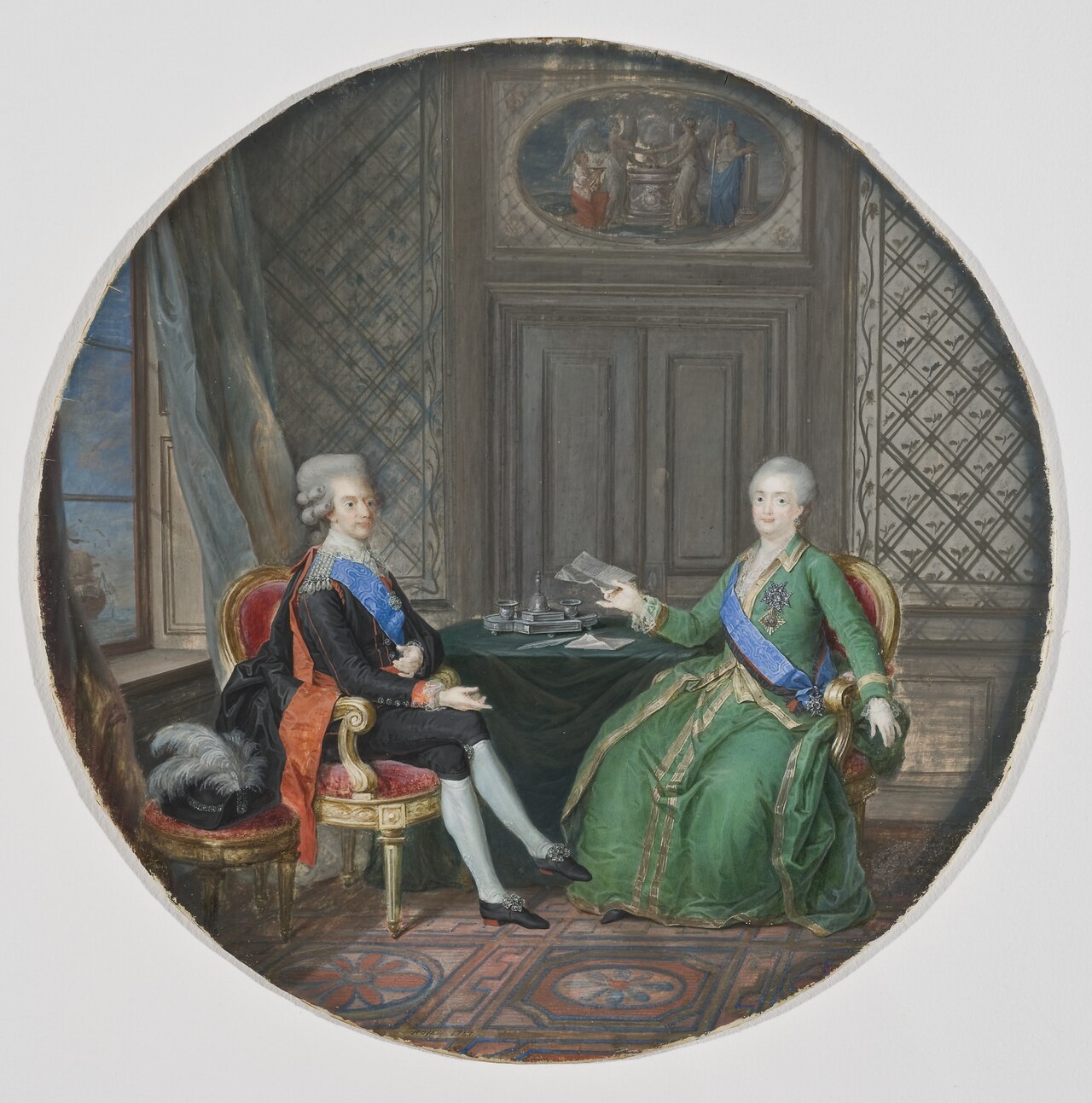
- King Gustavus III and Catherine II of Russia in Fredrikshamn 1783 (1784) – A diplomatic portrait commemorating the historic meeting of the Swedish monarch and the Russian empress. Hoeyer’s composition balances the two figures with equal prominence, using a restrained background that highlights their regal attire and the significance of the encounter.
- En orientalsk scene (1780) – Reflecting the contemporary fascination with Orientalist subjects, this work showcases Hoeyer’s versatility. Though still a miniature, the scene includes exotic costume and architectural motifs, rendered with the same delicate brushwork that characterises his portraiture.
- Portræt af J. J. Brandt (1758) – One of Hoeyer’s earlier dated pieces, this portrait of the Danish merchant J. J. Brandt demonstrates his early mastery of light and shadow. The sitter’s attire is rendered with careful attention to the texture of silk and the sheen of metal accessories.
- Kvindelig figur forestillende "Efter høsten" (1766) – Translating to “Female Figure Representing ‘After the Harvest’,” this miniature combines allegorical content with a realistic portrayal of a peasant woman. The work reflects a blend of genre painting and portraiture, illustrating Hoeyer’s capacity to adapt his technique to varied thematic demands.
These works collectively illustrate Hoeyer’s range—from formal court portraiture to genre and exotic scenes—while maintaining the consistent technical excellence that defined his career.
Influence and legacy Cornelius Hoeyer’s influence on Danish art lies principally in his elevation of miniature painting to an internationally recognised art form. By achieving acclaim beyond Denmark’s borders, he helped to position Danish portraiture within the broader European market. His meticulous technique set a benchmark for subsequent generations of miniaturists, who emulated his layered glazing and subtle colour modulation.
Although the miniature format fell out of favour with the advent of photography in the 19th century, Hoeyer’s surviving works remain valuable primary sources for historians studying court culture, fashion, and diplomatic relations of the late Enlightenment period. Collections in the National Gallery of Denmark and several Scandinavian royal museums retain his miniatures, where they are displayed alongside works by his contemporaries, offering insight into the cross‑cultural artistic exchanges of the era.
Modern scholarship often cites Hoeyer when discussing the transition from Rococo to Neoclassicism in Northern Europe, noting how his nuanced palette and compositional restraint anticipate the more austere aesthetic that would dominate the early 19th century. In this way, Hoeyer is recognised not only as a master of his medium but also as a subtle conduit of stylistic change.
Today, art historians and collectors regard his miniatures as exemplars of technical virtuosity and cultural documentation. His legacy persists in the continued study of miniature painting as a distinct, highly skilled discipline within art history.
--- *Cornelius Hoeyer’s work continues to be a touchstone for scholars exploring the interplay of portraiture, diplomacy, and the evolving tastes of the late 18th‑century European elite.*
Frequently asked questions
Who was Cornelius Hoeyer?
Cornelius Hoeyer (1741–1804) was a Danish painter celebrated for his miniature portraits, achieving an international reputation for his finely detailed and psychologically nuanced works.
What artistic style or movement is Hoeyer associated with?
Hoeyer did not belong to a formal movement, but his miniatures bridge the Rococo’s ornamental lightness and the emerging Neoclassical emphasis on clarity and proportion.
What are his most famous works?
His notable pieces include *Portrait of an Unknown Man*, *King Gustavus III and Catherine II of Russia in Fredrikshamn 1783 (1784)*, *En orientalsk scene* (1780), *Portræt af J. J. Brandt* (1758), and *Kvindelig figur forestillende "Efter høsten"* (1766).
Why does Hoeyer matter in art history?
Hoeyer elevated miniature painting to an internationally respected art form, influencing later miniaturists and providing valuable visual records of 18th‑century court culture and diplomatic exchange.
How can I recognise a Hoeyer miniature?
Look for his characteristic use of delicate glazing on ivory or vellum, subtle skin tones, meticulous rendering of costume and jewellery, and a restrained background that focuses attention on the sitter’s expression.