Clarence Gagnon
1881 – 1942
In short
Clarence Gagnon (1881–1942) was a Canadian painter, draughtsman, engraver and illustrator best known for his vivid landscapes of the Laurentians and Charlevoix regions of Quebec. Working in the early twentieth century, he combined rigorous academic training with a personal vision of the Canadian wilderness.
Notable works



Early life Clarence Alphonse Gagnon was born on 23 March 1881 in Montreal, Quebec, to a French‑Canadian family. His upbringing in a bilingual, culturally rich city gave him early exposure to both French artistic traditions and the emerging Canadian art scene. Gagnon displayed a talent for drawing from a young age, and his parents encouraged his artistic pursuits. He received his first formal instruction at the Art Association of Montreal, where he learned fundamentals of drawing, composition and colour under the guidance of local teachers.
Career and style After completing his initial studies in Montreal, Gagnon travelled to Paris to further his education, a common path for Canadian artists seeking exposure to European modernism. In France he attended the Académie Julian, absorbing the academic rigour of French painting while encountering contemporary movements such as Impressionism and Post‑Impressionism. He returned to Canada in the early 1900s, bringing with him a refined technique and a broadened aesthetic sensibility.
Back in Quebec, Gagnon settled in the Laurentian region, where the rugged terrain, seasonal light and deep winter snows became the central subjects of his work. His paintings are characterised by a balanced synthesis of realistic observation and atmospheric suggestion. He favoured a muted palette for winter scenes, punctuated by the crisp whites of snow and the subtle blues of ice. In contrast, his summer landscapes reveal richer, more saturated colours, reflecting the varied foliage of the Laurentians. Gagnon’s style does not align neatly with a single movement; it incorporates elements of naturalism, the French Barbizon tradition and a nascent Canadian regionalism.
Signature techniques Gagnon employed a meticulous underdrawing process, using fine charcoal or graphite to outline the compositional structure before applying paint. He preferred oil on canvas for his major works, exploiting the medium’s capacity for layered glazes that convey depth and luminosity. In many winter scenes he applied thin, semi‑transparent washes to render the translucency of ice and the soft diffusion of light. His brushwork varies from tight, controlled strokes in foreground details to looser, more gestural applications in background elements, creating a sense of atmospheric perspective.
In addition to painting, Gagnon was an accomplished draughtsman and engraver. His engravings display a strong linear quality, with careful hatching to suggest texture and volume. These prints often served as illustrations for travel books and magazines, disseminating his vision of the Canadian landscape to a wider audience.
Major works Gagnon’s oeuvre includes several iconic pieces that illustrate his evolving relationship with the Quebec countryside. **Village laurentien (1927)** captures a small settlement nestled among pine‑clad hills, the composition highlighted by a cool winter light that glints off snow‑covered roofs. The work demonstrates his ability to convey both the serenity and the isolation of rural life.
Le Pont de glace à Québec (1920) depicts the famed ice bridge over the St‑Lawrence River during the harsh winter months. Gagnon’s rendering of the bridge’s delicate arches against a stark sky showcases his mastery of structural perspective and his fascination with the interplay of human engineering and natural forces.
Earlier in his career, Gagnon turned his attention to the French seaside town of Dinard. Brise d’été à Dinard (1907) presents a breezy summer scene where the sea‑air stirs the dunes and the distant horizon glows with warm light. The work’s vibrant palette and fluid brushwork reveal his engagement with Impressionist techniques.
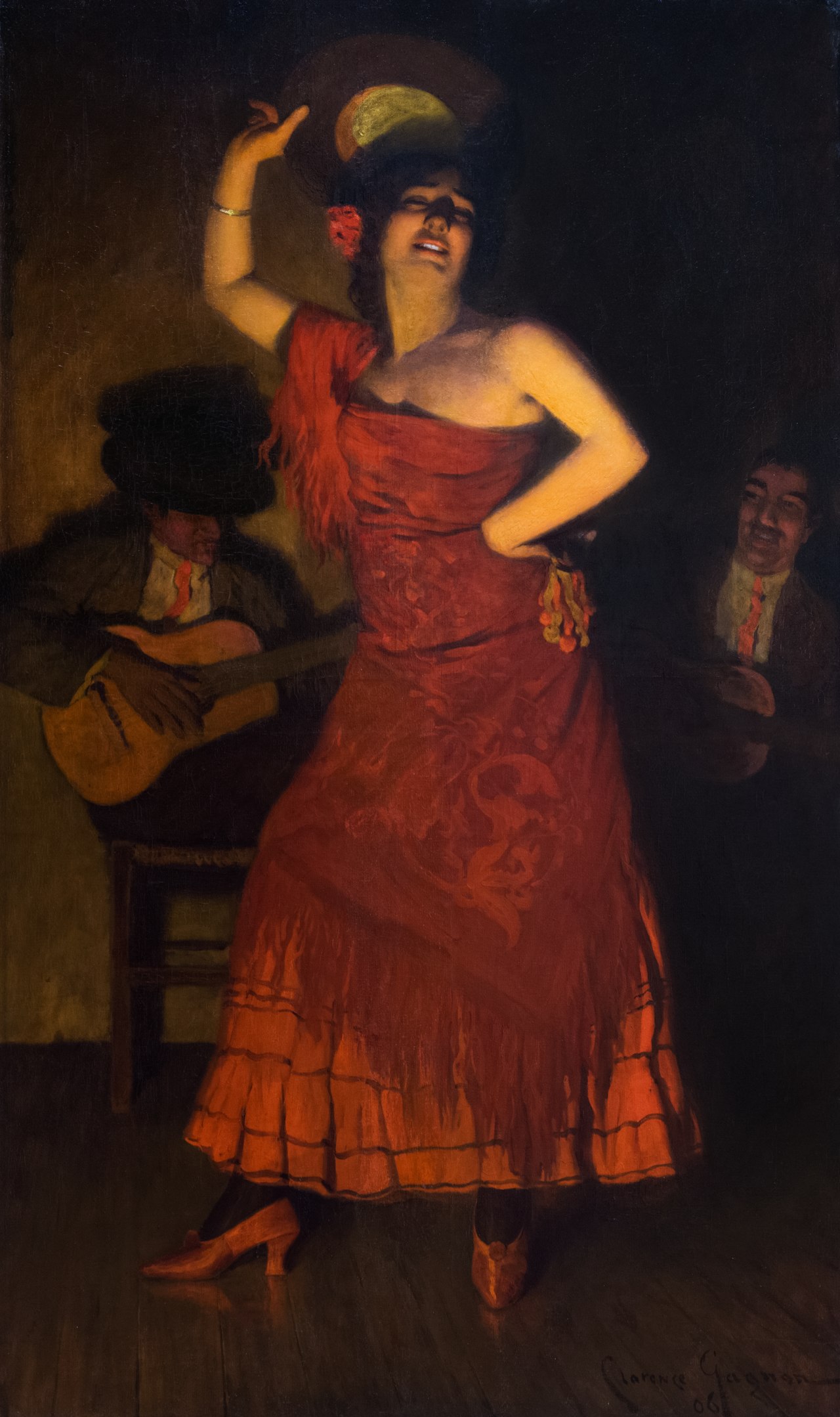
Olé! (1906) is a lively genre painting that portrays a festive moment, possibly a local celebration, rendered with energetic strokes and a bright colour scheme. Though less focused on landscape, the piece underscores Gagnon’s versatility and his capacity to capture human activity.
The Beach at Dinard (1909) returns to the coastal theme, showing a tranquil shoreline where figures stroll along the sand under a clear sky. The composition balances the expansive sea with intimate human presence, reflecting Gagnon’s skill in integrating narrative within natural settings.
These works collectively illustrate Gagnon’s transition from European influences to a distinct Canadian voice, as well as his continued interest in varied subject matter beyond pure landscape.
Influence and legacy Clarence Gagnon is regarded as a pivotal figure in the development of early twentieth‑century Canadian art. His depictions of the Laurentians and Charlevoix helped define a visual vocabulary for the Canadian wilderness that resonated with both contemporary audiences and later generations of artists. By marrying rigorous academic training with an authentic representation of northern light, he contributed to a growing sense of national artistic identity.
Gagnon’s prints and illustrations broadened the reach of his images, appearing in travel literature and periodicals that promoted Quebec’s natural beauty to a national and international readership. His teaching and mentorship of younger artists, though informal, encouraged a respect for direct observation and a commitment to portraying the Canadian environment with honesty.
Institutions such as the Musée national des beaux‑arts du Québec hold extensive collections of his paintings and prints, ensuring that his work remains accessible to scholars and the public. Contemporary Canadian landscape painters frequently cite Gagnon as an early exemplar of the balance between realism and atmospheric expression. His legacy endures in the continued appreciation of Quebec’s mountainous terrain as a source of artistic inspiration.
Overall, Clarence Gagnon’s career reflects the broader trajectory of Canadian art in the early twentieth century: an emerging confidence in local subjects, a synthesis of European techniques, and a lasting contribution to the visual articulation of national identity.
Frequently asked questions
Who was Clarence Gagnon?
Clarence Gagnon (1881–1942) was a Canadian painter, draughtsman, engraver and illustrator best known for his landscape paintings of the Laurentians and Charlevoix regions of Quebec.
What artistic style or movement is he associated with?
Gagnon does not belong to a single formal movement; his work blends academic realism, French Barbizon influences and early Canadian regionalism, characterised by careful observation of light and atmosphere.
What are his most famous works?
Key works include *Village laurentien* (1927), *Le Pont de glace à Québec* (1920), *Brise d’été à Dinard* (1907), *Olé!* (1906) and *The Beach at Dinard* (1909).
Why is Clarence Gagnon important in art history?
He helped define a visual language for the Canadian wilderness, marrying European technique with a distinctly Canadian vision, and his prints popularised Quebec’s landscapes both nationally and abroad.
How can I recognise a painting by Clarence Gagnon?
Look for meticulous underdrawings, a muted winter palette with crisp whites, layered glazes that convey translucent ice, and a balanced composition that highlights the quiet, atmospheric quality of northern light.