Maurice Galbraith Cullen
1866 – 1934
In short
Maurice Galbraith Cullen (1866–1934) was a Canadian painter recognised as the father of Canadian Impressionism, noted for his snow‑filled landscapes and depictions of ice‑harvest scenes in Quebec.
Notable works
.jpg)


Early life
Maurice Galbraith Cullen was born in 1866 in St. John’s, the capital of what was then the colony of Newfoundland. His family belonged to a modest middle‑class background, and the rugged coastal environment of his childhood left a lasting impression on his visual sensibility. From an early age Cullen demonstrated a talent for drawing, copying sketches of ships and harbour scenes that circulated in local newspapers. He received his first formal lessons from a visiting art instructor who introduced him to basic drawing techniques and the principles of composition. In his teenage years Cullen moved to Montreal, where the stark contrast between the Atlantic seaboard and the inland snow‑covered landscape sharpened his interest in the effects of light on water and ice.
Career and style
In the early 1880s Cullen travelled to Paris, the centre of the avant‑garde, to further his training. There he encountered the work of Claude Monet, Pierre‑Auguste Renoir and other Impressionists who were redefining the representation of atmosphere and colour. Although he never enrolled in a formal academy, Cullen absorbed the practice of painting en plein air and the emphasis on rapid, broken brushstrokes. On his return to Canada he settled in the province of Quebec, where he began to translate the luminous qualities of French Impressionism into a distinctly northern idiom. His canvases from the 1890s onward reveal a preoccupation with the interplay of cold, clear light and the muted palette of winter, while retaining the fluidity and spontaneity that characterised his French contemporaries.
Signature techniques
Cullen’s technique rests on three interlocking pillars. First, he employed a high degree of pigment separation, laying down small, overlapping strokes of pure colour that fused optically when viewed from a distance. Second, he gave particular attention to the way winter light scatters across snow and ice; he rendered the surface of frozen water with a mixture of cool blues, violets and subtle warm tones to suggest reflected sunlight. Third, Cullen favoured a relatively thin application of paint, allowing the substrate to show through and creating a sense of translucency. This approach enabled him to capture the crisp, almost tactile quality of northern atmospheres without resorting to heavy modelling.
Major works
- Landscape (1880) – One of Cullen’s earliest dated works, this piece shows a modest rural scene rendered in a loose, sun‑lit manner that already hints at his future preoccupation with light. Although the subject is not a winter view, the handling of colour foreshadows his later, more mature style.
- Marine (1890) – Painted a decade after his Parisian exposure, *Marine* depicts a bustling harbour under a grey sky. The brushwork is visibly looser than in his early works, and the surface of the water is broken into shimmering patches that echo the Impressionist concern with fleeting reflections.
- Portrait of a Man (1898) – This portrait is notable for its restrained palette and the subtle modelling of the sitter’s features through colour rather than line. The background consists of a muted, almost abstracted interior that allows the subject’s face to emerge from a field of soft light.
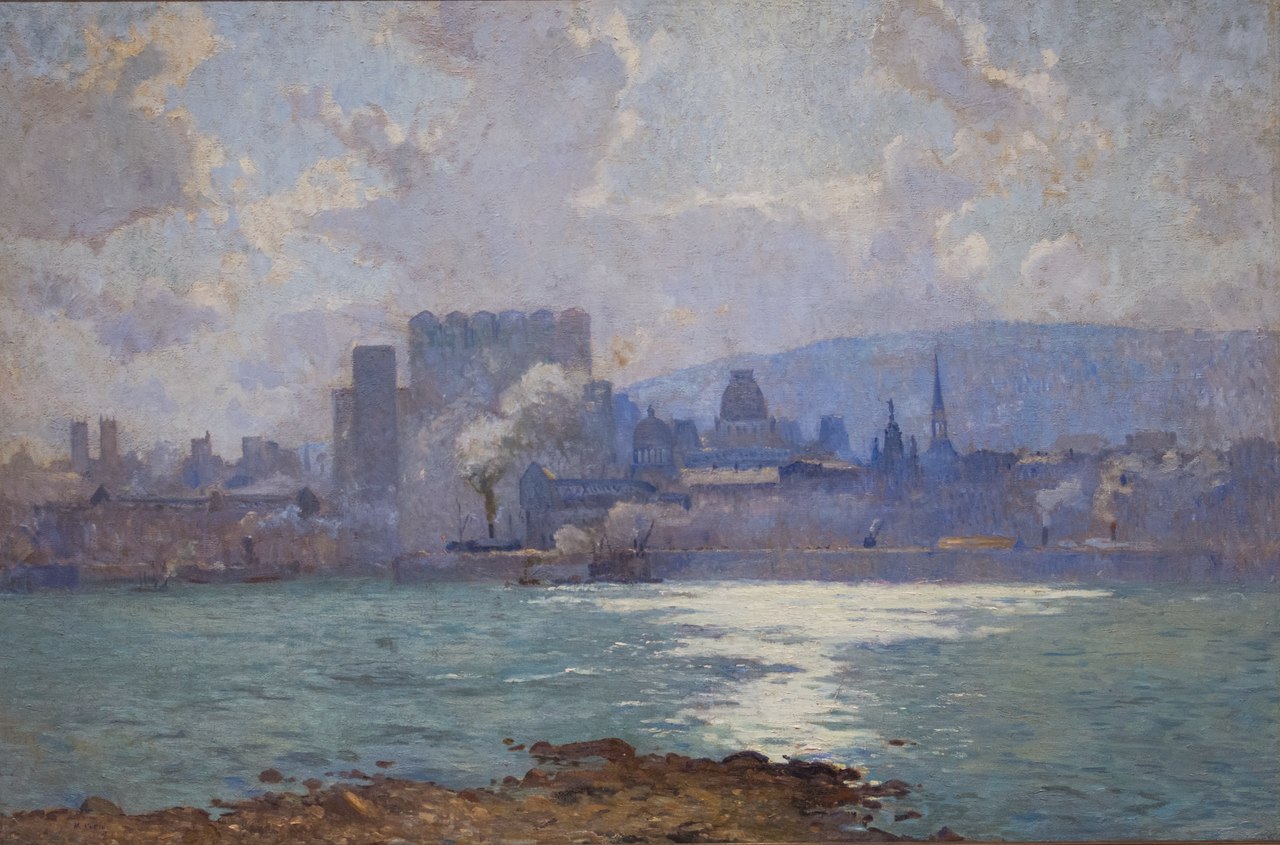
- Le Port de Montréal (1915) – In this larger composition Cullen returns to an urban waterfront, this time portraying the Port of Montreal bathed in early‑morning light. The canvas balances the industrial solidity of ships and warehouses with the delicate atmospheric veil that envelops the scene, demonstrating his ability to harmonise structure and impression.
- La Fonte des neiges (1930) – Completed just four years before his death, this work captures the moment when winter snow begins to melt in the Laurentian foothills. The painting is dominated by pale blues and pinks, and the melting snow is rendered with a series of delicate, almost stippled strokes that convey both the physical texture and the transient quality of the scene.
Influence and legacy
Maurice Cullen is widely regarded as the father of Canadian Impressionism. By adapting the French approach to the harsher, clearer light of the Canadian north, he established a visual vocabulary that later artists such as Lawren Harris, A.Y. Jackson and members of the Group of Seven would expand. Cullen’s winter scenes—particularly those that depict ice‑harvest activity on the frozen St. Lawrence River—became iconic representations of the Canadian landscape in the early twentieth century. His works are held in major public collections, including the National Gallery of Canada and the Musée des beaux‑arts de Montréal, and continue to be featured in exhibitions that explore the development of modern art in Canada. Scholars credit Cullen with demonstrating that the principles of Impressionism could be faithfully applied to a climate where snow and ice dominate the visual field, thereby enriching the nation’s artistic identity.
Frequently asked questions
Who was Maurice Cullen?
Maurice Galbraith Cullen (1866–1934) was a Canadian painter best known for pioneering the adaptation of French Impressionism to Canada’s northern light and landscape.
What style or movement is he associated with?
He is associated with Impressionism and is regarded as the founder of Canadian Impressionism.
What are his most famous works?
His most frequently cited works include *Landscape* (1880), *Marine* (1890), *Portrait of a Man* (1898), *Le Port de Montréal* (1915) and *La Fonte des neiges* (1930).
Why does he matter in art history?
Cullen showed that Impressionist techniques could be applied to the harsh, clear light of the Canadian north, influencing later artists and helping to shape a distinct Canadian visual identity.
How can you recognise a Cullen painting?
Look for crisp, broken brushstrokes that capture cold light, a muted yet vibrant palette of blues and whites, and subjects such as snow‑covered fields, frozen rivers and the subtle glow of northern winter.