Bénigne Gagneraux
1756 – 1795
In short
Bénigne Gagneraux (1756–1795) was a French painter born in Dijon, trained under François Devosge, who worked in Rome before retiring to Florence. He specialised in large‑scale historical and mythological scenes, among them The Blind Oedipus Commending his Children to the Gods and The Pope Pius VI Showing King Gustavus III the Vatican Galleries.
Notable works
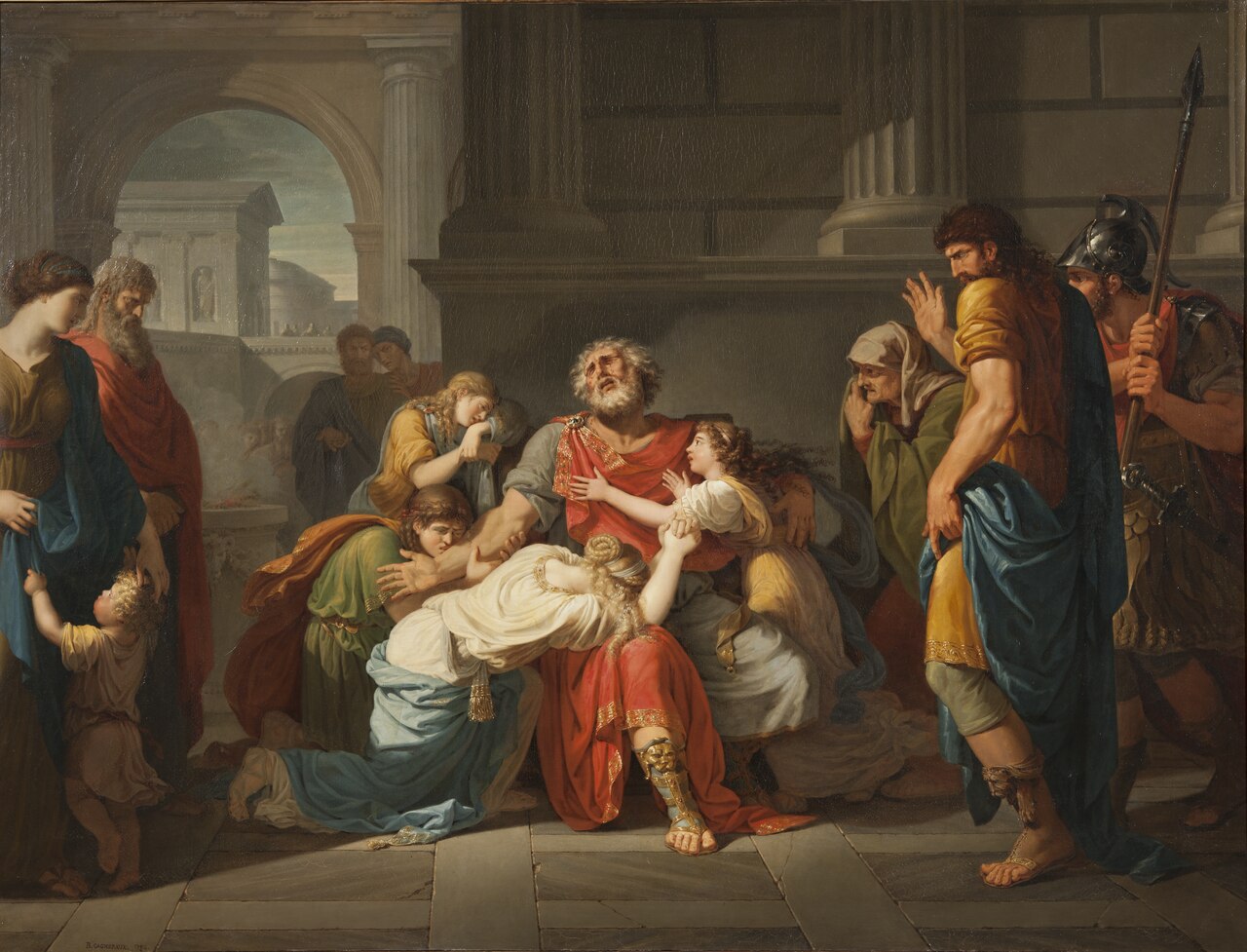


Early life Bénigne Gagneraux was born in Dijon in 1756, a city that at the time was a regional centre for artistic training. His first artistic instruction took place at the local academy, where he studied under François Devosge, a respected teacher who emphasized drawing from life and the study of classical models. The rigorous curriculum of the Dijon school provided Gagneraux with a solid foundation in anatomy, perspective and the compositional principles that would later underpin his historical canvases.
Career and style In his early twenties Gagneraux travelled to Rome, the epicentre of European art in the late eighteenth century. The city offered exposure to ancient sculpture, Renaissance masterpieces and the vibrant community of French artists gathering there. While in Rome he adopted a style that combined the clarity of French academic painting with the dramatic chiaroscuro favoured by Italian Baroque masters. His works frequently depict narrative episodes drawn from mythology, classical literature and contemporary history, reflecting the Enlightenment taste for moralising and didactic subjects.
The artist’s reputation grew after he exhibited a large canvas portraying the meeting of King Gustavus III of Sweden with Pope Pius VI. The painting, which later entered the royal collection in Stockholm, demonstrated his ability to render diplomatic ceremony with meticulous detail and a balanced composition. Critics of the period noted his skill in integrating portraiture within broader historical contexts, a quality that became a hallmark of his oeuvre.
Signature techniques Gagneraux’s technique is characterised by a disciplined handling of line and a restrained palette that favours earth tones punctuated by selective colour highlights. He often employed a layered glazing method to achieve depth in flesh tones and atmospheric effects. In many of his works the foreground figures are illuminated by a strong, directional light source, creating a sculptural quality that recalls the classical tradition. His compositions frequently use a pyramidal arrangement, guiding the viewer’s eye toward a central narrative focal point while maintaining a sense of spatial coherence.
Major works Among Gagneraux’s most frequently cited pieces are:
* The Blind Oedipus Commending his Children to the Gods (1784) – also known by its Swedish title *Den blinde Oidipus anbefaller sin familj åt gudarna*. The canvas portrays the mythic king, rendered blind, offering his offspring to the divine as a gesture of piety. The work is notable for its emotive expression, the delicate rendering of drapery, and the use of a subdued colour scheme that underscores the tragic theme.
* The Pope Pius VI Showing King Gustavus III the Vatican Galleries (1785) – a diplomatic scene that captures the exchange between the pontiff and the Swedish monarch. Gagneraux’s attention to architectural detail, coupled with the dignified poses of the figures, conveys both the grandeur of the Vatican interiors and the political significance of the encounter.
* Satyr and Bacchante (1784) – a mythological tableau that illustrates a playful interaction between a satyr and a bacchante. The painting demonstrates the artist’s facility with dynamic movement and his capacity to render sensual forms within a balanced composition.
* Ixion’s Wheel (date unspecified) – a dramatic representation of the punished titan bound to a perpetually turning wheel. Here Gagneraux employs a stark contrast of light and shadow to heighten the sense of endless torment.
In addition to these works, the Dijon Museum houses several other canvases attributed to Gagneraux, including *Soranus and Servilius*, *Battle of Senef*, *Passage of the Rhine by the French Army under Condé*, a *Bacchanal*, a *Cavalry Charge*, and a *Triumph of Neptune*. Each piece reflects his predilection for historical narrative and his skill in rendering complex groupings of figures.
Gagneraux’s later years were spent in Florence, where he continued to produce large‑scale history paintings. The Uffizi Gallery contains his self‑portrait, a *Battle Scene*, and a *Lion Hunt*, all of which attest to his continued engagement with dynamic composition and his ability to capture movement within a static medium.
Influence and legacy Bénigne Gagneraux’s career bridges the French academic tradition and the Italian classical revival of the late eighteenth century. Although he did not belong to a formally defined movement, his works exemplify the cross‑cultural exchange that characterised the period’s artistic production. By integrating French compositional rigor with the dramatic lighting favoured by Italian masters, he offered a synthesis that influenced younger artists travelling between France and Italy.
His paintings, particularly those held in public collections in Stockholm, Dijon and Florence, continue to serve as exemplars of Enlightenment‑era historical painting. Scholars cite Gagneraux when discussing the transmission of French academic techniques to Italian contexts, and his canvases are frequently reproduced in studies of eighteenth‑century diplomatic portraiture. While his name is not as widely recognised as some of his contemporaries, his contributions remain integral to the understanding of how French artists navigated and shaped the visual language of history painting on the eve of the Revolutionary era.
Overall, Gagneraux’s body of work provides valuable insight into the artistic priorities of his time—clarity of narrative, moralising content, and a measured yet expressive visual style—ensuring his place within the broader tapestry of European art history.
Frequently asked questions
Who was Bénigne Gagneraux?
Bénigne Gagneraux (1756–1795) was a French painter from Dijon who worked in Rome and later settled in Florence, known for large historical and mythological canvases.
What artistic style or movement is he associated with?
He is not linked to a specific movement, but his work reflects the French academic tradition combined with Italian classical and Baroque influences.
What are his most famous works?
His best‑known paintings include *The Blind Oedipus Commending his Children to the Gods* (1784), *The Pope Pius VI Showing King Gustavus III the Vatican Galleries* (1785), *Satyr and Bacchante* (1784) and *Ixion’s Wheel*.
Why is Gagneraux important in art history?
He exemplifies the cross‑cultural exchange between French and Italian art in the late eighteenth century, and his narrative paintings illustrate the Enlightenment’s emphasis on history, morality and classical subjects.
How can I recognise a painting by Gagneraux?
Look for a balanced, often pyramidal composition, a restrained palette with strategic colour highlights, clear narrative focus, and a polished handling of light that gives figures a sculptural quality.