Christen Dalsgaard
1824 – 1907
In short
Christen Dalsgaard (1824–1907) was a Danish painter noted for his naturalistic landscapes and genre scenes. A late pupil of Christoffer Wilhelm Eckersberg, he worked in the tradition of the Danish Golden Age, producing works such as Landscape (1849) and A Woman’s Solemn Churching after Childbirth (1860).
Notable works


Early life Christen Dalsgaard was born in 1824 at Krabbesholm, a small manor estate in the Danish countryside. Little is recorded about his family background, but the rural setting of his youth left a lasting imprint on his artistic sensibility. He grew up during the period known as the Danish Golden Age, when a flourishing of literature, music and visual arts was supported by a relatively stable political climate. In his early teens Dalsgaard showed an aptitude for drawing, and his talent was recognised by local patrons who encouraged him to pursue formal training in Copenhagen.
Career and style In the early 1840s Dalsgaard enrolled at the Royal Danish Academy of Fine Arts, where he eventually became a late student of Christoffer Wilhelm Eckersberg, often called the “father of Danish painting”. Under Eckersberg’s guidance Dalsgaard absorbed the academy’s emphasis on precise observation, linear draftsmanship and a balanced composition. While Eckersberg himself was a leading figure of Neoclassicism, his teaching encouraged students to depict contemporary Danish life with a naturalistic eye. Dalsgaard’s career therefore developed within a hybrid framework: technically academic, yet thematically rooted in everyday rural scenes.
After completing his studies, Dalsgaard exhibited regularly at the Charlottenborg Spring Exhibition, the principal venue for Danish artists. Critics noted his ability to render the subtle tonal shifts of the Danish landscape, especially the muted blues of the Lim Fjord and the soft greens of Jutland’s fields. Throughout the 1850s and 1860s he received commissions from both private collectors and local municipalities, often for works that combined landscape with genre narrative. His paintings were characterised by a calm, contemplative atmosphere, avoiding the dramatic chiaroscuro of Romanticism in favour of a more restrained, observational approach.
Signature techniques Dalsgaard’s technique rested on three inter‑related pillars. First, his drawing was exceptionally tight; he employed a fine, controlled line to define the architecture of buildings and the outlines of figures, a habit inherited from Eckersberg’s insistence on drawing from life. Second, his handling of light was subtle. He preferred diffused daylight, capturing the soft glow of early morning or the hazy light of late afternoon, which gave his canvases a gentle luminosity without harsh contrasts. Third, his palette was restrained, dominated by earth tones, muted greens and occasional touches of ochre. This restrained colour scheme reinforced the sense of realism and allowed the viewer to focus on the narrative content of each scene.
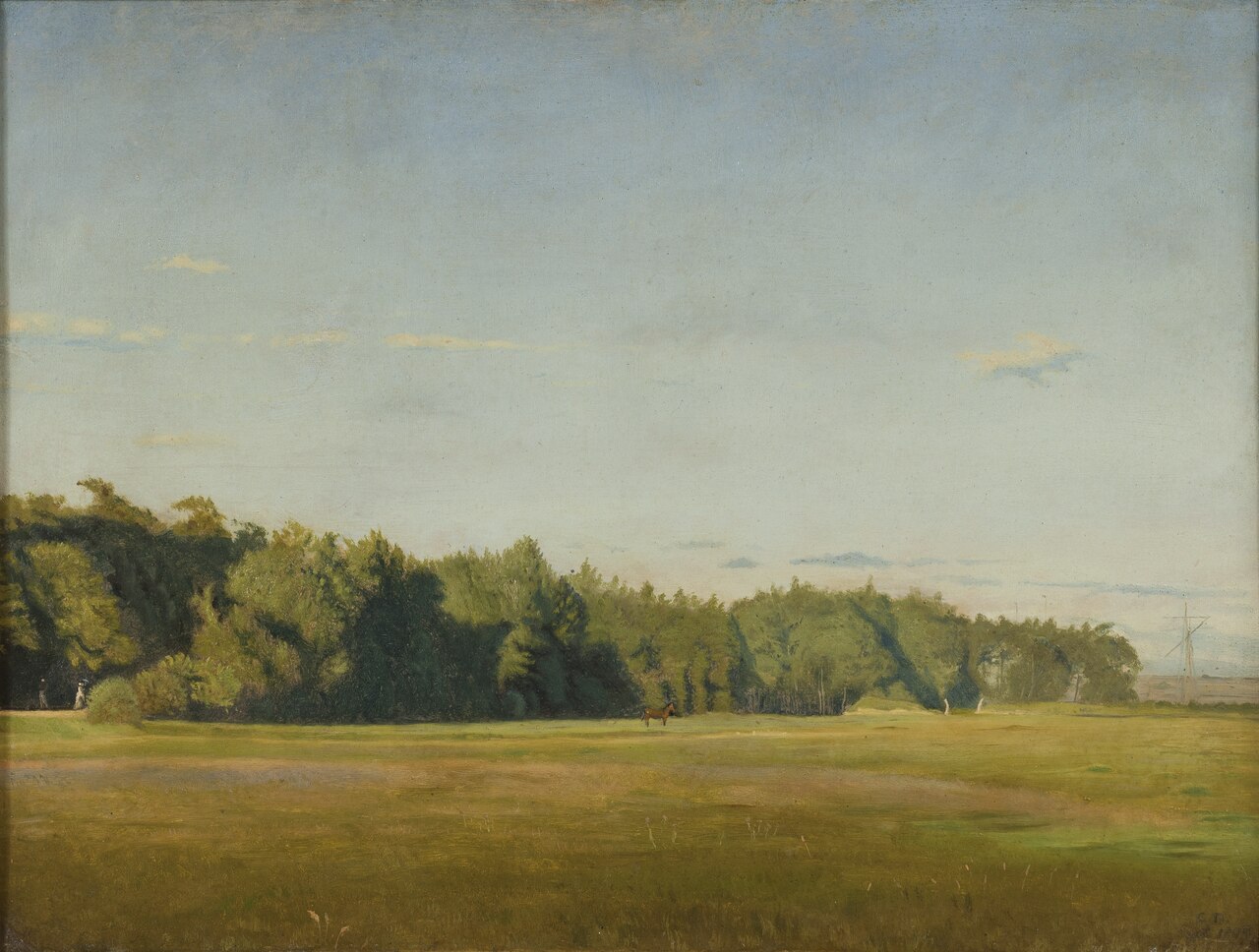
Major works - **Landscape (1849)** – One of Dalsgaard’s earliest mature works, this painting depicts a tranquil countryside with a distant horizon, a small river winding through the centre and a few scattered trees. The composition demonstrates his mastery of perspective and his ability to convey atmosphere through modest colour contrasts. - **En ung pige beder landsbyens gamle postbud besørge et brev (1858)** – Translating to “A young girl asks the village’s old postman to deliver a letter”, this genre piece combines a tender human interaction with a detailed rural setting. The painting is notable for its narrative clarity and the careful rendering of the postman’s weathered features, reflecting Dalsgaard’s interest in everyday Danish life. - **The Lim Fjord in Jutland. Study (1851)** – Executed as a study rather than a finished canvas, this work captures the expansive waters of the Lim Fjord, with its characteristic low horizon and reflective surface. The piece showcases Dalsgaard’s skill in depicting water and sky, employing subtle tonal shifts to suggest depth. - **A Woman's Solemn Churching after Childbirth (1860)** – This composition portrays a post‑natal religious ritual, a tradition still observed in rural Denmark. Dalsgaard places the central figure in a modest interior, illuminated by a soft window light that accentuates the solemn mood. The painting is praised for its respectful treatment of a private moment, rendered with dignity and compositional balance. - **Landscape near the Town of Skive with Skivehus Manor, Jutland (1849)** – Here Dalsgaard combines a recognizable landmark, Skivehus Manor, with the surrounding countryside. The manor’s architecture is rendered with precise line work, while the surrounding fields are softened by atmospheric perspective, creating a harmonious dialogue between built and natural environments.
Influence and legacy Christen Dalsgaard never achieved the international fame of some of his contemporaries, yet his work remains an important chapter in the narrative of Danish art. By faithfully recording rural customs and landscapes, he contributed to a visual archive of 19th‑century Danish life that scholars continue to reference. His adherence to the academic principles of Eckersberg ensured that the technical standards of the Danish Golden Age were preserved well into the latter half of the century.
In the decades following his death in Sorø in 1907, Dalsgaard’s paintings were exhibited in regional museums, where they were appreciated for their historical value as much as for their aesthetic qualities. Contemporary Danish art historians regard his oeuvre as a bridge between the strict classicism of early Golden Age painters and the more emotive, naturalistic tendencies that emerged in the late 19th century. While his name may not dominate popular art discourse, his paintings continue to be studied for their meticulous technique, their documentation of Danish rural traditions, and their subtle yet powerful visual poetry.
Overall, Christen Dalsgaard stands as a representative figure of a generation that sought to portray the everyday with dignity, using the disciplined tools of academic training to celebrate the ordinary landscapes and rituals of Denmark.
Frequently asked questions
Who was Christen Dalsgaard?
Christen Dalsgaard (1824–1907) was a Danish painter who specialised in naturalistic landscapes and genre scenes, and was a late student of the influential artist Christoffer Wilhelm Eckersberg.
What artistic style or movement is he associated with?
He worked within the tradition of the Danish Golden Age, combining academic precision with a realistic depiction of rural life, rather than aligning with a specific later movement.
What are his most famous works?
Among his best‑known paintings are Landscape (1849), En ung pige beder landsbyens gamle postbud besørge et brev (1858), The Lim Fjord in Jutland. Study (1851), A Woman's Solemn Churching after Childbirth (1860) and Landscape near the Town of Skive with Skivehus Manor (1849).
Why does Christen Dalsgaard matter in art history?
He provides a valuable visual record of 19th‑century Danish countryside and customs, and his disciplined technique helped preserve the academic standards of the Golden Age for later generations.
How can I recognise a painting by Dalsgaard?
Look for meticulous line work, a restrained earth‑tone palette, soft diffused daylight, and subjects that depict quiet rural scenes or domestic rituals with a calm, observational tone.