Charles Mellin
1597 – 1649
In short
Charles Mellin (1597–1649) was a French Baroque painter from Nancy who spent most of his career in Italy, where he was known as Carlo Lorenese. He is noted for religious and portrait works such as the Assumption of the Virgin and Roman Charity.
Notable works
_-_Portrait_of_a_Gentleman_-_Google_Art_Project.jpg)



Early life Charles Mellin was born in 1597 in Nancy, a city in the historic region of Lorraine, France. Little is recorded about his family background or early artistic training, but it is clear that he developed an interest in painting at a young age. In the early 17th century, many French artists sought opportunities abroad, and Mellin followed this pattern, moving to Italy to immerse himself in the flourishing artistic environment of the Baroque period. His relocation marked the beginning of a career that would be defined by a synthesis of French sensibility and Italian Baroque dynamism.
Career and style Mellin established himself in Italy, primarily in Rome, where he earned the nickname Carlo Lorenese, a reference to his Lorraine origins. The Roman artistic community of the 1620s and 1630s was dominated by the dramatic chiaroscuro and vigorous compositions associated with Caravaggio and his followers, as well as the grand classicism of the Bolognese school. Mellin’s work reflects an engagement with these currents while retaining a measured elegance that hints at his French heritage.
His style is characterised by a balanced use of light and shadow, a careful modelling of figures, and an emphasis on narrative clarity. Religious subjects dominate his oeuvre, a common feature of Baroque art, but he also produced portraiture that reveals an acute sensitivity to individual character. Mellin’s paintings often display a restrained colour palette, favouring earth tones and muted blues, which enhances the solemnity of his devotional scenes. Throughout his career, he received commissions for churches and private patrons, allowing him to work both on large altarpieces and smaller devotional works.
Signature techniques Mellin’s technique combines meticulous drawing with a layered painting approach. He typically began with a detailed underdrawing, using charcoal or ink to define the composition and the anatomical accuracy of his figures. Over this, he applied thin layers of oil paint, building up colour gradually to achieve a luminous surface. His handling of chiaroscuro is subtle; rather than the stark contrasts of Caravaggist tenebrism, Mellin prefers a gradual modulation of tone that gives his figures a three‑dimensional presence without overwhelming the narrative.
Another hallmark of his practice is the use of delicate drapery folds to convey movement and emotional tenor. In his religious scenes, Mellin often employs symbolic gestures—hands raised in supplication, eyes directed towards a divine source—to reinforce theological themes. The composition frequently centres on a focal point that draws the viewer’s eye, such as a saint’s illuminated face or a central sacrificial act, creating a visual hierarchy that guides interpretation.
Major works Mellin’s extant works provide insight into his artistic range. **Portrait of a Gentleman (1630)** exemplifies his portraiture, portraying a seated male figure with restrained elegance. The sitter is rendered with soft lighting that highlights the texture of the garment and the thoughtful expression, suggesting both status and introspection.
Roman Charity (1627) depicts the legendary act of a daughter feeding her imprisoned father, a subject popular in Baroque moral allegory. Mellin treats the scene with compassionate realism; the figures are bathed in warm light that accentuates the emotional tension while preserving the dignity of the characters. The composition’s tight framing and the careful rendering of the interior space underscore the narrative’s intimate nature.
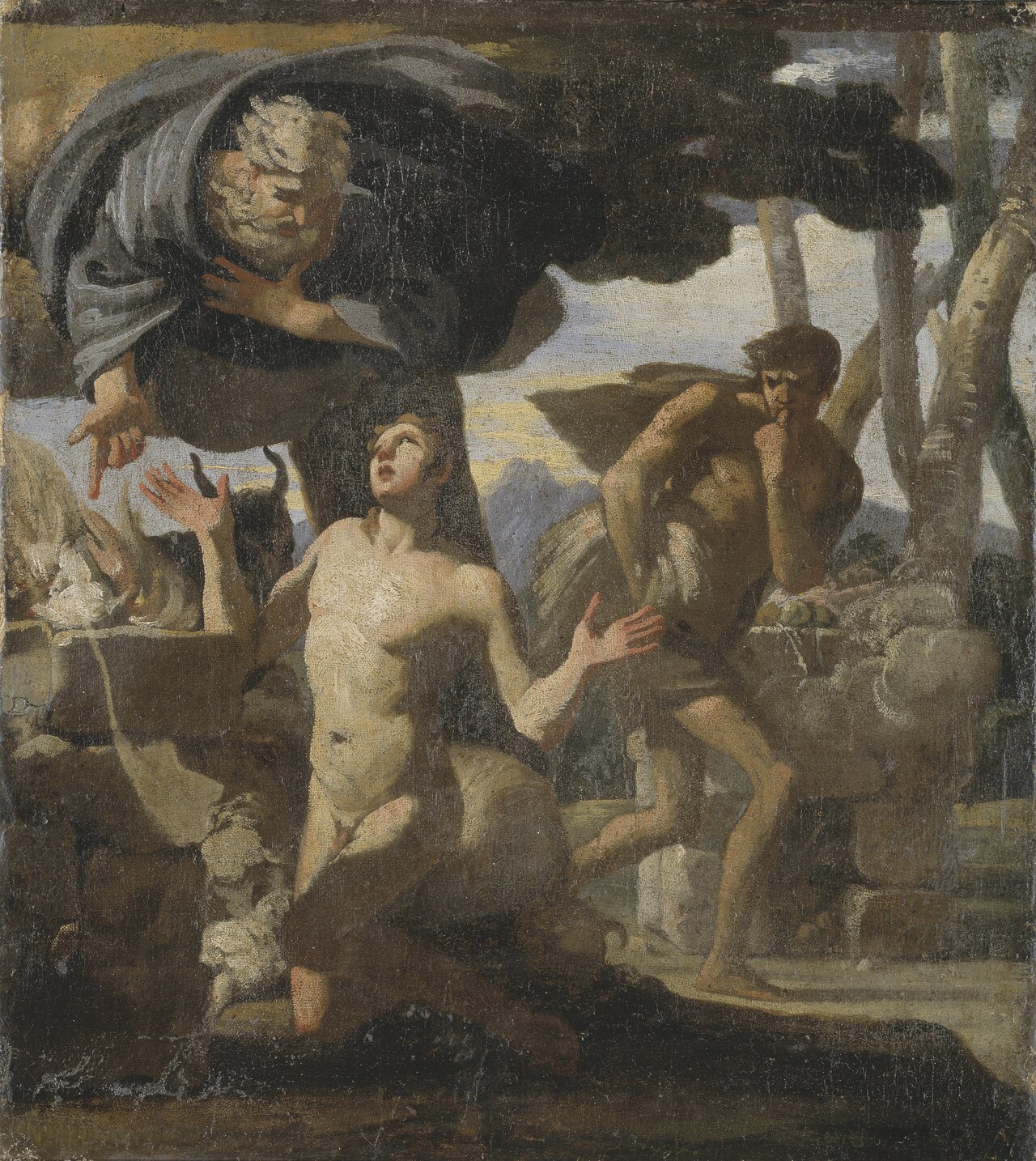
A preparatory work, The Sacrifice of Abel. Study, reveals Mellin’s process. The study, likely a drawing or oil sketch, shows a dynamic arrangement of the two brothers, with Abel’s vulnerable posture contrasted against Cain’s aggressive gesture. Though unfinished, the piece demonstrates Mellin’s ability to convey drama through gesture and composition.
The Assumption of the Virgin (1630) stands as one of Mellin’s most ambitious religious paintings. In this altarpiece, the Virgin is portrayed ascending towards heaven, surrounded by a host of angels. Mellin employs a luminous palette, with golden light enveloping the Virgin and a subtle gradation of clouds that suggests celestial movement. The work reflects the Baroque preoccupation with the divine transcending earthly space, while Mellin’s balanced composition maintains a sense of order.
Finally, Salvator Mundi—though less documented—illustrates Mellin’s engagement with the iconic image of Christ as the saviour of the world. The painting presents a serene Christ holding a globe, his gaze directed outward, inviting contemplation. Mellin’s handling of the figure’s robes and the delicate modelling of the facial features align with his broader aesthetic of restrained elegance.
Influence and legacy Charles Mellin’s career illustrates the fluid exchange between French and Italian artistic traditions in the early 17th century. While he never achieved the renown of contemporaries such as Caravaggio or Guido Reni, his work contributed to the diffusion of Baroque visual language across national boundaries. His paintings were part of the decorative programmes of Roman churches, influencing local artists who absorbed his balanced treatment of light and narrative.
Mellin’s legacy persists in scholarly assessments of cross‑cultural artistic migration during the Baroque era. His body of work, though modest in number, offers a valuable case study of a French painter negotiating the demands of Italian patronage while preserving a distinctive, measured style. Contemporary exhibitions of Baroque art occasionally include Mellin’s pieces, underscoring his role as a bridge between French and Italian visual cultures. Though not a household name, his contributions enrich the understanding of the period’s artistic diversity and the subtle ways in which individual artists shaped the broader Baroque movement.
Overall, Charles Mellin remains a noteworthy figure for historians interested in the interplay of national identities within the European Baroque, and his surviving works continue to provide insight into the aesthetic priorities of his time.
Frequently asked questions
Who was Charles Mellin?
Charles Mellin (1597–1649) was a French Baroque painter from Nancy who spent most of his career in Italy, where he was known as Carlo Lorenese.
What style or movement is he associated with?
He worked within the Baroque idiom, combining the dramatic chiaroscuro of the Italian Baroque with a restrained, elegant approach that reflects his French background.
What are his most famous works?
His most recognised pieces include the Portrait of a Gentleman (1630), Roman Charity (1627), the Assumption of the Virgin (1630), and his religious compositions such as Salvator Mundi.
Why is Charles Mellin important in art history?
Mellin exemplifies the cultural exchange between France and Italy in the 17th century, illustrating how French artists adapted to Italian Baroque patronage while contributing a distinctive, balanced visual style.
How can I recognise a painting by Charles Mellin?
Look for a calm use of light, careful modelling of figures, subtle chiaroscuro, and a focus on narrative clarity, often accompanied by muted colour palettes and refined drapery.