César de Cock
1823 – 1904
In short
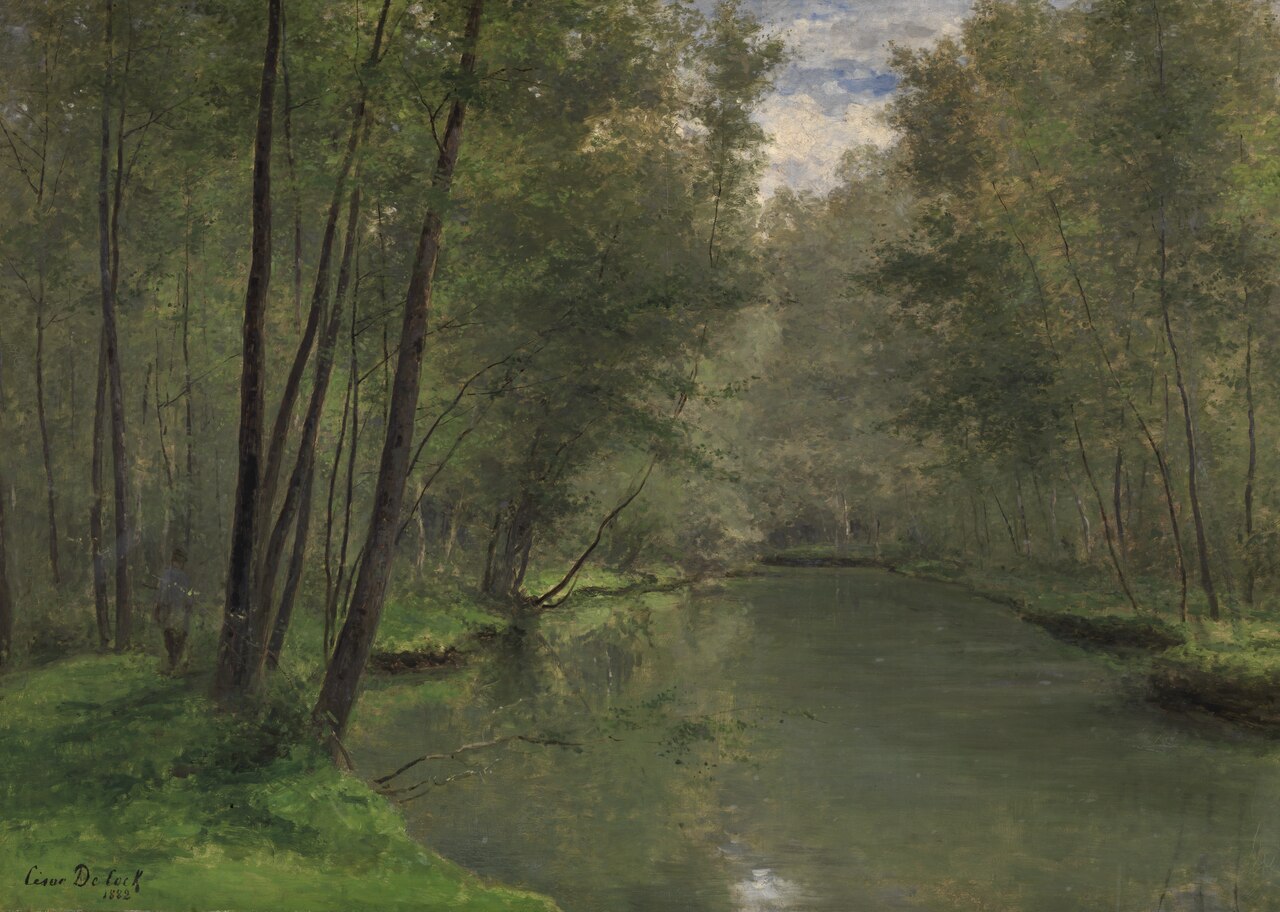
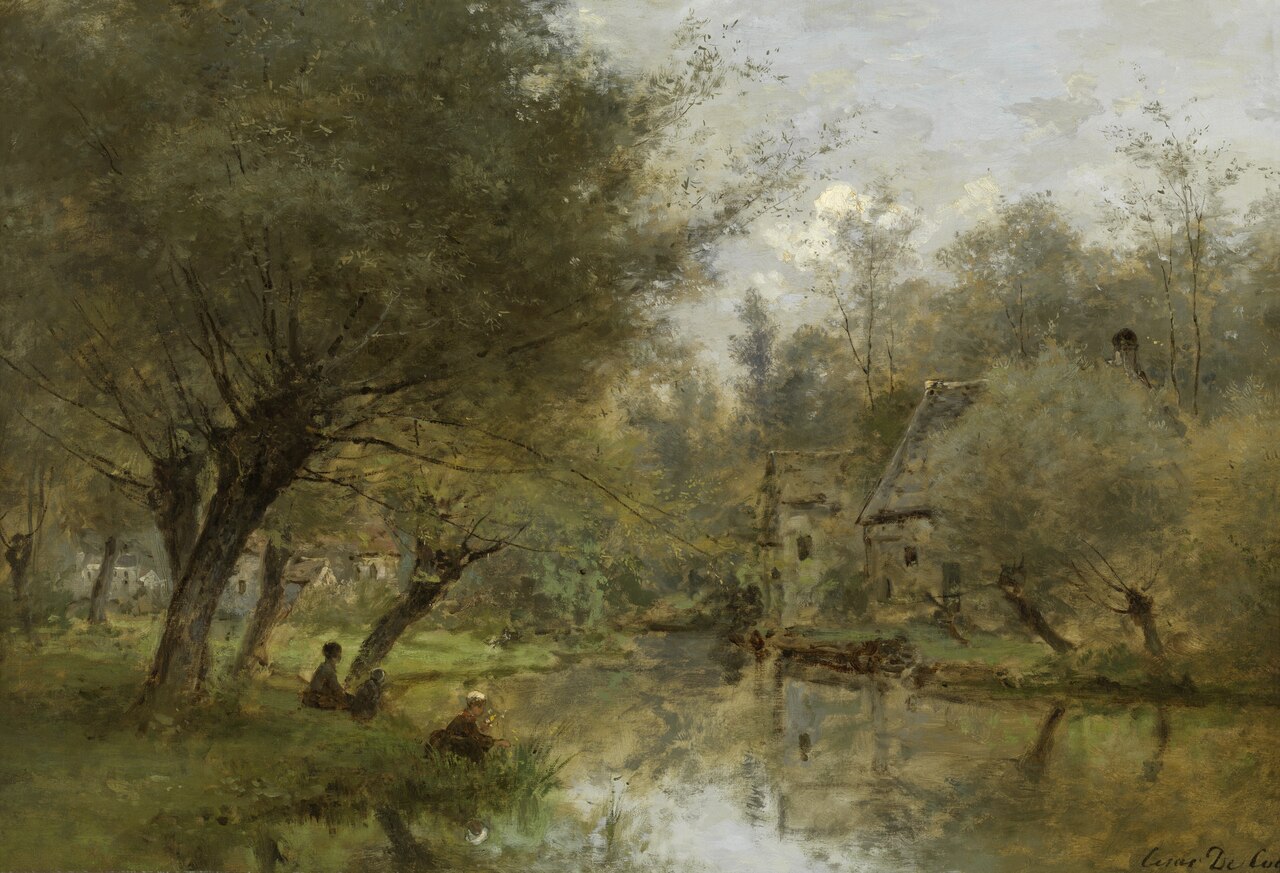
César de Cock (1823–1904) was a Belgian landscape painter who worked in the style of the French Barbizon school. Based in Ghent, he is noted for atmospheric forest and river scenes such as *Stream through the Forest* (1872) and *Along the River Epte in Gasny* (1882).
Notable works


.jpg)
Early life César de Cock was born in 1823 in Ghent, a city that was then part of the United Kingdom of the Netherlands and later became a centre of Belgian artistic activity. Little is recorded about his family background, but the vibrant cultural environment of Ghent—home to the Royal Academy of Fine Arts—provided him with early exposure to drawing and painting. He likely received his first formal training at the Academy, where the curriculum emphasized drawing from life and the study of classical techniques. By the 1840s, de Cock was already developing an interest in landscape painting, a genre that was gaining popularity across Europe as artists turned away from historical and religious subjects toward the natural world.
Career and style In the 1850s de Cock began to travel beyond Belgium, spending extended periods in France where he encountered the Barbizon school, a loose association of painters centred around the village of Barbizon near the Forest of Fontainebleau. The Barbizon artists, including Théodore Rousseau, Jean-François Millet and Charles-François Daubigny, advocated painting directly from nature, favouring a subdued palette and a focus on mood over precise topographical detail. De Cock absorbed these principles, integrating them with his Flemish sensibility. Returning to Ghent, he established a studio and became a regular participant in the annual Salons of the Société des Beaux‑Arts. His work was consistently praised for its lyrical treatment of light and atmosphere, and he earned a reputation as one of the few Belgian painters to adopt the Barbizon approach authentically.
Throughout the 1860s and 1870s de Cock’s output centred on forested scenes, riverbanks and rural pathways. He preferred subjects that allowed him to explore the interplay of shade and sunlight, often depicting mist‑laden mornings or the golden glow of autumn. While his early landscapes were relatively detailed, his mature style favoured a more simplified composition, where the essence of the place was conveyed through colour and tone rather than meticulous rendering. This evolution mirrored the broader shift within the Barbizon school toward a more poetic, almost impressionistic sensibility, a trajectory that would later influence the Impressionists.
Signature techniques De Cock’s technique combined several hallmarks of the Barbizon tradition with personal refinements: - **Plein‑air observation**: He frequently painted outdoors, using a portable easel and a limited palette to capture fleeting effects of light. Sketches made on site were later developed into larger studio works. - **Limited tonal palette**: Earthy greens, muted browns and soft ochres dominate his canvases, punctuated by occasional highlights of warm amber or cool blue to suggest atmospheric depth. - **Soft, blended brushwork**: Rather than the tight, stippled strokes of some contemporaries, de Cock employed smooth, layered brushstrokes that dissolved edges, creating a sense of mist or haze. - **Composition through natural framing**: Trees, foliage and watercourses often act as compositional devices, guiding the viewer’s eye toward focal points such as a distant clearing or a reflective pond. - **Subtle narrative hints**: Though primarily concerned with mood, his landscapes sometimes include small human figures or rustic structures, providing a quiet sense of scale and activity without dominating the scene. These techniques allowed de Cock to evoke the emotional resonance of a place rather than its exact topography, aligning his work with the philosophical aims of the Barbizon movement.
Major works - **Stream through the Forest (1872)** – This painting exemplifies de Cock’s mature style. A narrow watercourse winds through a densely wooded glade, the canopy filtering light into dappled patches. The muted greens and the reflective surface of the water create a tranquil atmosphere, while the subtle use of warm tones suggests the late afternoon. - **A Forest Pond** – Though undated, this work continues the theme of water within woodland. A still pond mirrors surrounding trees, with a delicate veil of mist that softens the horizon. The composition is balanced by a small, barely visible path that invites the viewer into the scene. - **Along the River Epte in Gasny (1882)** – Painted during a later French sojourn, the canvas captures the gentle flow of the Epte River near the village of Gasny. De Cock renders the river’s surface with light brushstrokes that convey motion, while the surrounding foliage is rendered in muted ochres, highlighting the seasonal transition. - **Landscape near Saint‑Germain‑en‑Laye (1879)** – This piece reflects the artist’s fascination with the outskirts of Paris. The composition centres on a sun‑lit clearing framed by trees, with distant hills softened by atmospheric perspective. The colour scheme leans toward warm amber, indicating a late‑summer light. - **Landscape by the River Lys or The Road to the ‘Patijntje’ in Ghent (1863)** – This early work, sometimes listed under two titles, depicts a tranquil stretch of the Lys River near Ghent. A narrow road leads toward a modest farmhouse, the ‘Patijntje’, while the riverbank is lined with reeds. The painting’s cooler palette and crisp detail contrast with the softer tones of his later pieces, illustrating his artistic development.
Influence and legacy César de Cock occupies a distinctive niche in Belgian art history as a conduit for the French Barbizon aesthetic. By adapting the school’s emphasis on natural light and tonal harmony, he helped broaden the visual language of Belgian landscape painting in the second half of the 19th century. His works were exhibited in Brussels and Paris, influencing younger Belgian artists such as Emile Claus and James Ensor, who, while moving toward Symbolism and Impressionism, retained an appreciation for atmosphere that can be traced back to de Cock’s approach.
After his death in Ghent in 1904, his paintings entered both public and private collections, though they never achieved the fame of his French counterparts. Nevertheless, art historians regard him as an important regional interpreter of Barbizon ideals, and recent exhibitions in Belgian museums have revived interest in his oeuvre. Contemporary curators highlight de Cock’s ability to merge Belgian topography with a French sensibility, offering a nuanced perspective on cross‑national artistic exchange during a period of rapid industrialisation and cultural change.
Today, César de Cock is recognised for his contribution to the development of a distinctly Belgian landscape tradition that balances realism with poetic mood. His paintings continue to be studied for their technical mastery of light, colour and composition, and they remain valuable reference points for scholars examining the diffusion of the Barbizon school beyond France.
---
Key works such as *Stream through the Forest* and *Along the River Epte in Gasny* are regularly featured in surveys of 19th‑century European landscape art, underscoring his lasting relevance within the broader narrative of modern art.
---
*For further reading, consult the catalogues of the Royal Museums of Fine Arts of Belgium and the archives of the Société des Beaux‑Arts, which hold several of de Cock’s original sketches and correspondences.*
Frequently asked questions
Who was César de Cock?
César de Cock (1823–1904) was a Belgian painter known for his atmospheric landscapes, working in the style of the French Barbizon school.
What artistic movement did he belong to?
He is associated with the Barbizon school, a mid‑19th‑century movement that emphasized painting directly from nature and a tonal, mood‑driven approach.
What are his most famous works?
His best‑known paintings include *Stream through the Forest* (1872), *A Forest Pond*, *Along the River Epte in Gasny* (1882), *Landscape near Saint‑Germain‑en‑Laye* (1879) and *Landscape by the River Lys* (also known as *The Road to the ‘Patijntje’*) from 1863.
Why is César de Cock important in art history?
He helped transmit the Barbizon aesthetic to Belgium, influencing later Belgian landscape painters and enriching the country’s 19th‑century artistic vocabulary.
How can I recognise a painting by César de Cock?
Look for quiet forest or river scenes rendered with a limited, earthy palette, soft blended brushwork, and a focus on light and atmosphere rather than precise detail.
Other Barbizon school artists
More Belgium artists
References: Wikidata