Carl Frederik Aagaard
1833 – 1895
In short
Carl Frederik Aagaard (1833–1895) was a Danish landscape painter and decorative artist, trained at the Royal Danish Academy of Fine Arts under P. C. Skovgaard, who became known for his vivid depictions of both Danish and Italian scenery, including works such as 'Efterårsmorgen i Jægersborg Dyrehave' and 'View to the Amalfi Coast'.
Notable works


Early life Carl Frederik Peder Aagaard was born on 21 April 1833 in the city of Odense on the island of Funen, Denmark. He grew up in a family that valued education and the arts, which gave him early exposure to drawing and painting. As a child he was drawn to the natural landscapes surrounding his hometown, a fascination that would later shape his artistic career. In his teenage years Aagaard moved to Copenhagen to pursue formal artistic training, enrolling at the Royal Danish Academy of Fine Arts. The Academy, at the time, was the centre of Danish artistic life and provided a rigorous grounding in drawing, composition, and the study of nature.
Career and style After completing his studies, Aagaard became a pupil of P. C. Skovgaard, one of Denmark’s leading landscape painters of the Golden Age. Under Skovgaard’s mentorship Aagaard absorbed the Danish tradition of plein‑air painting, which emphasized careful observation of light, atmosphere, and topographical detail. While his early work reflects the subdued palette and lyrical mood typical of the Golden Age, Aagaard gradually developed a brighter, more decorative approach, especially after his travels to Italy in the 1870s. His style can therefore be described as a synthesis of Danish naturalism with a Mediterranean sensibility, marked by clear brushwork, harmonious colour harmonies and an inclination to render tourist‑favoured sites with a sense of romantic allure.
Aagaard’s career was largely centred on the production of landscapes for both private collectors and public exhibitions. He participated regularly in the Charlottenborg Spring Exhibition, Denmark’s most prestigious annual art show, where his works were praised for their technical proficiency and atmospheric fidelity. In addition to easel paintings, he also undertook decorative commissions, creating murals and wall panels for public buildings and private residences. This dual practice as a painter and decorative artist reinforced his reputation as a versatile creator capable of adapting his landscape idiom to varied formats.
Signature techniques Aagaard’s paintings are distinguished by several recurring technical elements. First, his handling of light is meticulous; he often captured the fleeting moments of sunrise or the soft glow of late afternoon, using delicate gradations of tone to convey depth. Second, his brushwork combines fine detail in the foreground – such as individual leaves, grasses, or ripples on water – with broader, more gestural strokes in the background, creating a sense of atmospheric perspective. Third, he employed a relatively bright palette, especially in his Italian scenes, favouring warm ochres, terracotta reds, and luminous blues that evoke the Mediterranean climate. Lastly, his compositional structures frequently employ a low horizon line, allowing the sky to dominate the canvas and emphasise the expansive quality of the landscape.
Major works Aagaard’s oeuvre includes a number of paintings that have become emblematic of his artistic vision. "Efterårsmorgen i Jægersborg Dyrehave" (1866) portrays a mist‑laden autumn morning in the royal deer park north of Copenhagen. The work demonstrates his early mastery of atmospheric effects, with muted greens and browns that convey the quiet stillness of the season.
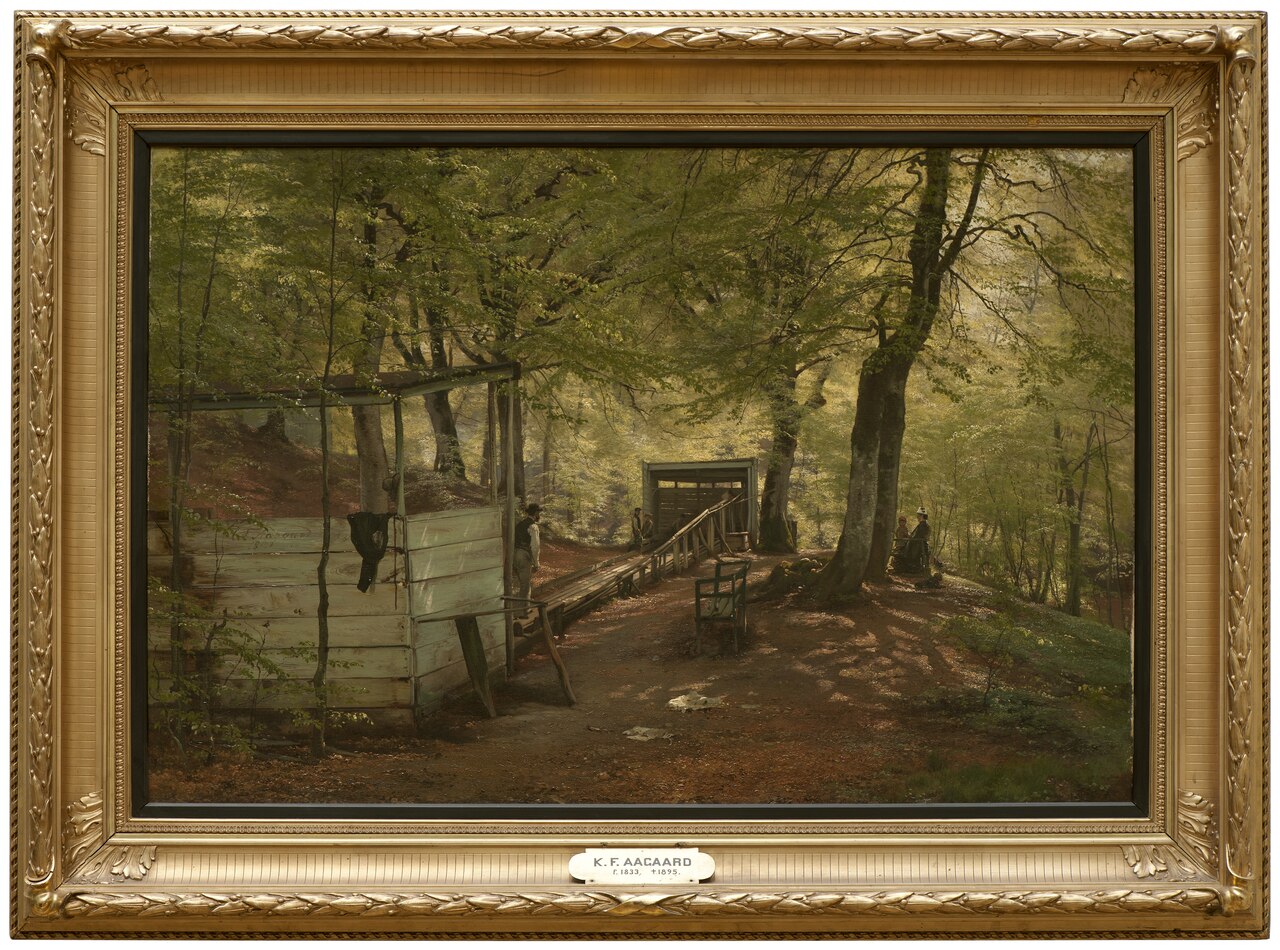
"Skittle‑alley in Saeby Forest. Spring Morning" (1882) captures a sun‑dappled forest path in the Danish countryside. Here Aagaard’s use of bright, fresh greens and the play of light through the canopy illustrate his later, more vibrant palette. The composition leads the viewer’s eye along the winding lane, inviting an imagined walk through the scene.
His Italian subjects, such as "View to the Amalfi Coast" and "Pergola in Amalfi" (1880), reveal his fascination with the Mediterranean landscape. In "View to the Amalfi Coast" he renders the steep cliffs and sparkling sea with a combination of precise line and colour, while "Pergola in Amalfi" focuses on a shaded garden structure, juxtaposing the cool shadows of the pergola with the warm, sun‑lit terraces beyond.
"Deer beside a Lake" (1888) returns to a Danish motif, depicting a solitary deer drinking at the water’s edge. The painting combines a tranquil surface of the lake with the delicate rendering of the animal’s form, showcasing Aagaard’s ability to blend naturalistic detail with a poetic ambience.
These works collectively illustrate Aagaard’s range: from the quiet, introspective scenes of his native Denmark to the luminous, exotic vistas of Italy. Each painting reflects his consistent interest in locations popular with tourists, suggesting an intention to provide viewers with idealised, postcard‑like impressions of the places depicted.
Influence and legacy Carl Frederik Aagaard occupies a respected niche within 19th‑century Danish art. Though he never aligned himself with a formal avant‑garde movement, his paintings contributed to the continuation of the Danish landscape tradition beyond the Golden Age. By integrating decorative elements and a brighter colour scheme, he helped bridge the gap between academic naturalism and the more decorative tendencies that would emerge in the early 20th century.
Aagaard’s works were widely collected in his lifetime, and many remain in Danish museums, including the National Gallery of Denmark, where they are displayed alongside those of his mentor Skovgaard and his contemporaries. His paintings continue to be cited in studies of Danish tourism art, illustrating how landscape painting served both aesthetic and commercial purposes in the late 19th century.
Although his name is not as universally recognised as that of some of his peers, Aagaard’s legacy endures through the clarity of his vision, the technical skill evident in his brushwork, and the enduring charm of his depictions of both Danish and Italian scenery. Contemporary scholars view his oeuvre as a valuable record of the visual culture of his era, offering insight into the ways artists mediated the experience of travel and nature for a growing bourgeois audience.
Frequently asked questions
Who was Carl Frederik Aagaard?
Carl Frederik Aagaard (1833–1895) was a Danish landscape painter and decorative artist, trained at the Royal Danish Academy of Fine Arts and known for his depictions of Danish and Italian scenery.
What artistic style or movement is he associated with?
Aagaard is linked to the Danish landscape tradition of the Golden Age, blending naturalistic observation with brighter, decorative elements influenced by his Italian travels.
What are his most famous works?
Among his best‑known paintings are "Efterårsmorgen i Jægersborg Dyrehave" (1866), "Skittle‑alley in Saeby Forest. Spring Morning" (1882), "View to the Amalfi Coast", "Pergola in Amalfi" (1880) and "Deer beside a Lake" (1888).
Why is Carl Frederik Aagaard important in art history?
He helped extend the Danish landscape tradition into the late 19th century, merging academic naturalism with decorative colour, and his work provides a visual record of popular tourist sites of his time.
How can I recognise a painting by Carl Frederik Aagaard?
Look for clear, luminous light, a bright palette, detailed foreground elements contrasted with broader background strokes, and subjects that depict well‑known Danish or Mediterranean landscapes.