Alexander Bogomazov
1880 – 1930
In short
Alexander Bogomazov (1880–1930) was a Ukrainian painter of the Russian Empire, a leading figure of the Ukrainian avant‑garde, and a theorist whose writings helped shape early 20th‑century modern art. He is best known for his cubo‑futurist paintings and later spectralist work, as well as his treatise on the relationship between object, artist, picture and spectator.
Notable works
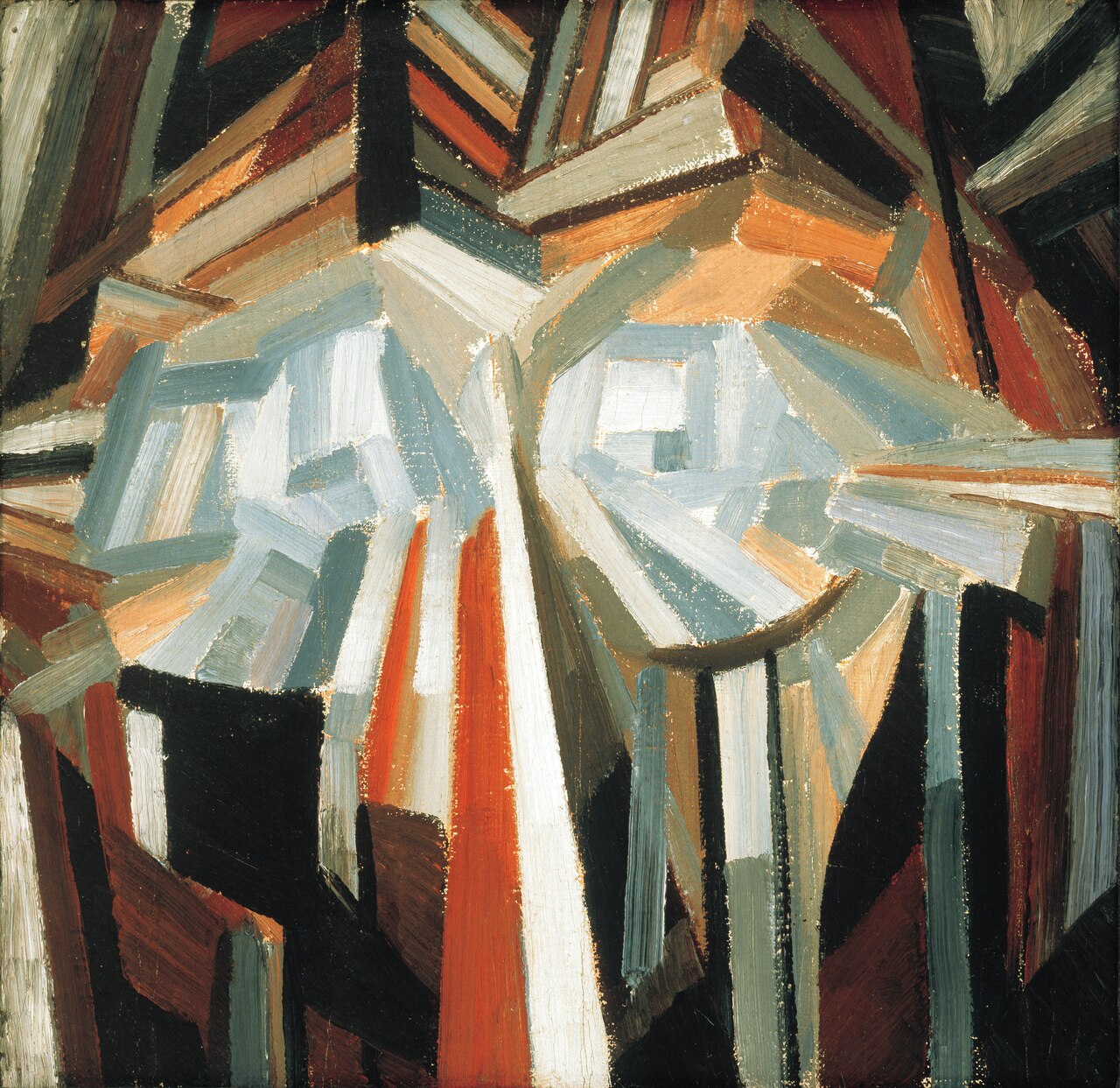


Early life Alexander Konstantinovich Bogomazov was born in 1880 in the village of Ivanivka, then part of the Russian Empire (today Ukraine). His family were modest peasants, and his early education took place in local schools where he displayed a talent for drawing. In the late 1890s he moved to Kyiv to attend the city’s art school, where he received formal training in drawing and composition. The cultural milieu of Kyiv at the turn of the century, with its growing interest in European modernism, provided Bogomazov with exposure to the latest artistic developments, especially those emerging from Paris.
Career and style After completing his studies, Bogomazov began exhibiting in Kyiv and St. Petersburg. By the 1910s he had become closely associated with the nascent Ukrainian avant‑garde, joining circles that included painters, writers and architects eager to break from academic conventions. His style evolved rapidly: early works show the influence of Impressionism and Symbolism, but from 1913 onward he embraced a synthesis of Cubism and Futurism, a hybrid later termed “cubo‑futurism”. In this period his canvases fragmented objects into geometric planes while simultaneously suggesting motion and dynamism, reflecting both the analytical rigor of Cubism and the kinetic energy of Futurism.
The outbreak of World War I and the subsequent Russian Revolution disrupted artistic activity, yet Bogomazov continued to work and write. In 1914 he published the treatise *The Art of Painting and the Elements*, in which he examined the roles of the object, the artist, the picture and the spectator, laying out a theoretical framework that anticipated later modernist discourse. During the 1920s he turned away from strict cubo‑futurist vocabulary and developed a personal visual language known as “Spectralism”. This later phase emphasized colour modulation, light effects and a more lyrical approach to form, while still retaining an analytical concern with structure.
Signature techniques Bogomazov’s paintings are characterised by several recurring technical choices. First, he employed a rigorous fragmentation of the visual field, breaking down subjects into intersecting planes that convey multiple viewpoints simultaneously. Second, his colour palette shifted according to the period: early cubo‑futurist works often use muted earth tones and stark contrasts, whereas his spectralist canvases favour a broader spectrum of saturated hues, applied in layered washes to suggest depth and vibration. Third, he frequently used diagonal lines and implied motion to give his compositions a sense of temporal progression, a hallmark of his Futurist influence. Finally, his brushwork varies from precise, almost mechanical strokes in analytical passages to looser, more expressive applications in later works, reflecting his evolving philosophical stance on the relationship between painter and picture.
Major works Among Bogomazov’s most cited pieces are three early paintings that illustrate his stylistic development. *Portrait* (1907) predates his cubo‑futurist period and presents a conventional representation of a seated figure, yet already hints at a concern with formal composition and psychological depth. *Flower Bed, Crimea* (1906) captures a landscape motif with a modest colour scheme, showing his ability to render natural forms with a measured hand. The later *Cubist Head* (1914) marks a decisive shift: the subject—a human head—is rendered as a series of overlapping geometric facets, each plane rendered with a distinct tonal value. This work exemplifies his integration of Cubist analysis with an energetic sense of movement, and it remains one of the most reproduced images of Ukrainian modernism.
Influence and legacy Bogomazov’s impact on Ukrainian and broader Soviet art was profound. His theoretical writings provided a conceptual scaffold for artists grappling with the challenges of abstraction, and his experimental practice demonstrated how local artistic concerns could engage with international avant‑garde movements. Throughout the Soviet period his work was periodically reassessed, and after the dissolution of the USSR renewed scholarly interest placed him alongside figures such as Kazimir Malevich and David Burliuk as a key architect of Eastern European modernism. Today his paintings are held in major Ukrainian museums, and exhibitions of his work continue to attract scholarly attention, confirming his status as a pivotal figure in the transition from 19th‑century realism to 20th‑century abstraction.
Frequently asked questions
Who was Alexander Bogomazov?
Alexander Bogomazov (1880–1930) was a Ukrainian painter and art theorist, renowned for his role in the Ukrainian avant‑garde and for pioneering cubo‑futurist and spectralist styles.
What artistic movement is he associated with?
He is most closely linked to cubo‑futurism (1913–1917) and later to spectralism (1920–1930), both of which blend geometric abstraction with dynamic expression.
What are his most famous works?
His best‑known paintings include *Cubist Head* (1914), *Portrait* (1907) and *Flower Bed, Crimea* (1906), each illustrating a different stage of his stylistic evolution.
Why is Bogomazov important in art history?
He helped articulate a theoretical basis for modern art in Eastern Europe, influencing generations of artists and positioning Ukrainian modernism within the broader European avant‑garde.
How can I recognise a Bogomazov painting?
Look for fragmented geometric forms, a tension between analytical planes and kinetic lines, and, in later works, vibrant colour washes that convey light and vibration.