Max Bohm
1868 – 1923
In short
Max Bohm (1868–1923) was an American painter who worked mainly in the Etaples art colony in France, producing genre scenes, marine subjects and portraits. He is remembered for works such as Ancient Seaport, The Happy Mother and Springtime in France, and for bridging American and European artistic currents in the early twentieth century.
Notable works

.jpg)
.jpg)
.jpg)
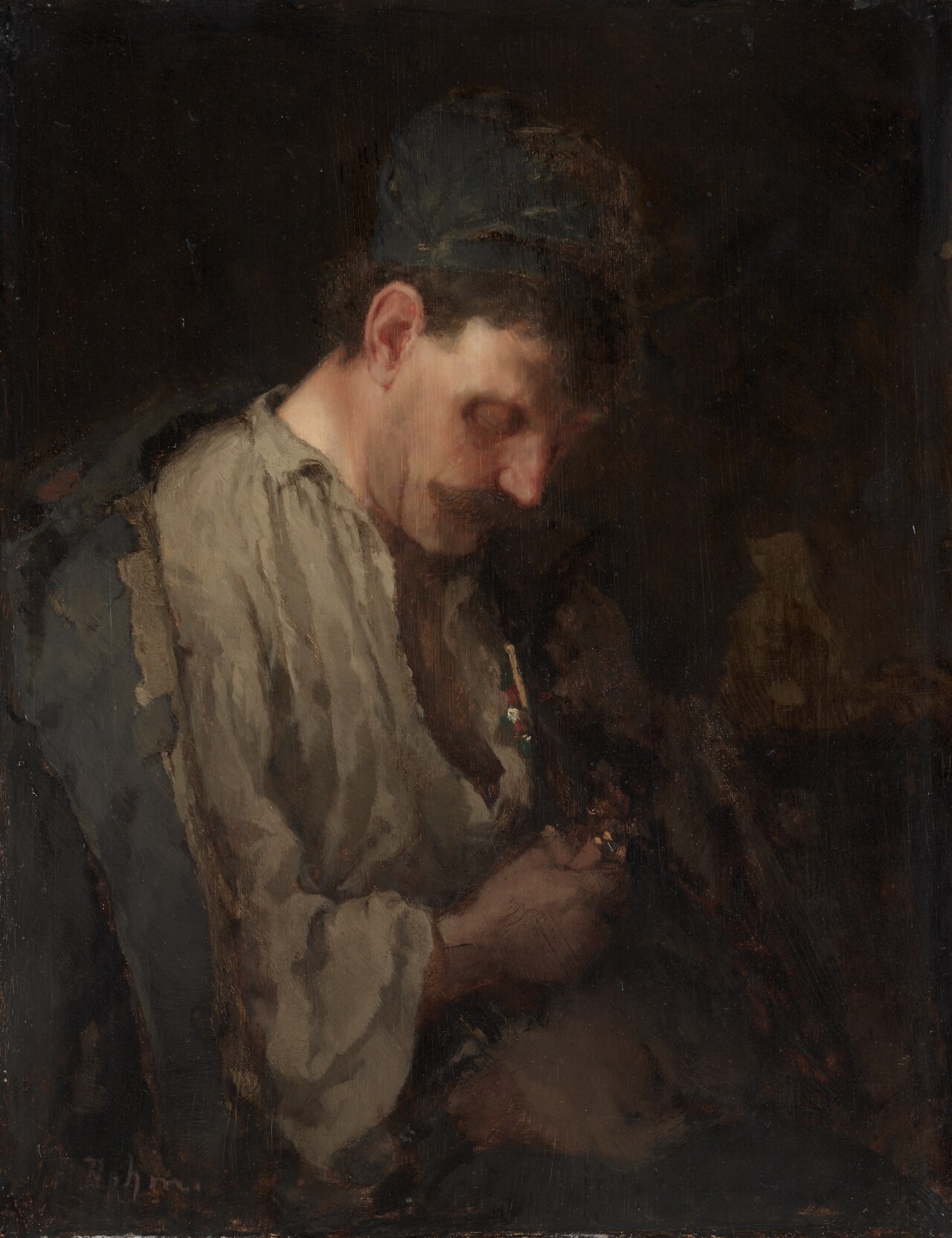
Early life Max Bohm was born in 1868 in Cleveland, Ohio, to a family that encouraged artistic interests. Little is recorded about his formal schooling, but the cultural climate of the late‑nineteenth‑century United States offered a growing number of opportunities for aspiring artists. By his early twenties Bohm had decided to pursue a career in painting, and like many of his contemporaries he looked to Europe for artistic training and inspiration. He travelled to the continent, eventually settling for periods in France, where he would become associated with the Etaples art colony, a community of international painters attracted by the region’s coastal light and rustic charm.
Career and style Bohm’s career unfolded against the backdrop of a vibrant expatriate scene in northern France. The Etaples colony, centred on the fishing town of Étaples near the English Channel, was known for its emphasis on plein‑air painting and a naturalistic approach to everyday life. Within this environment, Bohm developed a style that combined the realist observation of French academic tradition with a softer, impressionistic handling of colour and atmosphere. His subject matter frequently included maritime scenes, domestic interiors and portraiture, reflecting both his American roots and his adopted French surroundings.
The artist’s work displays a measured balance between detail and suggestion. He often rendered figures and objects with careful modelling, yet allowed light and colour to dissolve hard edges, creating a sense of immediacy. This hybrid approach placed him alongside other Etaples painters who sought to capture the fleeting qualities of light while maintaining narrative clarity. Bohm’s American background also left a subtle imprint: his compositions sometimes reveal a straightforward, almost documentary sensibility, reminiscent of the genre painting tradition in the United States.
Signature techniques Bohm’s technique rested on several recurring elements. First, his palette favoured muted earth tones punctuated by occasional bright accents—particularly blues and greens that evoke the sea and sky. He employed layered brushwork, beginning with a thin underpainting to establish form, then building up glazes that enriched colour depth. In many marine subjects, he used a wet‑on‑wet method to suggest the movement of water and the translucency of clouds.
Second, Bohm paid particular attention to the interplay of light and shadow. He often painted scenes at dawn or twilight, moments when natural illumination is soft and directional. This allowed him to model forms through subtle tonal shifts rather than stark contrasts. In portraiture, he favoured a restrained lighting scheme that highlighted the sitter’s face while keeping the surrounding environment in gentle focus.
Finally, Bohm’s compositional choices frequently employed a low horizon line, especially in seascapes, to give prominence to expansive skies and to convey a sense of openness. He balanced this with strong foreground elements—boats, nets, or figures—to anchor the viewer’s eye and provide narrative context.
Major works **Ancient Seaport (1921)** – This oil painting captures a historic harbour bathed in the golden light of early evening. Bohm’s deft handling of atmospheric perspective draws the viewer’s gaze from the bustling quayside to the distant, mist‑shrouded cliffs, illustrating his mastery of depth and mood.
The Happy Mother (1913) – A domestic interior scene that portrays a mother and child in a modest, well‑lit room. The work exemplifies Bohm’s ability to convey intimacy through simple gestures and warm colour harmonies, underscoring his interest in everyday American‑type subjects despite the French setting.
An Incident on the English Channel (1919) – Depicting a small vessel caught in a sudden squall, this piece showcases Bohm’s skill in rendering the drama of sea weather. The turbulent brushstrokes and muted palette convey the tension of the moment while retaining a clear narrative structure.
Springtime in France (1923) – Completed shortly before his death, this landscape celebrates the renewal of the French countryside. Lush greens, blossoming trees and a distant village are rendered with light, airy brushwork, reflecting an impressionistic optimism.
Portrait of Mr. C. (1892) – One of Bohm’s earliest known portraits, this work presents a gentleman in a formal suit, rendered with precise modelling and a subtle play of light across the face. The portrait demonstrates Bohm’s early command of academic techniques, which he later softened through his Etaples experience.
Influence and legacy Max Bohm’s legacy rests on his role as a cultural bridge between American and European art at the turn of the twentieth century. By participating in the Etaples colony, he contributed to a transatlantic exchange of ideas that enriched both sides of the Atlantic. His paintings, while not avant‑garde, exemplify the synthesis of realist narrative and impressionistic atmosphere that characterised many expatriate artists of his era.
Although Bohm did not achieve the fame of some of his French contemporaries, his works remain of interest to scholars studying the diffusion of artistic practices across borders. They also attract collectors who appreciate the quiet lyricism of his marine and domestic scenes. In the United States, his later years spent in Provincetown—a hub for American modernist painters—position him within the early history of that community, linking the European colony experience to the burgeoning American art scene of the 1920s.
Today, Bohm’s paintings are held in a handful of regional museums and private collections, where they serve as exemplars of the Etaples aesthetic and of an American artist’s adaptation to European artistic currents. His careful balance of observation, light, and narrative continues to offer insight into the cross‑cultural dynamics of the period, ensuring his place in the broader story of transatlantic art history.
Frequently asked questions
Who was Max Bohm?
Max Bohm (1868–1923) was an American painter who worked mainly in France’s Etaples art colony, producing marine scenes, domestic interiors and portraits.
What artistic movement or style is he associated with?
He is linked to the Etaples art colony, a naturalistic and plein‑air movement that blended realist detail with impressionistic colour and light.
Which works are considered his most famous?
His best‑known paintings include Ancient Seaport (1921), The Happy Mother (1913), An Incident on the English Channel (1919), Springtime in France (1923) and Portrait of Mr. C. (1892).
Why is Max Bohm important in art history?
Bohm exemplifies the transatlantic exchange of artistic ideas in the early 20th century, linking American genre painting with European plein‑air techniques and influencing the development of both the Etaples colony and the Provincetown art community.
How can I recognise a Max Bohm painting?
Look for muted earth tones punctuated by bright blues or greens, a soft handling of light, low horizons in seascapes, and a balance between detailed modelling and atmospheric brushwork.