Adrien Dauzats
1804 – 1868
In short
Adrien Dauzats (1804–1868) was a French painter known for his landscape and genre scenes, especially those depicting Oriental subjects. He travelled extensively in the Ottoman Empire, illustrating travel books for Baron Taylor, and produced works such as The Giralda, Seville (1836) and Mt. Sinai.
Notable works



Early life
Adrien Dauzats was born in 1804 in Bordeaux, a city whose vibrant port and commercial activity offered a young artist exposure to a variety of cultural influences. Little is recorded about his family background, but the artistic climate of early‑19th‑century France provided ample opportunity for formal training. He likely entered a regional atelier before moving to Paris, the centre of the French academic system, where he would have encountered the teachings of the École des Beaux‑Arts. The rigorous academic curriculum emphasised drawing from life, mastery of perspective, and the study of classical models—foundations that would later underpin his meticulous landscape compositions.
Career and style
Dauzats began exhibiting in the 1820s, initially focusing on genre scenes and domestic interiors that reflected the French penchant for narrative painting. By the early 1830s his interests shifted toward the emerging fascination with the exotic, a trend driven by France’s expanding colonial and diplomatic contacts with the Near East. The artist embraced Orientalism, a movement that sought to portray the architecture, landscapes, and peoples of the Ottoman Empire and beyond through a Romantic lens. His style blended the precise draftsmanship of academic training with a colour palette that captured the luminous quality of southern light and desert heat. This synthesis produced works that were both technically refined and evocatively atmospheric.
Signature techniques
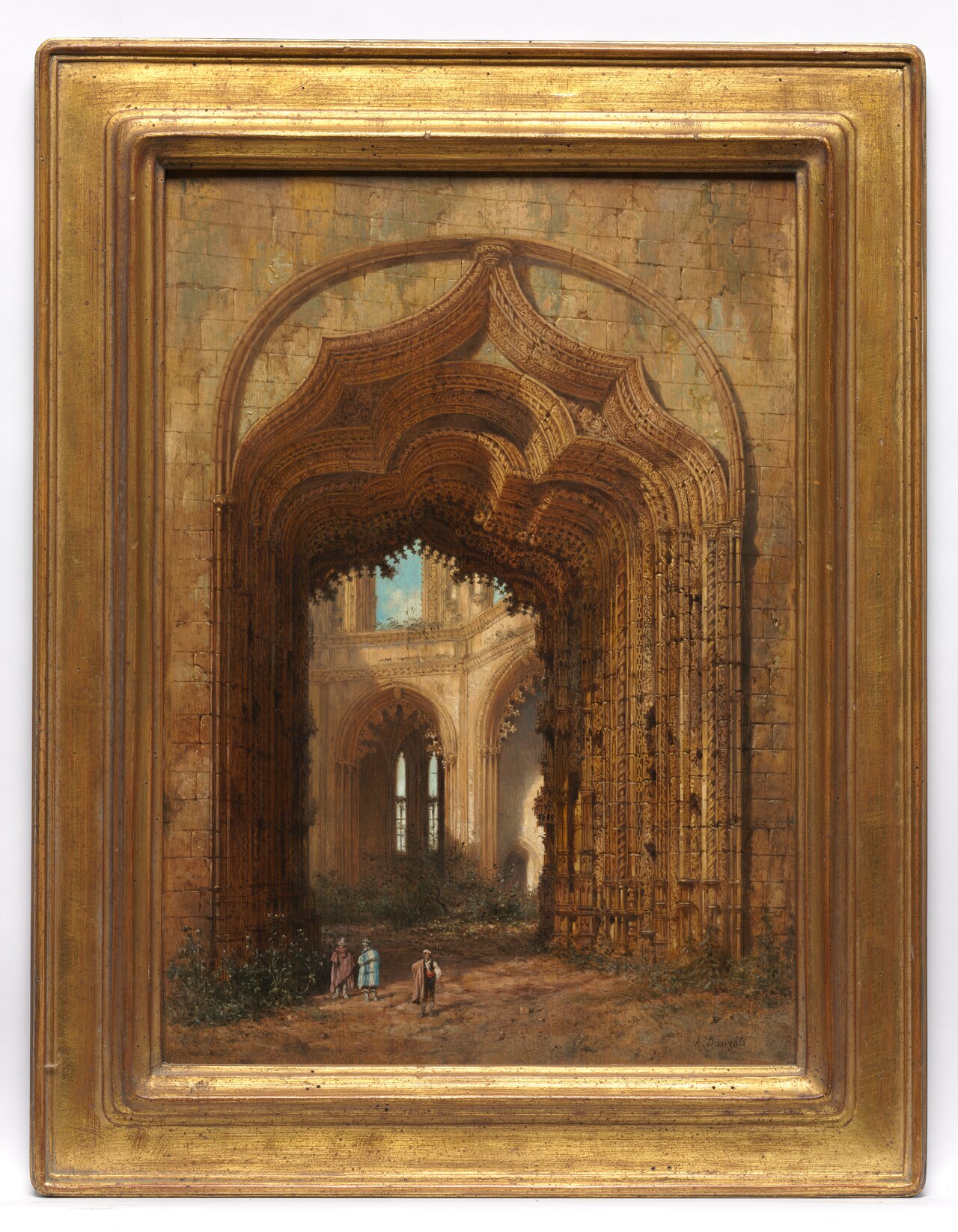
Dauzats is distinguished by several recurring technical choices. First, he employed a tight underdrawing, often executed in charcoal or fine graphite, to establish architectural forms before applying pigment. This preparatory stage allowed him to render intricate details such as the ornate arches of a Moorish gate or the weathered stone of a ruined chapel. Second, his handling of light was characterised by a warm, diffused glow that bathes the foreground while retaining subtle tonal contrasts in the distance. He achieved this effect through layered glazes of ochre, sienna and ultramarine, which gave his scenes a sense of depth without sacrificing clarity. Finally, Dauzats frequently incorporated figures in modest attire, not as the primary focus but as compositional anchors that convey scale and human presence within vast architectural settings.
Major works
- The Giralda, Seville (1836) – This oil painting captures the iconic bell tower of Seville’s cathedral from a low viewpoint, emphasising its soaring verticality against a bright sky. Dauzats rendered the intricate Moorish details with exacting precision, while the surrounding plaza is suffused with a golden light that hints at the city’s historic synthesis of Christian and Islamic cultures.
- Ruined Church (1840) – In this work the artist depicts a decaying ecclesiastical structure, its cracked walls and collapsed roof suggesting the passage of time. The composition balances ruin with nature, as vines and foliage reclaim the stone, a motif common in Romantic landscape painting that underscores the transience of human endeavour.
- Puits du Chateau de Nantes, Bretagne (1846) – This piece illustrates a well‑head within the ruins of a Breton chateau. The crisp rendering of the stonework and the reflective surface of the water demonstrate Dauzats’s skill in capturing both texture and atmosphere. The work reflects his continued interest in historic architecture, even when the setting is not overtly Oriental.
- Mt. Sinai – Though undated, this painting portrays the biblical mountain as a dramatic silhouette against a sunrise‑tinged sky. The composition conveys both the spiritual significance of the site and the stark, rugged terrain of the Sinai Peninsula. Dauzats’s use of warm reds and purples in the sky highlights his ability to render the dramatic light of desert environments.
These works illustrate Dauzats’s range: from the detailed observation of European historic sites to the evocative imagination of Near‑Eastern landscapes. They also reveal his consistent focus on architecture as a conduit for exploring cultural identity and temporal change.
Influence and legacy
Adrien Dauzats contributed to the visual vocabulary of Orientalism at a time when French audiences were eager for images of distant lands. By collaborating with the travel writer Baron Taylor, he helped shape the public’s perception of the Ottoman world, providing illustrations that blended documentary accuracy with artistic romance. His meticulous architectural renderings set a standard for later Orientalist painters who sought to balance scholarly observation with aesthetic appeal.
While not as widely known today as some of his contemporaries, Dauzats’s works remain valuable to scholars of 19th‑century French art. They serve as primary visual sources for the study of historic preservation, as his depictions often capture structures that have since been altered or lost. Moreover, his paintings are held in several French regional museums, where they continue to be exhibited alongside other Orientalist masters, underscoring his role in the broader narrative of French artistic engagement with the East.
In contemporary art history, Dauzats is recognised for his disciplined approach to landscape and architectural painting, his contribution to travel literature, and his ability to convey the atmospheric qualities of both European and Oriental settings. His legacy persists in the way modern curators and scholars interpret the cross‑cultural dialogues embedded in 19th‑century visual culture.
Frequently asked questions
Who was Adrien Dauzats?
Adrien Dauzats (1804–1868) was a French painter from Bordeaux who specialised in landscapes, genre scenes, and Oriental subjects, travelling widely in the Ottoman Empire and illustrating travel books for Baron Taylor.
What artistic style or movement is he associated with?
He is closely linked to Orientalism, a 19th‑century movement that depicted the cultures and architecture of the Near East through a Romantic, often exoticised lens.
What are his most famous works?
His best‑known paintings include The Giralda, Seville (1836), Ruined Church (1840), Puits du Chateau de Nantes, Bretagne (1846) and a depiction of Mt. Sinai.
Why is Adrien Dauzats important in art history?
Dauzats helped shape European visual knowledge of the Ottoman world, combining accurate architectural detail with atmospheric artistry, and his works provide valuable historical records of sites that have since changed.
How can I recognise an Adrien Dauzats painting?
Look for precise architectural lines, a warm, diffused light, modestly dressed figures used for scale, and a focus on historic or exotic settings rendered with meticulous detail.