Adriaan Jozef Heymans
1839 – 1921
In short
Adriaan Jozef Heymans (1839–1921) was a Belgian landscape painter associated with the Barbizon school and impressionist tendencies. He is noted for his atmospheric depictions of rural scenes, such as "Sunset on the Heath" and "Woodland near Bertogne".
Notable works
.jpg)
Early life Adriaan Jozef Heymans was born in 1839 in the bustling port city of Antwerp, Belgium. Little is recorded about his family background, but contemporary accounts suggest that he was exposed to artistic influences at an early age, likely through the city's vibrant trade and cultural connections. He pursued formal training at the Royal Academy of Fine Arts in Antwerp, where he received instruction in drawing, composition, and the fundamentals of painting. The academy's emphasis on academic rigour provided Heymann a solid technical foundation, while the growing interest in naturalistic representation among his peers sparked his curiosity about painting directly from life.
Career and style After completing his studies, Heymans moved to Brussels, the political and artistic centre of Belgium. The capital offered a dynamic environment where emerging ideas about light, colour, and atmosphere were being debated. It was here that Heymans encountered the work of French painters linked to the Barbizon school, whose emphasis on painting outdoors and capturing the fleeting qualities of nature resonated with his own sensibilities. Over the 1860s and 1870s he increasingly embraced plein‑air techniques, producing landscapes that combined the realism of the Barbizon tradition with the lighter touch of impressionism.
Heymans' style is characterised by a restrained palette dominated by earthy greens, muted blues, and warm ochres, punctuated by occasional bursts of brighter hue to convey the play of sunlight on foliage or water. His compositions often feature a quiet, intimate perspective, inviting the viewer into the scene rather than presenting a grandiose panorama. The artist's allegiance to the Barbizon ethos—faithful observation of nature, modest subject matter, and a focus on mood—remains evident throughout his oeuvre, even as he incorporated the looser brushwork and colouristic concerns of the later Impressionists.
Signature techniques Heymans employed several technical approaches that distinguish his work. He preferred a thin, semi‑transparent application of paint, allowing underlying tones to shimmer through and contribute to the overall luminosity. This glazing technique, combined with a careful modulation of value, creates a subtle depth that suggests atmospheric perspective. His brushstrokes are generally short and directional, often following the contours of foliage or the grain of tree trunks, which imparts a tactile quality to the surface.
Light is a central preoccupation: Heymans frequently painted at dawn or dusk, when the sky's colour is soft and the landscape is bathed in a diffused glow. In such conditions he rendered shadows not as deep black but as cool extensions of the surrounding tones, reinforcing the sense of a cohesive, natural environment. Additionally, he occasionally used a limited palette of earth pigments mixed with a touch of cadmium yellow or vermilion to achieve the warm highlights that enliven his scenes.
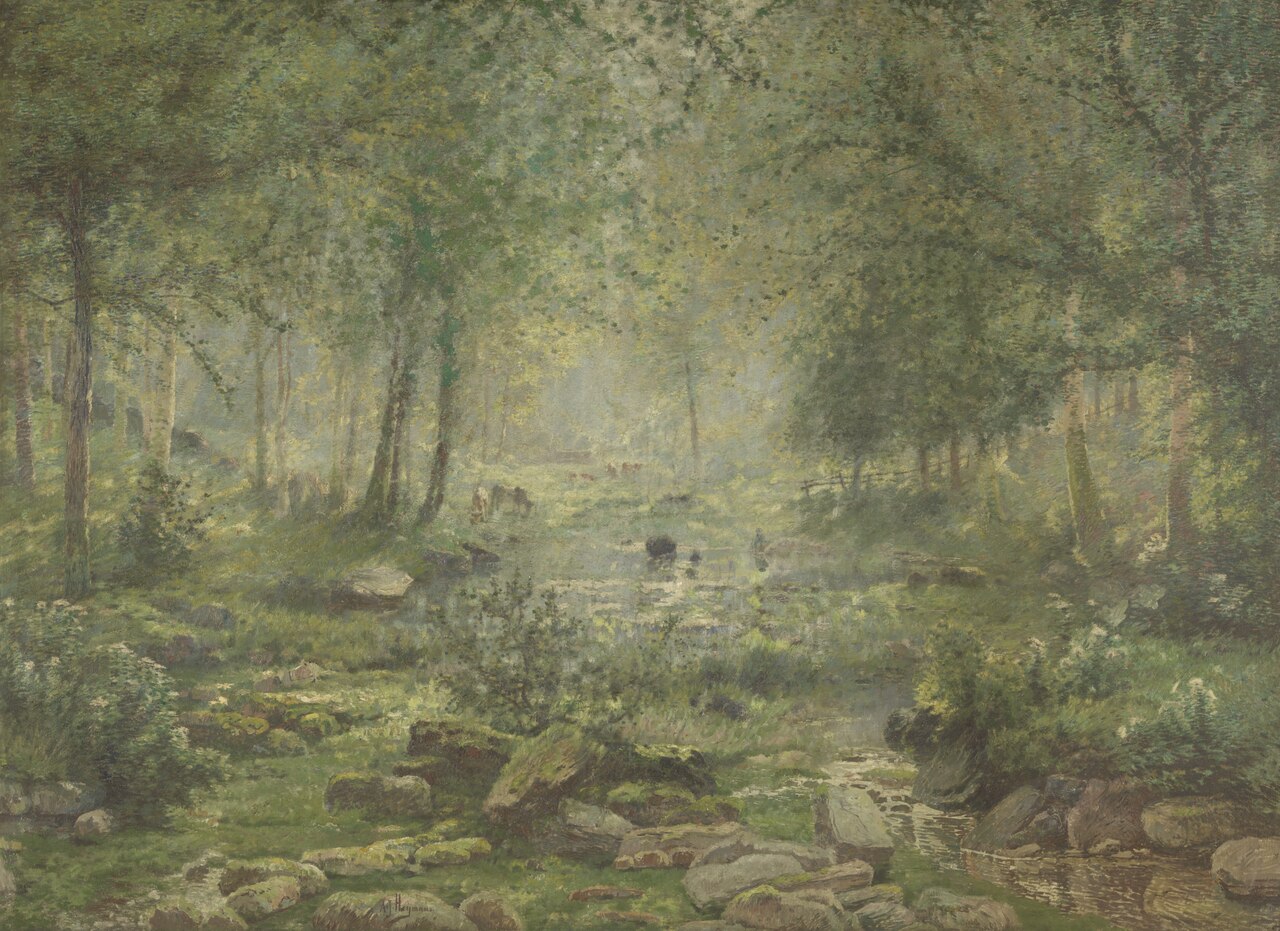
Major works Heymans' most celebrated paintings demonstrate his command of mood and his ability to render specific locales with emotive clarity. "Sunset on the Heath" (1877) captures a low‑lying heath bathed in the amber light of evening; the sky is rendered in soft pinks and golds, while the foreground grasses are hinted at with delicate, feather‑like strokes. "Woodland near Bertogne" (1875) portrays a dense forest scene near the village of Bertogne, where shafts of light filter through the canopy, creating a pattern of bright spots on the forest floor. The work exemplifies his skill in balancing dark understory with luminous highlights.
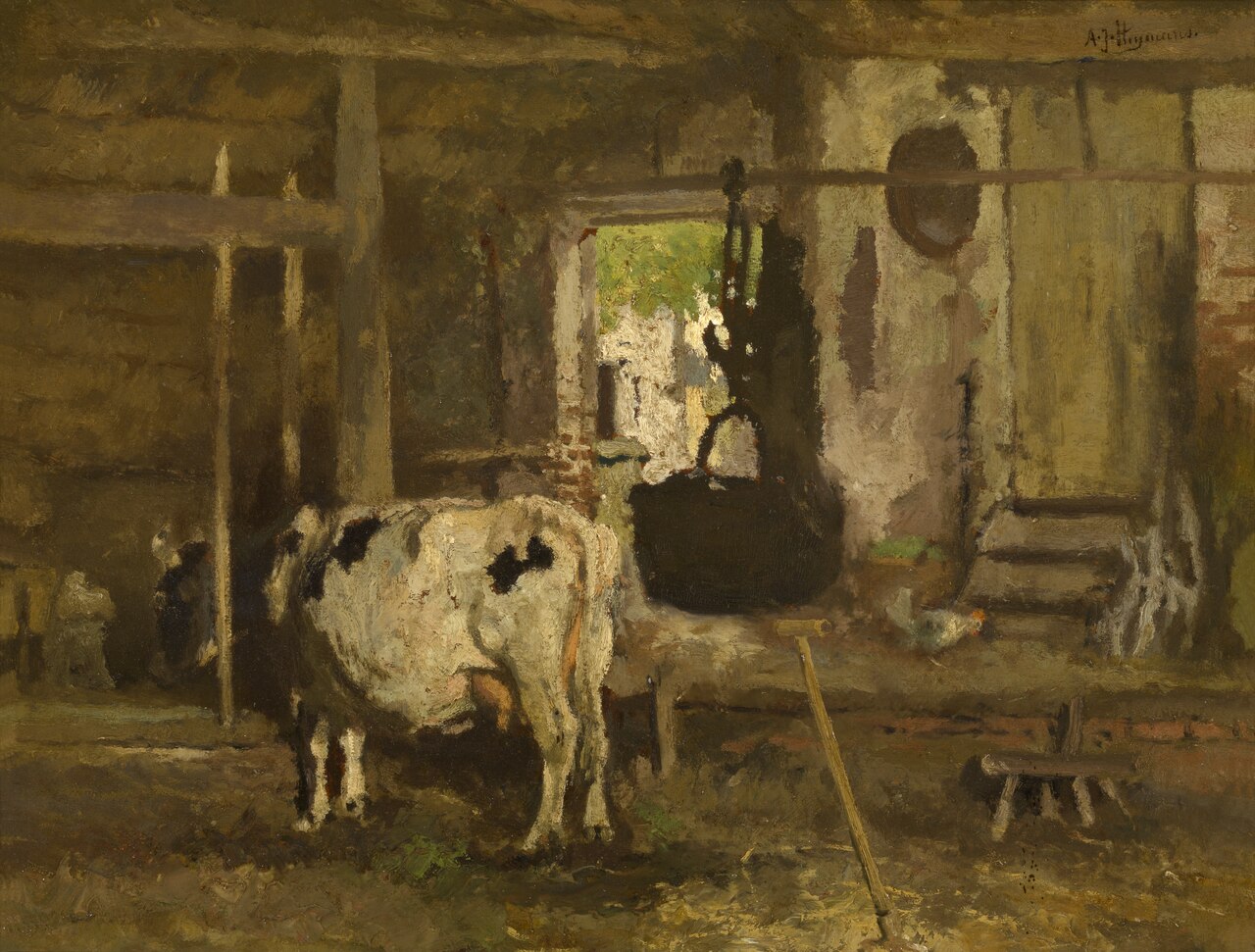
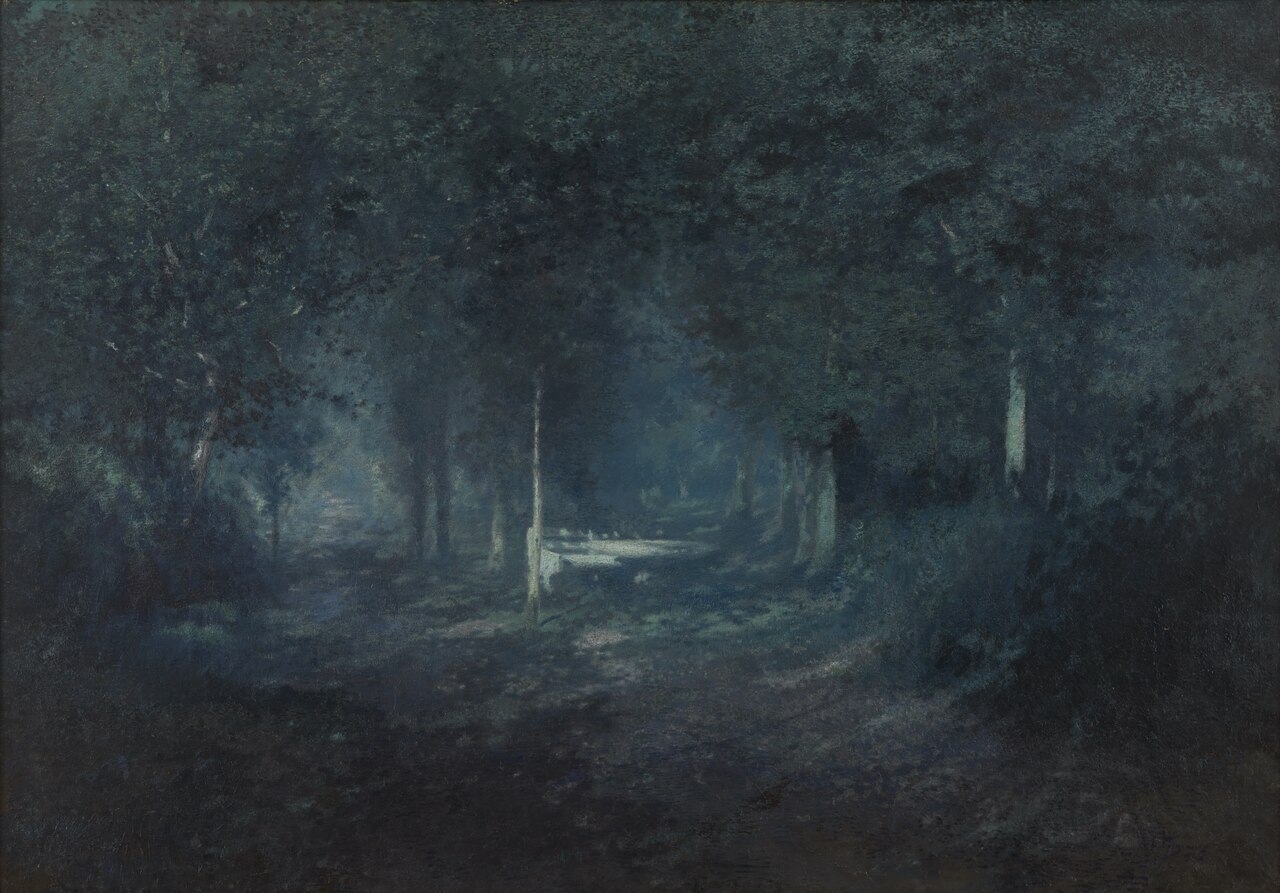
In "Stable Interior", Heymans turns his attention to a man‑made environment, depicting the quiet interior of a rural stable. The composition is anchored by wooden beams and the muted tones of hay, while a sliver of daylight entering through a door window provides a subtle contrast that emphasizes the calm atmosphere. "Wood by Moonlight" showcases his fascination with nocturnal light; the moon casts a silvery sheen over a stand of trees, and Heymans renders the scene with a restrained palette of blues and greys, punctuated by the faint reflected glow on the trunks.
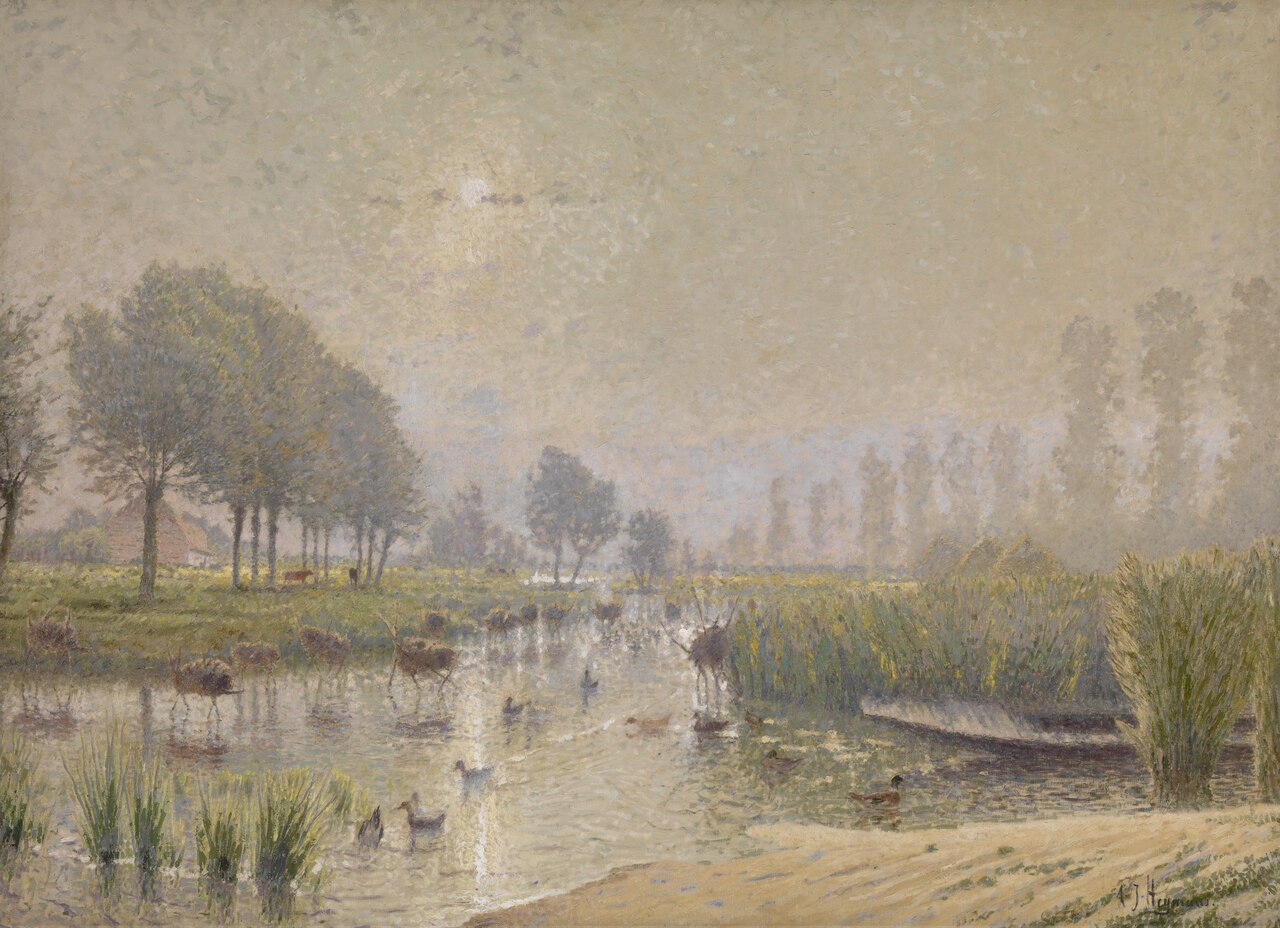
Finally, "Duck Nests in the Reed" presents a tranquil wetland scene where water‑fowl nest among reeds. The painting's surface is textured with short, stippled strokes that suggest the movement of reeds in the breeze, while the muted green‑brown tones convey the marsh's damp, earthy quality. Together, these works illustrate Heymans' consistent interest in rural subjects and his ability to convey atmosphere through colour, light, and brushwork.
Influence and legacy Adriaan Jozef Heymans occupied a pivotal position in the development of Belgian landscape painting at the turn of the twentieth century. By integrating the observational rigour of the Barbizon school with the emerging impressionist concern for fleeting light effects, he helped to broaden the visual language available to Belgian artists. He participated in several artists' societies in Brussels, where he exchanged ideas with contemporaries and mentored younger painters interested in plein air techniques.
After his death in Schaerbeek in 1921, Heymans' paintings continued to be exhibited in Belgian museums and private collections. His works are now part of the permanent holdings of institutions such as the Royal Museums of Fine Arts of Belgium, where they are cited as exemplars of the transition from academic realism to modernist landscape painting. Art historians view Heymans as a bridge figure who contributed to the gradual acceptance of impressionist aesthetics in Belgium, and his paintings remain a reference point for scholars studying the diffusion of Barbizon ideas north of the Alps.
In recent decades, renewed scholarly interest in lesser‑known Impressionist figures has led to a reassessment of Heymans' contribution. Exhibitions and publications have highlighted his nuanced handling of light and his subtle colour harmonies, confirming his status as an artist of quiet but enduring significance within the broader narrative of European art history.
Frequently asked questions
Who was Adriaan Jozef Heymans?
He was a Belgian landscape painter (1839–1921) known for his impressionist‑leaning works linked to the Barbizon school.
What style or movement is Heymans associated with?
Heymans is associated with the Barbizon school and is recognised for incorporating impressionist techniques in his rural scenes.
What are his most famous works?
His most noted paintings include "Sunset on the Heath" (1877), "Woodland near Bertogne" (1875), "Stable Interior", "Wood by Moonlight" and "Duck Nests in the Reed".
Why does Heymans matter in art history?
He helped bridge academic realism and modernist landscape painting in Belgium, influencing later artists and expanding the use of light and colour in northern European art.
How can I recognise a painting by Heymans?
Look for quiet rural subjects, a restrained earthy palette, soft atmospheric light, and short, directional brushstrokes that suggest foliage or water.