Adolphe Appian
1818 – 1898
In short
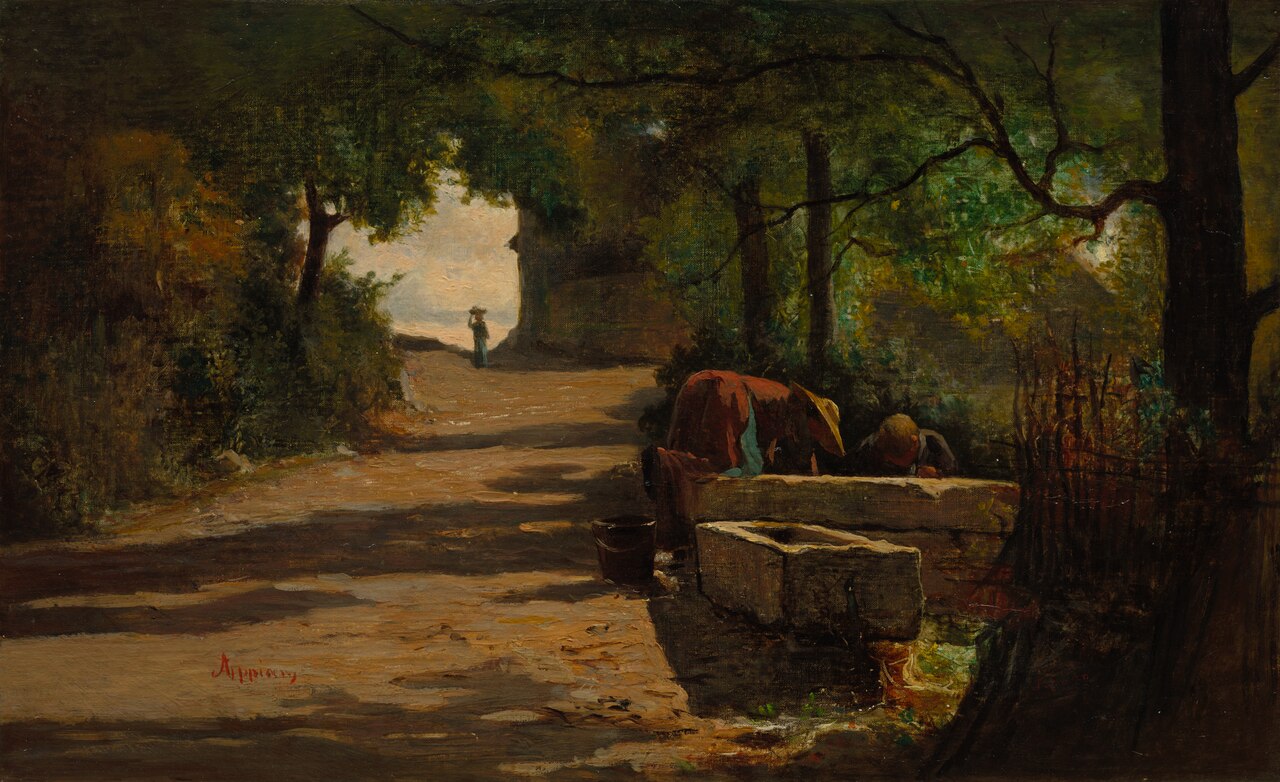
Adolphe Appian (1818–1898) was a French landscape painter and etcher associated with the Barbizon school. Born and died in Lyon, he is noted for his atmospheric rural scenes and occasional maritime subjects, such as "Well at the Side of a Road" (1864) and "The Port of Monaco" (1873).
Notable works


Early life Adolphe Appian was born in 1818 in Lyon, a city with a long tradition of artistic production. Little is recorded about his family background, but the cultural environment of Lyon in the early nineteenth century offered ample exposure to drawing academies and the burgeoning French art market. Appian received his initial training locally, where he developed a solid grounding in drawing and the fundamentals of composition. His early years coincided with the rise of Romanticism, yet he gravitated toward the more naturalistic approach that would later define the Barbizon school. By his early twenties, Appian was already exhibiting small works in regional salons, demonstrating a keen interest in capturing the French countryside.
Career and style Appian’s professional career unfolded primarily in the 1840s and 1850s, a period when the Barbizon painters were reshaping French landscape art. He embraced the school’s emphasis on direct observation, painting en plein air to record the transient effects of light and atmosphere. While his peers such as Théodore Rousseau and Jean‑François Millet focused on dramatic narratives, Appian tended toward quieter scenes, often depicting solitary trees, calm waters, and modest rural structures. His palette was restrained, favouring earth tones, muted greens, and soft blues that conveyed a sense of serenity rather than theatrical contrast. Throughout his career, Appian also worked as an etcher, translating his painterly sensibility into monochrome prints that retained the same lyrical quality.
Signature techniques Appian’s technique combined careful draftsmanship with a sensitive handling of tone. In oil, he layered thin glazes to build depth, allowing underlying colours to shine through and creating a luminous surface. His brushwork was economical; broad, softened strokes suggested foliage and water while finer lines defined structural elements such as the trunks of trees or the outlines of distant hills. In his etchings, Appian employed a delicate line, often using cross‑hatching to suggest atmospheric perspective. He favoured a restrained compositional balance, frequently placing a single focal point—such as a well, a tree, or a lone fisherman—against a broader, muted background. This approach gave his works an intimate, contemplative mood that distinguished them from the more overtly dramatic landscapes of his contemporaries.
Major works Appian’s oeuvre includes several works that have become reference points for his style. "Well at the Side of a Road" (1864) captures a rustic well framed by overgrown vegetation, the composition bathed in soft, diffused light that underscores the tranquility of a rural path. "A Woodland River with a Fisherman" presents a solitary figure casting a line against a backdrop of dense woodland, the water rendered with subtle ripples that reflect the surrounding foliage. "The Port of Monaco" (1873) marks a departure toward maritime subject matter; here Appian depicts the bustling harbour with a muted palette, focusing on the interplay of sky and sea rather than bustling activity. "A Great Beech Tree at the Edge of a Wood" (1840) showcases his early fascination with solitary trees, the massive trunk dominating the canvas while the surrounding forest recedes into gentle haze. Finally, "A Rider by a Mountain Pond at Sunset" (1870) blends figure and landscape, portraying a lone rider silhouetted against a glowing pond, the sunset sky rendered in warm amber tones that highlight Appian’s skill in capturing fleeting light. Each of these works exemplifies his commitment to naturalism, his restrained palette, and his ability to evoke mood through subtle compositional choices.
Influence and legacy Although not as widely celebrated as some of his Barbizon peers, Appian contributed significantly to the development of French landscape painting in the second half of the nineteenth century. His emphasis on quiet, contemplative scenes helped broaden the thematic range of the Barbizon school, showing that rural landscapes could be both modest and emotionally resonant. As an etcher, he also influenced younger printmakers who sought to translate painterly effects into monochrome media. Appian’s works continued to be exhibited in French salons well into the 1880s, and his paintings entered several public collections, ensuring that his contribution remained visible to successive generations. Modern scholarship recognises him as a bridge between the early Romantic landscape tradition and the later Impressionist focus on light, positioning him as a valuable, if understated, figure in the narrative of nineteenth‑century French art.
Frequently asked questions
Who was Adolphe Appian?
Adolphe Appian (1818–1898) was a French landscape painter and etcher associated with the Barbizon school, known for his tranquil rural scenes.
What style or movement did he belong to?
He worked within the Barbizon school, favouring naturalistic, plein‑air landscapes that emphasized atmosphere and modest rural subjects.
What are his most famous works?
Key works include "Well at the Side of a Road" (1864), "A Woodland River with a Fisherman", "The Port of Monaco" (1873), "A Great Beech Tree at the Edge of a Wood" (1840) and "A Rider by a Mountain Pond at Sunset" (1870).
Why does Appian matter in art history?
He broadened the thematic scope of the Barbizon school with quieter, contemplative scenes and helped bridge Romantic landscape painting to later Impressionist concerns with light.
How can I recognise an Appian painting?
Look for a restrained palette of earth tones, a focus on solitary natural elements (like a single tree or well), soft atmospheric light, and a calm, balanced composition.