William Degouve de Nuncques
1867 – 1935
In short
William Degouve de Nuncques (1867–1935) was a Belgian painter associated with Symbolism, renowned for his nocturnal landscapes that blend mysterious atmosphere with visionary ambience. His work bridges late 19th‑century Symbolist aesthetics and early 20th‑century modernist tendencies.
Notable works

,_oil_on_canvas,_98_x_119_cm.,_Kr%C3%B6ller-M%C3%BCller_Museum,_Otterlo.jpg)
Early life William Degouve de Nuncques was born in 1867 in Monthermé, a small town on the Belgian‑French border. Little is recorded about his family background, but the region’s wooded valleys and riverine scenery left a lasting impression on his visual sensibility. He received his initial artistic training locally before moving to larger cultural centres where he encountered the burgeoning Symbolist circle.
Career and style Degouve de Nuncques began exhibiting in the 1890s, aligning himself with the Symbolist movement that prized emotion, myth, and the evocation of inner states over strict naturalistic representation. While his early canvases retain a post‑Impressionist vigor, by the turn of the century his style had crystallised around night‑time subjects. He favoured a muted, often monochromatic palette punctuated by luminous points of colour, creating an uncanny sense of stillness. The artist’s canvases frequently depict solitary figures, deserted roads, or quiet villages under moonlight, inviting viewers to contemplate the boundary between reality and imagination.
Signature techniques Degouve de Nuncques employed several techniques that became hallmarks of his oeuvre: - **Atmospheric light** – He rendered moonlight and artificial illumination with soft, diffused edges, allowing light to appear as a palpable, almost tactile presence. - **Limited colour range** – A restrained palette of blues, greys, and ochres dominates his nocturnal scenes, punctuated by occasional warm highlights that draw the eye. - **Deliberate brushwork** – Broad, smooth strokes convey the smoothness of night‑sky surfaces, while finer, directional brushwork suggests the texture of snow, foliage, or distant architecture. - **Composition of depth** – Degouve de Nuncques often placed a solitary element—such as a carriage, a lone figure, or a tree—in the foreground, leading the viewer’s gaze into a receding landscape that fades into darkness.
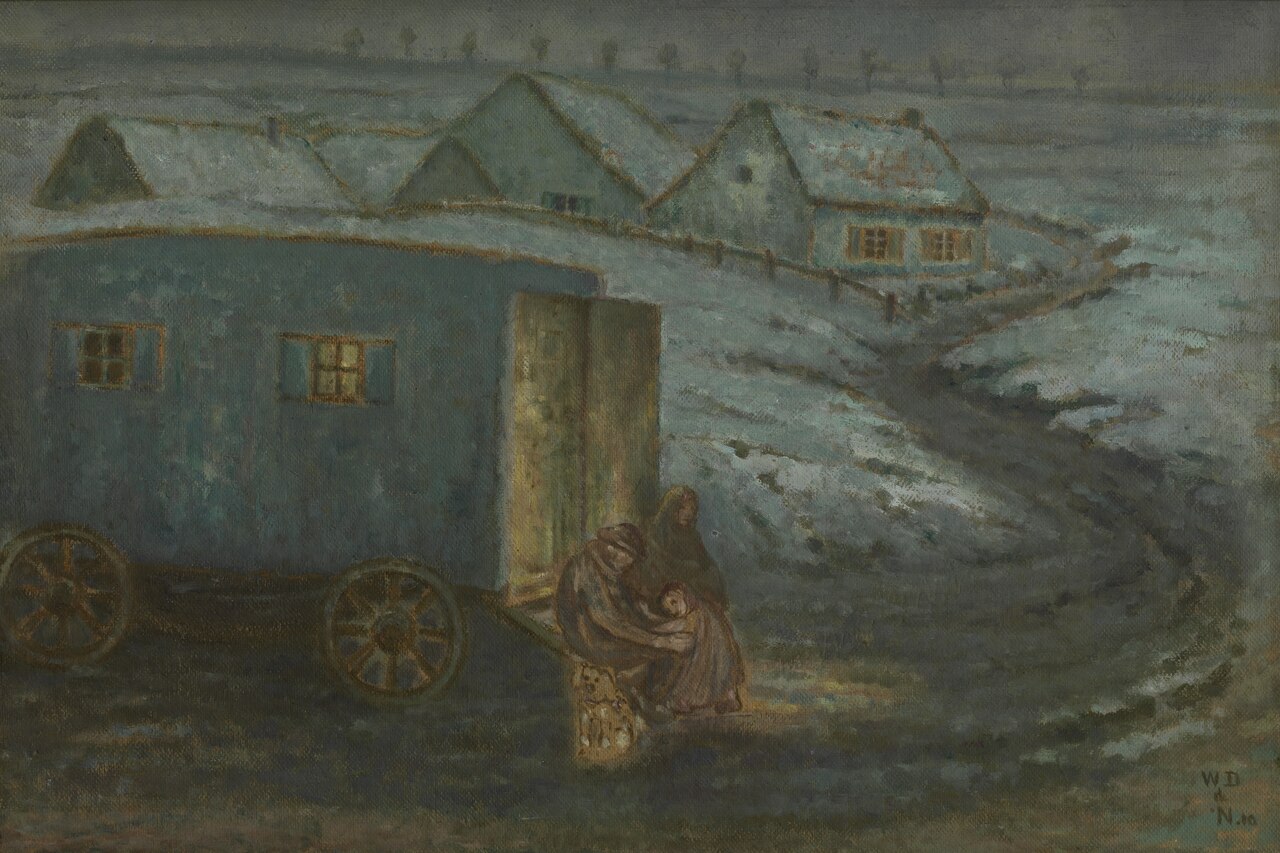
Major works - **Almond trees, Balearic (1902)** – This early work, though not a night scene, demonstrates his fascination with light and form. The almond trees are rendered with a delicate balance of shadow and sun, hinting at the atmospheric concerns that would later dominate his nightscapes. - **The Caravan (1910)** – A quintessential nocturnal composition, the painting portrays a caravan of horses and travelers moving through a moon‑lit plain. The muted tones and the faint glow of lanterns accentuate the sense of isolation and the timeless quality of travel. - **Hamlet in the Snow (1911)** – Perhaps his most celebrated piece, it shows a small hamlet buried beneath fresh snow under a silvery sky. The subdued palette and the soft, almost ethereal quality of the snow convey a quiet, contemplative mood that epitomises Degouve de Nuncques’s Symbolist vision.
Influence and legacy Degouve de Nuncques occupies a distinctive niche in early‑20th‑century art. His nocturnal landscapes influenced younger Symbolist and early modernist painters who sought to capture mood rather than precise detail. Though his overt Symbolist language waned after 1900, the atmospheric techniques he refined continued to resonate in later movements, including the early phases of Surrealism, where night and dream‑like settings became central motifs. Today his works are held in major European collections and continue to be cited in scholarly discussions of Symbolism’s transition into modernist abstraction.
Frequently asked questions
Who was William Degouve de Nuncques?
He was a Belgian painter (1867–1935) linked to Symbolism, best known for atmospheric nocturnal landscapes.
What artistic movement is he associated with?
Degouve de Nuncques is primarily associated with Symbolism, though his early work also shows post‑Impressionist influences.
What are his most famous works?
His most renowned paintings include The Caravan (1910), Almond trees, Balearic (1902), and Hamlet in the Snow (1911).
Why does Degouve de Nuncques matter in art history?
He pioneered a distinctive nocturnal ambience that bridged Symbolist mysticism and early modernist concerns, influencing later artists who explored mood and dream‑like imagery.
How can I recognise a Degouve de Nuncques painting?
Look for night‑time scenes with a limited, muted palette, soft diffused light, solitary figures or structures, and a serene, almost otherworldly atmosphere.