Victoria Dubourg
1840 – 1926
Notable works

_-_Flowers_-_Google_Art_Project.jpg)
_-_Roses_-_GLAHA-43525_-_Hunterian_Museum_and_Art_Gallery.jpg)

Early life Victoria Dubourg was born in Paris in 1840, a time when the city was emerging as a global centre of artistic innovation. Details of her family background are scarce, but contemporary records indicate that she grew up amid the vibrant cultural milieu of mid‑nineteenth‑century France. The Parisian art world, dominated by the École des Beaux‑Arts and the burgeoning Salon system, provided early exposure to academic training and the growing interest in naturalistic subjects. Dubourg’s formative years coincided with the rise of Realism, which would later inform her meticulous approach to still‑life painting.
Career and style Dubourg began her professional career in the 1860s, initially focusing on portraiture. Her portraits are characterised by a restrained palette, careful modelling of flesh tones, and an emphasis on psychological presence rather than overt theatricality. As the Impressionist movement gathered momentum in the 1870s, Dubourg remained outside its core group, yet she absorbed the period’s fascination with light and colour. Her still‑life works, produced primarily from the 1880s onward, display a synthesis of academic precision and the looser brushwork associated with Impressionism. While she never formally aligned herself with a specific movement, her oeuvre reflects the broader Belle Époque fascination with beauty, nature, and domestic elegance.
Dubourg’s subjects often centre on flowers, fruit, and porcelain vessels, rendered with an almost photographic attention to detail. The compositional balance in her paintings demonstrates an understanding of classical principles, while the subtle modulation of light suggests an awareness of contemporary developments in colour theory. Her work was regularly exhibited at Parisian Salons, where it attracted favourable reviews for its technical mastery and lyrical sensibility.
Signature techniques Dubourg’s technique is distinguished by several recurring methods:
1. Layered glazing – She built depth by applying thin, translucent layers of oil, allowing underlying colours to shine through and creating a luminous surface. 2. Controlled brushwork – In the rendering of petals and delicate objects, she employed fine, almost invisible strokes, contrasting with broader passages used for background foliage or drapery. 3. Colour harmony – A muted, pastel palette predominates, often centred on soft greens, pinks, and creams, which she balanced with occasional accents of saturated reds or blues to draw the eye. 4. Meticulous detailing of textures – Whether depicting the translucency of a rose petal, the glossy sheen of porcelain, or the fuzz of a hydrangea, Dubourg achieved convincing texture through careful observation and precise rendering. 5. Subtle chiaroscuro – Light is used to model forms without harsh shadows, giving her subjects a gentle, three‑dimensional presence.
These techniques collectively contribute to a serene, almost contemplative atmosphere that defines much of her still‑life output.
Major works Dubourg’s most frequently cited pieces illustrate the evolution of her style and thematic interests.
- A Basket of Flowers (1900) – This composition presents a loosely arranged bouquet within a wicker basket, set against a muted background. The work showcases her mature glazing technique, with delicate petals rendered in soft pinks and whites, while the basket’s texture is conveyed through subtle cross‑hatching.
- Flowers – Though the exact date is unclear, this painting exemplifies Dubourg’s fascination with botanical subjects. The floral arrangement is rendered with a focus on individual bloom structures, each petal receiving careful attention to colour gradation and light.
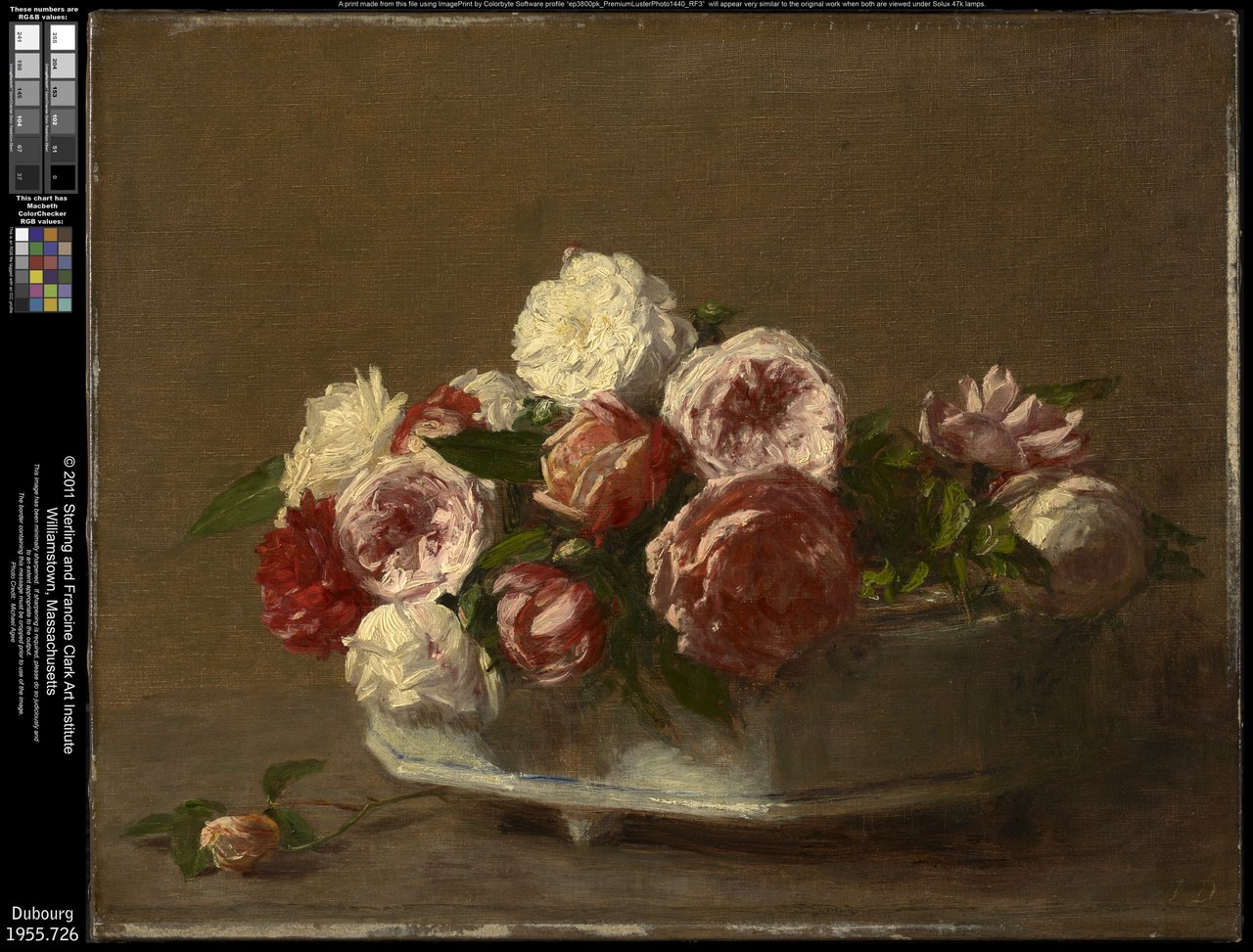
- Roses in a Porcelain Planter – In this piece, the juxtaposition of organic roses against a smooth, glossy ceramic vessel highlights Dubourg’s skill in contrasting textures. The porcelain’s reflective quality is achieved through fine, layered brushstrokes that capture the play of light.
- Roses (1850) – One of her earlier works, *Roses* demonstrates an academic approach to portraiture of flowers, with a tighter compositional structure and a more restrained palette, reflecting the artistic conventions of the mid‑nineteenth century.
- White Hydrangeas – This later work focuses on a cluster of hydrangeas rendered in a palette of whites and pale blues. The subtle tonal variations convey the softness of the blossoms, while the background remains intentionally understated to foreground the flowers.
Each of these works underscores Dubourg’s commitment to rendering natural subjects with both technical exactness and a poetic sensibility, aligning her with the broader aesthetic currents of her era while maintaining a distinctive personal voice.
Influence and legacy Although Victoria Dubourg never achieved the fame of contemporaries such as Monet or Renoir, her contributions to French still‑life painting have been reassessed in recent decades. Scholars note that her meticulous approach provided a counterpoint to the more radical experiments of the Impressionists, preserving a lineage of academic still‑life practice into the twentieth century. Her paintings are held in several French regional museums, where they are valued for their representation of Belle Époque domestic elegance.
Dubourg’s legacy is also evident in the way later women artists navigated the expectations of the French Salon system. By maintaining a professional studio and exhibiting regularly, she demonstrated that a female painter could sustain a career within the prevailing artistic institutions. Contemporary exhibitions that focus on women artists of the nineteenth century often include Dubourg as an exemplar of technical proficiency and quiet innovation.
In the digital age, her works have become part of online art databases and are frequently referenced in discussions of floral still‑life traditions. While she did not found a distinct school, her paintings continue to influence collectors and artists interested in the intersection of academic technique and the softer visual language of the Belle Époque.
Overall, Victoria Dubourg remains a noteworthy figure whose paintings offer insight into the aesthetic values of late nineteenth‑ and early twentieth‑century France, bridging the gap between strict academic realism and the more atmospheric concerns of Impressionism.
Frequently asked questions
Who was Victoria Dubourg?
Victoria Dubourg (1840–1926) was a French painter known for her portrait and still‑life works, active during the Impressionist and Belle Époque periods.
What artistic style or movement is she associated with?
She is not tied to a single movement but blended academic realism with Impressionist‑influenced handling of light and colour, typical of the Belle Époque.
What are her most famous works?
Key works include *A Basket of Flowers* (1900), *Roses in a Porcelain Planter*, *Roses* (1850), *Flowers*, and *White Hydrangeas*.
Why does she matter in art history?
Dubourg exemplifies the high level of technical skill in French still‑life painting and illustrates how women artists sustained professional careers within the Salon system of the nineteenth century.
How can I recognise a Victoria Dubourg painting?
Look for meticulously rendered floral subjects, a muted pastel palette, subtle glazing, and a calm, balanced composition that highlights texture contrast between delicate petals and smooth surfaces such as porcelain.