Victor Vignon
1847 – 1909
In short
Victor Vignon (1847–1909) was a French Impressionist landscape painter and graphic artist, known for his atmospheric rural scenes and participation in the Paris Impressionist Exhibitions of the 1880s.
Notable works
,_1893,_NGA_131728.jpg)

.jpg)
Early life Victor Alfred Paul Vignon was born in 1847 in the small town of Villers‑Cotterêts, located in the Aisne department of northern France. Little is recorded about his family background, but the region’s pastoral scenery left an early imprint on his sensibilities. He received his first artistic instruction locally before moving to Paris, the centre of French artistic life, where he entered the ateliers that were shaping the new generation of painters.
Career and style In Paris, Vignon came under the influence of the emerging Impressionist movement. He was part of the circle that gathered around Claude Monet, Camille Pissarro and Alfred Sisley, sharing their interest in painting en plein air and capturing the fleeting effects of light. Vignon’s work reflects the core tenets of Impressionism: a focus on atmospheric conditions, rapid brushwork, and a palette that favours colour over line. He exhibited regularly at the independent Impressionist exhibitions, taking part in the fifth (1880), sixth (1881), seventh (1882) and eighth (1886) Paris Impressionist Exhibitions. These shows provided him with a platform to present his landscapes alongside those of the movement’s leading figures.
During the 1880s Vignon settled in the suburbs of Paris, where the juxtaposition of urban expansion and remaining countryside offered abundant material for his canvases. He travelled to various rural locales, particularly in the Île‑de‑France region, to paint the fields, villages and seasonal scenes that would become his signature subjects. By the 1890s his reputation as a competent landscape painter had grown, though he never achieved the fame of his more celebrated contemporaries.
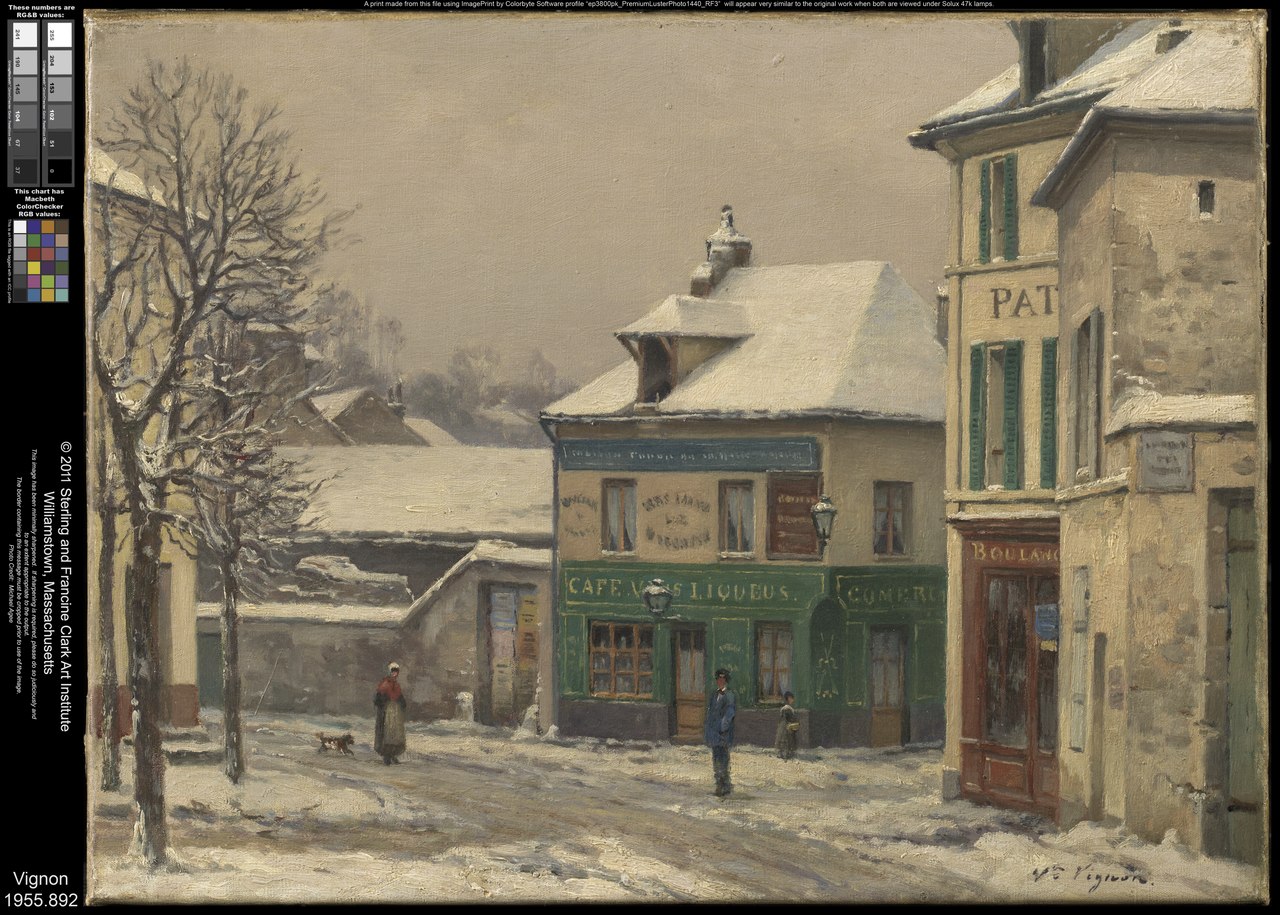
Signature techniques Vignon’s technique is characterised by a light, almost translucent handling of paint. He often applied thin layers of colour to suggest the play of sunlight on foliage, water and earth. His brushstrokes are loose but controlled, allowing the underlying structure of the composition to emerge through the texture of the paint. In works that depict winter or snow, Vignon employed subtle variations of white, grey and muted blues to convey the reflective quality of snow‑covered surfaces.
A distinctive element of his method is the use of atmospheric perspective to create depth. By diminishing colour intensity and sharpening detail in the foreground while allowing distant elements to fade into softer tones, Vignon conveys the sense of space that is a hallmark of Impressionist landscape painting. His graphic work, such as drawings and prints, mirrors this approach, employing fine line and cross‑hatching to suggest texture without sacrificing the overall impression of the scene.
Major works - **The Cow (La Vache) (1893)** – This painting exemplifies Vignon’s late style, with a solitary bovine set against a luminous, open field. The animal is rendered with loose, gestural strokes that capture its form while the surrounding landscape is bathed in warm, late‑summer light. The work demonstrates Vignon’s skill in balancing figurative detail with atmospheric effect. - **Summer Landscape with Haystacks** – In this composition, Vignon portrays a rural tableau of stacked hay against a sun‑drenched horizon. The haystacks are rendered with a muted palette of ochres and siennas, while the sky is depicted in soft blues, illustrating his command of colour harmony. - **Snow Effect in the Suburbs (1880)** – Created early in his career, this piece shows a suburban street blanketed in snow. Vignon uses delicate whites and greys to convey the quiet hush of a wintry scene, and the subtle reflections on the icy ground hint at his interest in the interplay of light and surface. - **Village Entrance** – This work captures the threshold of a small village, with a modest doorway opening onto a path lined by trees. The composition invites the viewer into the scene, and Vignon’s treatment of foliage and sky creates a sense of tranquility and timelessness.
These works collectively illustrate Vignon’s preoccupation with rural France, his ability to render seasonal light, and his adherence to the Impressionist emphasis on momentary perception.
Influence and legacy Although Victor Vignon never attained the household name of Monet or Renoir, his contributions to the Impressionist movement are noteworthy. By consistently exhibiting with the Impressionists, he helped sustain the group’s independent exhibitions, which were crucial for the movement’s development. His landscapes, characterised by their calm observation of nature, influenced a number of younger French painters who sought to depict the French countryside with sincerity and subtlety.
In the decades following his death in 1909 at Meulan‑en‑Yvelines, Vignon’s paintings have been acquired by regional museums and private collections, where they are valued for their authentic representation of late‑19th‑century rural life. Art historians regard his oeuvre as a useful counterpoint to the more flamboyant works of his contemporaries, providing a measured, lyrical perspective on Impressionist landscape painting. Contemporary exhibitions of French Impressionism often include Vignon’s pieces to illustrate the breadth of the movement beyond its most celebrated figures.
Today, Vignon’s work continues to be studied for its technical proficiency and its embodiment of the core Impressionist concern with light, atmosphere and the fleeting moments of everyday life. His paintings serve as a reminder that the movement was a collective endeavour, enriched by the contributions of many artists whose names may not dominate the popular narrative but whose work remains integral to the period’s artistic fabric.
Frequently asked questions
Who was Victor Vignon?
Victor Vignon (1847–1909) was a French Impressionist landscape painter and graphic artist who exhibited regularly in the Paris Impressionist Exhibitions of the 1880s.
What style or movement is he associated with?
He is associated with Impressionism, particularly its focus on plein‑air landscape painting, atmospheric light, and rapid brushwork.
What are his most famous works?
His most recognised works include *The Cow (La Vache)* (1893), *Summer Landscape with Haystacks*, *Snow Effect in the Suburbs* (1880) and *Village Entrance*.
Why does Victor Vignon matter in art history?
Vignon helped sustain the independent Impressionist exhibitions, contributed a measured lyrical perspective to the movement, and influenced later French landscape painters with his nuanced treatment of light and atmosphere.
How can I recognise a Victor Vignon painting?
Look for gentle, translucent brushstrokes, a muted yet harmonious palette, and a focus on rural scenes that capture fleeting light—often featuring calm fields, modest village settings, or subtle winter atmospheres.