Victor Honoré Janssens
1658 – 1736
In short
Victor Honoré Janssens (1658‑1736) was a Flemish painter and tapestry designer from Brussels, noted for religious, mythological and historical canvases and for his service as court painter to Emperor Charles VI in Vienna.
Notable works



Early life Victor Honoré Janssens was born in 1658 in Brussels, a city that lay within the Habsburg Netherlands. His family was part of the local artisan class, and he received his initial artistic training in the workshops of the capital, where the strong tradition of Flemish Baroque painting was still flourishing. The early years of his education would have involved copying the works of the great Antwerp masters, mastering drawing, and learning the technical foundations of oil painting and tapestry design. Brussels at this time was a cultural crossroads, exposing Janssens to both the lingering influence of Rubens and the emerging classicising tendencies that would shape his later style.
Career and style After completing his apprenticeship, Janssens embarked on a peripatetic career that took him to several European courts. He spent time in Germany and Italy, where exposure to Italian classicism and the courtly taste for grand historical subjects broadened his artistic outlook. By the early 1700s he had secured a position as court painter to Emperor Charles VI in Vienna, a role that placed him at the centre of imperial patronage and required the production of both large‑scale canvases and decorative tapestries. Janssens also worked in London, where the demand for mythological subjects among aristocratic collectors was high. His style can be described as a late Baroque synthesis: vigorous composition and rich colour typical of Flemish painting combined with a more restrained, classical handling of figure and architecture. This blend gave his works a dignified grandeur while retaining the dynamism that characterised the period.
Signature techniques Janssens favoured a luminous palette, often employing warm ochres, deep reds and subtle blues to model flesh and drapery. His brushwork was controlled yet expressive; the underlayer of thin glazes created depth, while the final highlights gave his figures a sculptural quality. In his tapestry designs, he translated the painterly effects of oil onto woven media by using intricate hatching and a careful arrangement of colour blocks, ensuring that the narrative clarity of his compositions survived the reduction in detail inherent to tapestry. A recurring compositional device was the use of architectural arches or natural rock formations to frame the central action, guiding the viewer’s eye toward the focal point. His figures display a measured idealisation, with proportion informed by classical sculpture rather than the exaggerated dynamism of earlier Baroque.
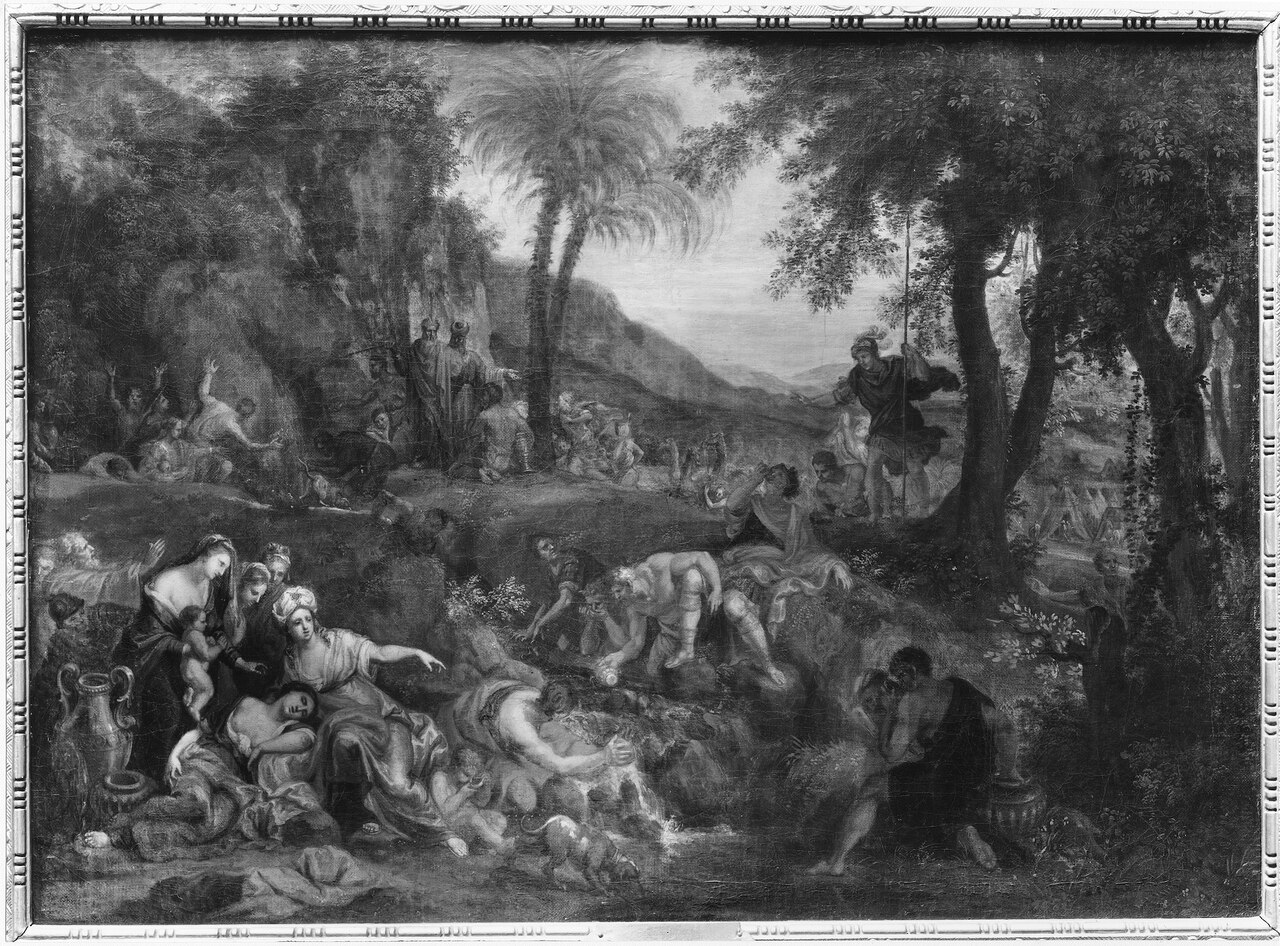
Major works Among Janssens' most documented paintings are several dated 1704, a year that marks a productive period in his Vienna tenure. *The Death of Caesar* presents the Roman dictator in a dramatic, yet orderly tableau, with a carefully staged crowd that reflects both historical gravitas and the artist’s interest in moralising themes. *Landscape with Messalina's Wedding* juxtaposes a sumptuous court scene with a sweeping natural backdrop, illustrating his skill at integrating figural narrative within an expansive setting. *Venus Weeping over the Slain Adonis* captures the tender sorrow of the goddess, employing soft lighting to accentuate the melancholy atmosphere. *Landscape with Sacrifice to Diana* again demonstrates his facility with combining mythological ritual and landscape, using the forest as a sacred space. The work *Moses Striking the Rock*—though undated—exemplifies his biblical repertoire, portraying the biblical miracle with a clear, didactic composition that would have appealed to ecclesiastical patrons. Across these pieces, Janssens consistently balances narrative clarity with a refined aesthetic, making each painting both an instructive tableau and a decorative object for elite interiors.
Influence and legacy Victor Honoré Janssens occupies a distinctive niche in the transition from high Baroque to the more restrained classicism that dominated early eighteenth‑century European art. His ability to serve multiple courts and adapt his style to varied patronage helped spread a Flemish visual vocabulary across central Europe. While he never founded a distinct school, his tapestries and canvases influenced younger artists in Vienna and Brussels who sought to combine the vitality of Flemish painting with the compositional order of classical antiquity. Modern scholarship regards Janssens as an example of the itinerant artist whose career reflects the interconnectedness of European artistic networks before the rise of the academy system. His works remain in museum collections and private holdings, valued for their historical narratives, technical finesse, and the glimpse they provide into the cultural exchange of the Habsburg realm.
Frequently asked questions
Who was Victor Honoré Janssens?
Victor Honoré Janssens was a Flemish painter and tapestry designer (1658‑1736) from Brussels, known for religious, mythological and historical works and for serving as court painter to Emperor Charles VI.
What artistic style or movement is he associated with?
He worked in a late Baroque style that blended Flemish vigor with classical restraint, reflecting the tastes of European courts in the early 18th century.
What are his most famous works?
Key works include *The Death of Caesar* (1704), *Moses Striking the Rock*, *Landscape with Messalina's Wedding* (1704), *Venus Weeping over the Slain Adonis* (1704) and *Landscape with Sacrifice to Diana* (1704).
Why is Janssens important in art history?
He exemplifies the itinerant court artist who helped transmit Flemish Baroque techniques across Europe, and his synthesis of narrative drama with classical composition influenced later Central European painters.
How can I recognise a Janssens painting?
Look for a balanced composition featuring classical architecture or landscape framing, a luminous colour palette, controlled brushwork, and figures rendered with idealised, sculptural proportions.