Valerius de Saedeleer
1867 – 1941
In short
Valerius de Saedeleer (1867–1941) was a Belgian landscape painter associated with Expressionism and the Symbolist‑Mystic tradition. He was a central figure of the first School of Latem, blending 16th‑century Flemish landscape conventions with modernist sensibilities.
Notable works

.jpg)


Early life Valerius de Saedeleer was born in 1867 in the industrial town of Aalst, Belgium. His family was modest but supportive of his artistic interests, and he showed an early aptitude for drawing. After completing primary school, de Saedeleer enrolled at the Royal Academy of Fine Arts in Brussels, where he received formal training in drawing and painting. The academy’s curriculum emphasized classical techniques, but his exposure to the burgeoning Symbolist movement began to shape his aesthetic sensibilities. By the early 1890s he had developed a fascination with the Flemish countryside, a theme that would dominate his later work.
Career and style In the first decade of the 20th century de Saedeleer joined a community of artists in the village of Sint‑Martens‑Latem, often referred to as the first School of Latem. This group, which included figures such as Albert Servaes and Gustave van de Woestijne, sought to renew Belgian art by integrating Symbolist spirituality with the emerging currents of modernism. De Saedeleer’s style evolved from a detailed, academic approach to a more lyrical, expressionist language. His landscapes convey a contemplative mood, reflecting a mystic‑religious sensitivity that draws on the atmospheric qualities of early Flemish masters while employing a simplified, modern palette.
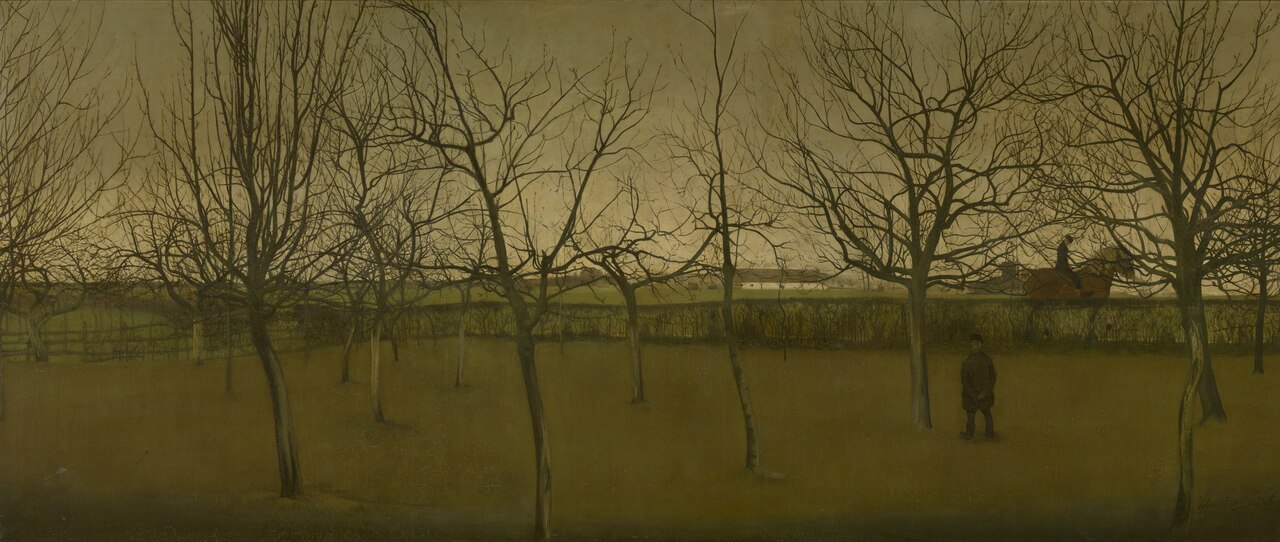
Signature techniques De Saedeleer’s paintings are characterised by a restrained colour scheme, dominated by muted earth tones, greys and cold blues. He often employed a low‑key palette to evoke the quietude of winter or twilight, allowing subtle variations in tone to suggest depth. His compositions are typically broad and panoramic, with a strong horizontal emphasis that mirrors the flatness of the Flemish terrain. Brushwork is generally smooth and controlled, favouring seamless transitions over visible strokes, yet occasional broader passages hint at the underlying emotional intensity. Light is rendered in a diffused manner, creating an almost ethereal glow that unifies sky and ground.
Major works - **Snow in Flanders (1928)** – This late masterpiece captures a barren, snow‑covered field under a pale sky. The work exemplifies de Saedeleer’s mastery of tonal harmony, with the white of the snow balanced against the dark outlines of distant trees and the muted horizon. - **A Farm in a Valley (1916)** – Painted during World War I, the piece portrays a solitary farmhouse nestled within a gentle valley. The composition is anchored by the low‑lying hills and a soft, overcast light that conveys a sense of refuge amid turmoil. - **Coastal Landscape near Aberystwyth (1915)** – Though the title references a Welsh location, the painting reflects de Saedeleer’s fascination with sea‑coast atmospheres. Broad, sweeping clouds dominate the sky, while the shoreline is rendered with minimal detail, focusing on the mood rather than topographical accuracy. - **Before Spring (1923)** – In this work the artist depicts a landscape on the cusp of renewal. Subtle hints of emerging foliage and a faint, hopeful light suggest the transition from winter’s dormancy to spring’s awakening. - **Orchard in Winter (1907)** – One of his earlier winter scenes, this painting shows leaf‑less trees standing against a stark sky. The starkness of the composition is softened by a delicate interplay of light and shadow, underscoring the contemplative quality that would become his hallmark.
Influence and legacy Valerius de Saedeleer remains a pivotal figure in Belgian art history. His integration of Symbolist spirituality with modernist expression helped lay the groundwork for later Belgian avant‑garde movements. The first School of Latem, of which he was a leading member, introduced a new visual language that influenced subsequent generations of painters, sculptors and printmakers. De Saedeleer’s works were exhibited widely in Belgium and abroad, gaining recognition for their serene yet powerful depiction of the Flemish landscape. After his death in 1941 in Leupegem, his paintings continued to be collected by major museums, and scholarly interest in his contribution to early 20th‑century Expressionism endures. Today, his canvases are valued both for their aesthetic merit and for the way they encapsulate a uniquely Belgian response to the broader currents of modern art.
Frequently asked questions
Who was Valerius de Saedeleer?
Valerius de Saedeleer was a Belgian landscape painter (1867–1941) known for his expressionist, Symbolist‑infused depictions of rural and coastal scenes.
What artistic movement is he associated with?
He is linked to Expressionism and the Symbolist‑Mystic tradition, and he was a central figure of the first School of Latem.
What are his most famous works?
Key works include *Snow in Flanders* (1928), *A Farm in a Valley* (1916), *Coastal Landscape near Aberystwyth* (1915), *Before Spring* (1923) and *Orchard in Winter* (1907).
Why is Valerius de Saedeleer important in art history?
He helped bridge 16th‑century Flemish landscape traditions with modernist trends, influencing Belgian modernism and shaping the visual language of the School of Latem.
How can I recognise a de Saedeleer painting?
Look for broad, horizontal compositions, a muted colour palette dominated by greys and blues, smooth brushwork, and an atmospheric, almost mystical treatment of light and sky.