Thomas Davidson
1842 – 1919
In short
Thomas Davidson (1842–1919) was a painter noted for his historical naval scenes, producing works such as England's Pride and Glory, The Pensioner's Story, and Life Guards at the Battle of Tel‑el‑Kebir.
Notable works

_-_Life_Guards_at_the_Battle_of_Tel-el-Kebir,_1882_-_517715_-_National_Trust.jpg)


Early life Thomas Davidson was born in 1842 in London, a city that offered abundant exposure to England’s maritime heritage and the bustling artistic life of the capital. Details of his family background and formal education remain sparse, and records do not definitively state his nationality, though his career was firmly rooted in the British art world. Growing up near the Thames, Davidson would have been familiar with the visual culture of naval triumphs, public commemorations, and the burgeoning interest in historicism that characterised mid‑nineteenth‑century Britain.
Career and style Davidson emerged as a professional artist in the 1860s, a period in which the Royal Academy and other institutions were promoting a revival of history painting. He was elected a Royal Academician (RA), a distinction that placed him among the leading painters of his generation. His oeuvre is dominated by large‑scale canvases that depict naval battles, ceremonial events, and dramatized moments from English history. The style he cultivated blends the academic rigor of the Academy with a narrative vigor that anticipates later Victorian historical painters.
Davidson’s compositions are anchored in a realistic rendering of ships, uniforms, and period architecture. He favoured a restrained palette of deep blues, muted earth tones, and occasional splashes of crimson to highlight flags or uniforms. Light is often employed to draw the viewer’s eye toward focal actions – for example, the glare of cannon fire or the glow of a sunrise over a fleet. While his work does not align neatly with a single avant‑garde movement, it reflects the Victorian appetite for grand, didactic histories and the technical precision of academic realism.
Signature techniques Davidson’s paintings are distinguished by several recurring technical approaches:
1. Meticulous marine research – He consulted naval records, ship plans, and contemporary accounts to ensure the accuracy of rigging, armament, and sea conditions. This scholarly diligence lends his battle scenes a documentary quality. 2. Layered glazing – Using thin layers of oil glaze, Davidson achieved depth in the water and atmospheric effects, allowing distant ships to recede with a subtle haziness while keeping foreground details crisp. 3. Dynamic diagonal composition – Many canvases employ strong diagonal lines—often the angle of a ship’s hull or a flagpole—to generate movement and tension across the picture plane. 4. Narrative focal points – He frequently places a central figure—such as a commanding officer or a symbolic emblem—at the heart of the action, ensuring that the story remains clear even in complex battle scenes. 5. Use of chiaroscuro – Contrasting light and shadow accentuates the drama of conflict, particularly in night‑time engagements where muzzle flashes become central visual cues.
These techniques collectively create works that are both historically informative and visually compelling, appealing to patrons who valued patriotic subject matter and to museum curators seeking accurate depictions of naval heritage.
Major works Davidson’s most celebrated pieces illustrate his focus on pivotal moments in British maritime history:
- England's Pride and Glory (1894) – This large canvas captures a triumphant fleet sailing past an imagined idealised shoreline, symbolising the empire’s naval supremacy. The meticulous depiction of ships’ rigging and the golden light that bathes the scene underscore Davidson’s skill in rendering both technical detail and allegorical meaning.
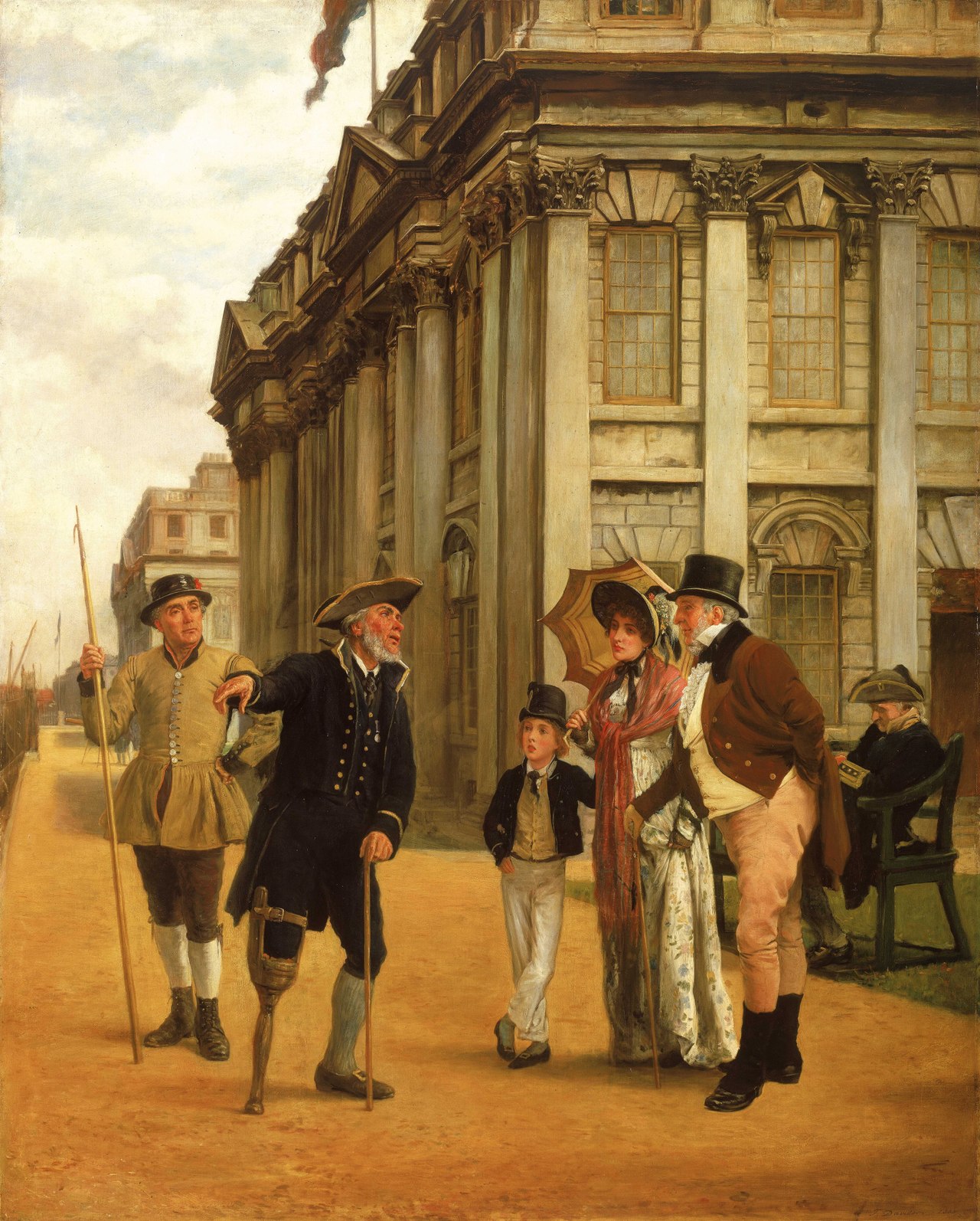
- The Pensioner's Story (1883) – A more intimate work, it portrays an elderly veteran recounting his service to a younger generation. The composition centres on the pensioner’s weathered hands, while the background hints at a distant battlefield, linking personal memory with national history.
- Life Guards at the Battle of Tel‑el‑Kebir, 1882 (1882) – Though the title references a land engagement, Davidson renders the cavalry charge with the same precision he applies to naval subjects. The painting reveals his capacity to depict movement across varied terrains, and his attention to uniforms reflects his broader interest in military attire.
- Burial of Admiral Drake (1500) – This work imagines a ceremonial interment for the famed Elizabethan explorer, blending Renaissance iconography with Victorian sensibilities. Davidson’s treatment of draped cloth and solemn expression conveys reverence for historic heroes.
- The Court Jester (1877) – Diverging from his usual martial themes, this piece shows a court entertainer in a moment of levity. The painter’s skill in rendering fabrics and facial expression demonstrates his versatility and willingness to explore subjects beyond the battlefield.
Each of these paintings demonstrates Davidson’s commitment to historical accuracy, his mastery of academic technique, and his ability to convey narrative drama.
Influence and legacy Thomas Davidson’s legacy rests on his role as a chronicler of Britain’s naval past during a period when the nation’s maritime dominance was a source of pride and identity. By integrating scholarly research with the visual language of the Academy, he provided future generations with a visual archive that complements written histories.
His works were frequently exhibited at the Royal Academy’s summer exhibitions, attracting patrons ranging from naval officers to civic institutions seeking commemorative art. The precision of his ship depictions influenced later illustrators of naval history, particularly those producing textbooks and museum displays in the early twentieth century.
While Davidson did not pioneer a new artistic movement, his dedication to historical realism helped sustain the relevance of history painting in an era increasingly dominated by Impressionism and later modernist trends. Contemporary scholars cite his paintings as primary visual sources for the study of Victorian naval iconography, and his canvases remain part of the collections of several British regional museums.
In recent decades, renewed interest in maritime heritage has prompted restorations of his major works, and digital archives now feature high‑resolution images that allow researchers to examine his technique in detail. As a result, Thomas Davidson is recognised not only as a skilled painter but also as an important visual historian of Britain’s seafaring legacy.
Frequently asked questions
Who was Thomas Davidson?
Thomas Davidson (1842–1919) was a painter best known for his historically accurate naval and military scenes, many of which were exhibited at the Royal Academy.
What style or movement is he associated with?
He worked within the academic realism tradition, producing narrative history paintings that align with Victorian historicism rather than a specific avant‑garde movement.
What are his most famous works?
His most celebrated canvases include England's Pride and Glory (1894), The Pensioner's Story (1883), Life Guards at the Battle of Tel‑el‑Kebir (1882), Burial of Admiral Drake (1500), and The Court Jester (1877).
Why does Thomas Davidson matter in art history?
Davidson provides a visual record of 19th‑century British naval and military heritage, combining scholarly research with academic painting techniques, and his works continue to inform studies of Victorian historicism and maritime iconography.
How can I recognise a Thomas Davidson painting?
Look for meticulous ship and uniform details, a restrained palette with dramatic lighting, diagonal compositions that convey movement, and a narrative focal point that tells a clear historical story.