Tenshō Shūbun
1414 – 1463
In short
Tenshō Shūbun (1414–1463) was a Japanese Zen Buddhist monk and painter of the Muromachi period, celebrated for establishing the ink‑landscape tradition that shaped Japanese painting for centuries.
Notable works


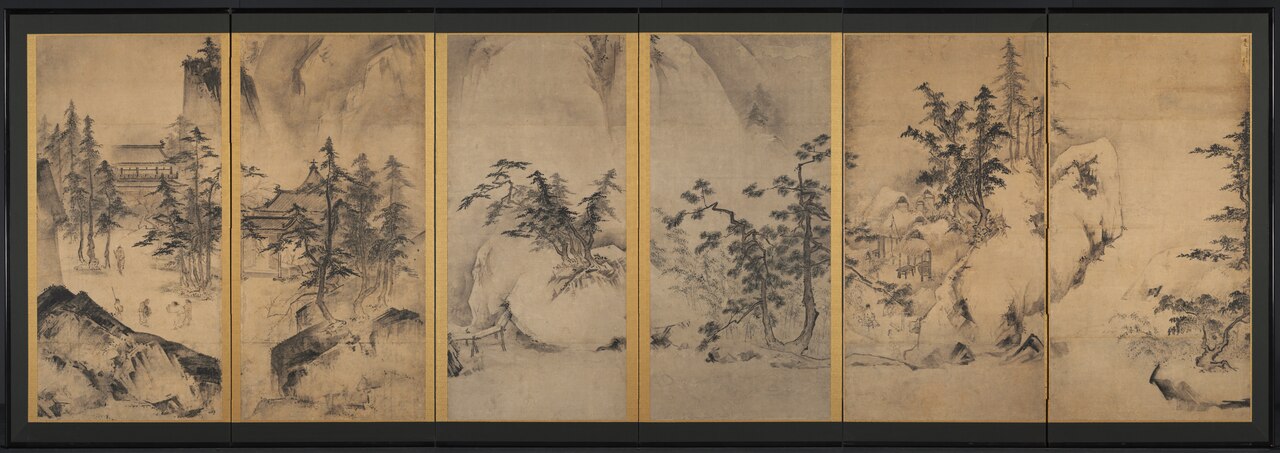


Early life Tenshō Shūbun was born in 1414, although the precise location of his birth remains undocumented. He entered the monastic world at a young age, becoming a Zen Buddhist priest. The rigorous discipline of Zen practice, combined with the intellectual environment of the Ashikaga shogunate’s cultural centre, provided the foundation for his artistic development. Early training would have involved copying Chinese Song and Yuan dynasty paintings, a common practice among monk‑artists seeking to internalise the principles of brushwork and composition.
Career and style By the mid‑15th century Shūbun had emerged as a leading figure in the nascent Japanese ink‑landscape (sumi-e) school. He served as a painter‑advisor to the shogunate and was appointed chief painter at the Kanazawa‑ji temple in Kyoto. His style synthesises the austerity of Chinese monochrome landscapes with a distinctly Japanese sensibility, favouring asymmetrical compositions that echo the impermanence central to Zen philosophy. Shūbun’s canvases often depict mist‑shrouded mountains, solitary pines and flowing water, rendered with a restrained palette that foregrounds the brush’s tonal variation rather than colour. The overall effect is one of quiet contemplation, inviting the viewer to enter a meditative state.
Signature techniques Shūbun’s technical repertoire is characterised by a disciplined use of the "haboku" (broken ink) technique, where the brush is lifted and the ink is allowed to dry partially before being re‑applied, creating a textured, atmospheric effect. He also employed "yosegi" – the strategic placement of empty space – to suggest depth and to balance the composition. His brushstrokes vary from fine, calligraphic lines for foliage to broader, sweeping strokes for mountain mass. The controlled modulation of ink density, from deep black to delicate gray, enables subtle gradations that convey fog, water surface and distant horizons. These methods became hallmarks of the Shōka (monk‑painting) tradition.
Major works Although precise dating is problematic, several paintings are traditionally attributed to Shūbun. *Landscape* (1412) is an early example, showing a stark mountain range rendered in monochrome, hinting at his developing mastery of spatial recession. *Winter and Spring Landscape* (1441) juxtaposes the barren chill of winter with the budding vitality of spring, employing contrasting brushwork to differentiate seasons. *Hue of the Water, Light on the Peaks* (1445) demonstrates his skill in capturing reflective water surfaces and the subtle illumination of distant peaks, a study in atmospheric perspective. *Reading in a Bamboo Grove* (1500) and *Elegant Conversation in Mountains* (1649) are later attributions; scholars suggest they may be copies or works produced by Shūbun’s followers that preserve his compositional principles. All five pieces illustrate his consistent focus on natural scenery as a vehicle for Zen contemplation.
Influence and legacy Tenshō Shūbun’s impact on Japanese art is profound. He is widely regarded as the founder of the Japanese ink‑landscape tradition, paving the way for later masters such as Sesshū Tōyō and Kanō Masanobu. His integration of Chinese techniques with native aesthetic values established a visual language that persisted throughout the Edo period and beyond. Shūbun’s teachings, transmitted through his monastic network, helped institutionalise the role of the monk‑artist, reinforcing the link between spiritual practice and visual art. Contemporary scholars continue to study his surviving works for insights into the evolution of Japanese painting, and his name remains a reference point in discussions of Zen visual culture.
Frequently asked questions
Who was Tenshō Shūbun?
Tenshō Shūbun (1414–1463) was a Japanese Zen Buddhist monk and painter of the Muromachi period, known for pioneering the ink‑landscape tradition.
What artistic style or movement is he associated with?
He is associated with the early Japanese ink‑landscape (sumi‑e) style, a branch of the broader Shōka (monk‑painting) movement.
What are his most famous works?
His most frequently cited works include *Landscape* (1412), *Winter and Spring Landscape* (1441), *Hue of the Water, Light on the Peaks* (1445), *Reading in a Bamboo Grove* (1500) and *Elegant Conversation in Mountains* (1649).
Why does Tenshō Shūbun matter in art history?
He laid the foundations for Japanese ink‑landscape painting, influencing later masters such as Sesshū Tōyō and shaping the visual expression of Zen Buddhism for centuries.
How can I recognise a Tenshō Shūbun painting?
Look for monochrome compositions featuring misty mountains, sparse foliage, and a strong use of empty space, with brushwork that combines fine calligraphic lines and broader, textured strokes typical of the haboku technique.