Sebastiano Conca
1680 – 1764
In short
Sebastiano Conca (1680–1764) was an Italian Baroque painter born in Gaeta who worked chiefly in Naples, producing religious and mythological works such as Madonna and Child with Saint John of Nepomuk and Allegory of Fame.
Notable works


Early life Sebastiano Conca was born in 1680 in the coastal town of Gaeta, a region that at the time was part of the Kingdom of Naples. Details of his family background are scarce, and contemporary records do not clarify his exact nationality, though he is generally regarded as part of the Italian artistic milieu. Little is known about his formal education, but it is probable that he received an apprenticeship typical of the period, learning drawing, composition and the techniques of fresco and oil painting in a workshop environment. The artistic climate of southern Italy in the late seventeenth century was dominated by the lingering influence of the high Baroque, a style characterised by dramatic chiaroscuro, dynamic movement and emotional intensity. Conca’s early exposure to these visual values would shape his later output.
Career and style Conca’s professional life unfolded primarily in Naples, a city that, after the 1656 plague, experienced a revival of artistic patronage under the Bourbon rulers. By the early eighteenth century he had established a reputation as a competent painter of both sacred and secular subjects. His style reflects the late Baroque sensibility, blending the luminous colour palette of the Neapolitan school with a compositional vigor inherited from earlier masters such as Luca Giordano and Francesco Solimena. Conca favoured a balanced arrangement of figures, often employing a central focal point surrounded by ancillary characters that reinforce the narrative. Light is used to model forms and to draw the viewer’s eye toward key gestures or expressions. While his work does not break radically from Baroque conventions, it demonstrates a refined synthesis of tradition and personal expression.
Signature techniques A hallmark of Conca’s technique is his handling of drapery. He renders fabric with a subtle interplay of highlights and shadows that convey both texture and movement, allowing garments to appear weightless yet grounded in three‑dimensional space. In oil, he often builds up layers of glazes, creating a depth of colour that enhances the flesh tones and the atmospheric background. His frescoes reveal a quick, confident brushstroke, suggesting that he was adept at working on a large scale under the time pressures typical of ecclesiastical commissions. Conca also employed a limited but vivid palette—deep ultramarine, warm ochre, and occasional vermilion—strategically placed to accentuate the emotional climax of a scene. The compositional geometry of his canvases frequently employs an implied triangular or pyramidal structure, a device that guides the viewer’s gaze toward the central narrative.
Major works Among Conca’s extant works, the *Madonna and Child with Saint John of Nepomuk* stands out as a prime example of his devotional painting. The composition places the Virgin on a modest throne, the infant Christ in her lap, while Saint John of Nepomuk—identified by his halo and the martyr’s palm—kneels in reverence. The work is distinguished by its soft modelling of flesh and the delicate handling of the saint’s cloak, which catches a subtle light that accentuates his pious expression.
The *Allegory of Fame* (1730) showcases Conca’s capacity for allegorical and secular themes. In this canvas, the personification of Fame is depicted as a winged figure holding a trumpet, surrounded by putti and mythic symbols. The painting’s dynamic diagonal composition and the luminous colour of the wings illustrate Conca’s skill in rendering movement and narrative symbolism within a single frame.
*Boreas Abducting Oreithyia* (1750) demonstrates his engagement with classical mythology. Here the north wind Boreas is captured in the act of seizing the mortal princess Oreithyia. The drama is heightened by a gust of wind that billows the figures’ garments, while the background recedes into an idealised landscape. Conca’s treatment of the wind’s invisible force through the tension of the bodies and the swirling drapery exemplifies his late Baroque theatricality.
A preparatory piece, the *Sketch for Sepulchrers* (1750), reveals Conca’s methodical approach to large commissions. The sketch, executed in charcoal, outlines the placement of mournful figures within a tomb setting, indicating his careful planning of composition before committing to full‑scale execution.
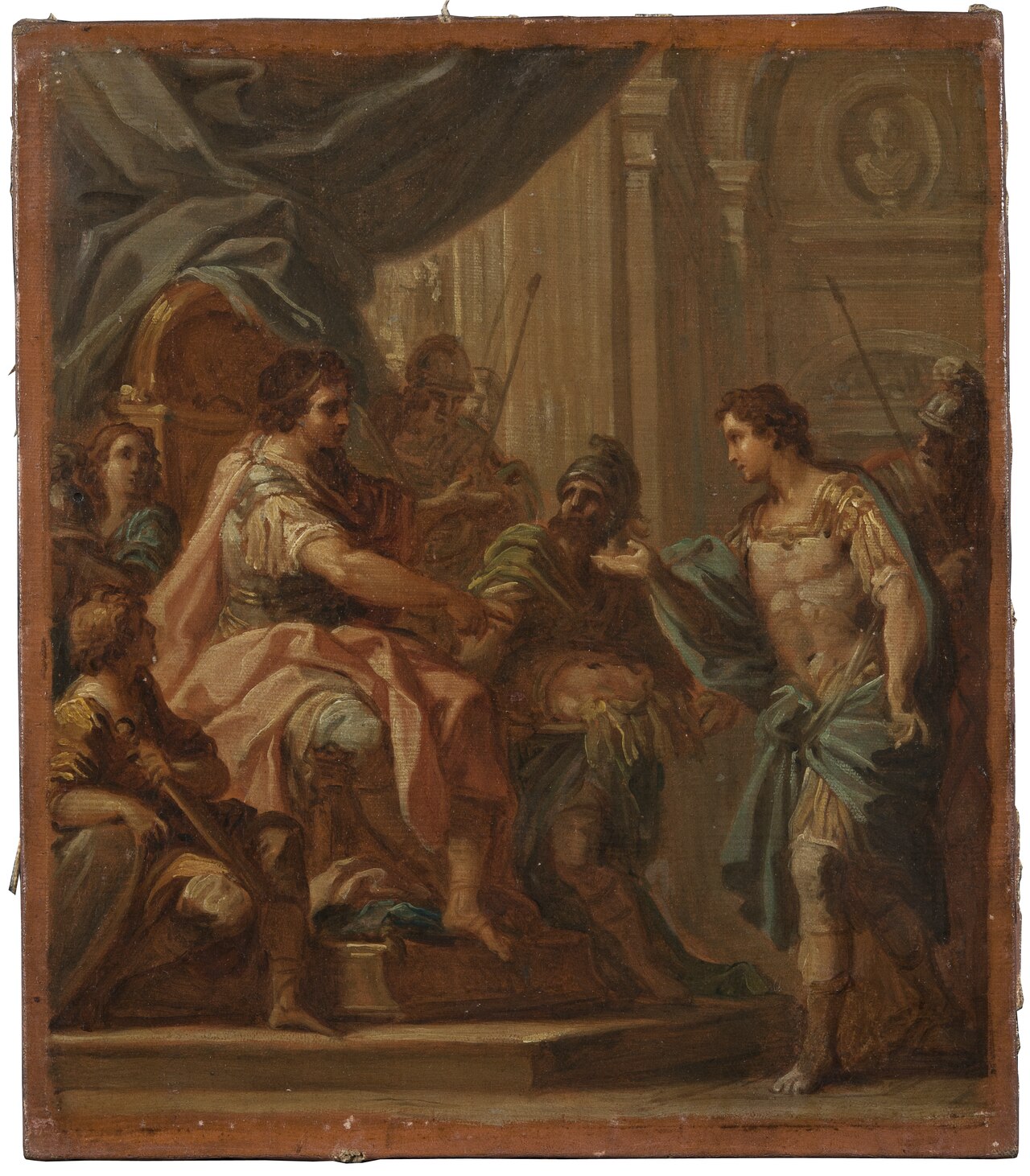
Finally, the *David and Saul. Study* provides insight into Conca’s interest in biblical narrative. The study captures the moment of tension between the young David and the older King Saul, using stark contrasts of light to underline the psychological drama. Though only a study, it reflects the same compositional balance and emotive intensity evident in his finished works.
Influence and legacy Sebastiano Conca’s career spanned the transition from the high Baroque to the early Rococo in southern Italy. While he never achieved the fame of contemporaries such as Francesco Solimena, his paintings contributed to the diffusion of Baroque aesthetics beyond the major artistic centres of Rome and Venice. Conca’s workshop in Naples trained a number of younger artists who carried forward his compositional language, particularly the use of dramatic lighting and the integration of allegory with devotional content. His works remain in churches and private collections across Italy, offering scholars a window into the late Baroque period’s stylistic continuities. In recent decades, art historians have begun to reassess Conca’s oeuvre, recognising his role as a bridge between the exuberant baroque of the seventeenth century and the more decorative sensibilities of the eighteenth. His paintings, therefore, are valuable not only for their aesthetic qualities but also for the insight they provide into the evolving tastes of patrons and the artistic networks of Naples during a period of political and cultural change.
Frequently asked questions
Who was Sebastiano Conca?
Sebastiano Conca (1680–1764) was a Baroque painter born in Gaeta who worked mainly in Naples, creating religious and mythological works.
What style or movement is he associated with?
He is generally classified within the late Italian Baroque, employing dramatic lighting, dynamic composition and a refined colour palette.
What are his most famous works?
Among his best‑known pieces are *Madonna and Child with Saint John of Nepomuk*, *Allegory of Fame* (1730), *Boreas Abducting Oreithyia* (1750) and his studies for sepulchral scenes.
Why does Sebastiano Conca matter in art history?
Conca bridges the high Baroque and early Rococo in southern Italy, illustrating how Baroque visual language persisted and influencing younger Neapolitan artists.
How can I recognise a Sebastiano Conca painting?
Look for luminous flesh tones, finely modelled drapery, a balanced triangular composition, and a subtle yet vivid colour scheme that highlights dramatic narratives.