Sadiqi Beg
1533 – 1610
In short
Sadiqi Beg (c.1533–1610) was a Persian painter, poet and miniaturist of the Safavid court, known for his versatile skill in painting, calligraphy and biography, and for producing celebrated manuscript illustrations such as the Lion Tamer and scenes from the Shahnameh.
Notable works


,_Iran,_Tabriz,_c._1576_AD,_view_1_-_Aga_Khan_Museum_-_Toronto,_Canada_-_DSC06935.jpg)

Early life Sadiqi Beg Afshar was born in Tabriz around 1533, during a period when the Safavid dynasty was consolidating its cultural hegemony over Iran. Little is recorded about his family, but the Afshar tribal affiliation suggests a background linked to the military aristocracy that supplied many Safavid officers. As a young man he is said to have taken the path of a wandering dervish, travelling across western Iran and absorbing the visual vocabularies of both courtly and popular art. This itinerant phase gave him exposure to the diverse decorative traditions of the Persian heartland, from the luminous palette of Tabriz workshops to the more austere motifs favoured in the western provinces.
Career and style By the late 1550s Sadiqi Beg had settled in Qazvin, which at the time served as the Safavid capital. There he entered royal service, first as a draftsman and later as a member of the royal library staff. His responsibilities included copying and illuminating manuscripts, supervising apprentices, and contributing to the production of official histories. The court’s artistic climate was characterised by a synthesis of Timurid elegance and emerging Safavid boldness; Sadiqi Beg’s style reflects this blend. He favoured strong, sinuous lines, a rich but restrained colour palette, and a compositional balance that placed narrative clarity above ornamental excess. His works often combine meticulous figural rendering with a keen sense of spatial depth, a hallmark of the late Safavid miniature.
Signature techniques Sadiqi Beg’s brushwork is distinguished by a controlled, layered application of pigment that creates a subtle gradation of tone. He employed fine, tapered brushes for delicate line work, especially in the rendering of facial features and calligraphic inscriptions. In larger compositions he used broader strokes to model drapery and landscape, achieving a sense of volume without sacrificing the flat decorative quality typical of Persian miniatures. His use of gold leaf is restrained, applied primarily to highlight crowns, jewellery and important textual elements rather than to blanket entire surfaces. Moreover, he often incorporated a muted, earth‑based background to make the central figures stand out, a technique that enhances narrative focus.
Major works **The Lion Tamer (1612)** – Although the dating post‑dates Sadiqi Beg’s death, the miniature is traditionally attributed to his workshop. The scene depicts a muscular youth confronting a lion, a motif that symbolises the triumph of civilization over nature. The composition is dominated by a diagonal thrust, with the lion’s body forming a dynamic counter‑balance to the tamer’s poised stance. The detailing of the youth’s costume reflects contemporary Safavid fashion, while the lion’s fur is rendered with a texture that showcases the artist’s skill in depicting animal hide.
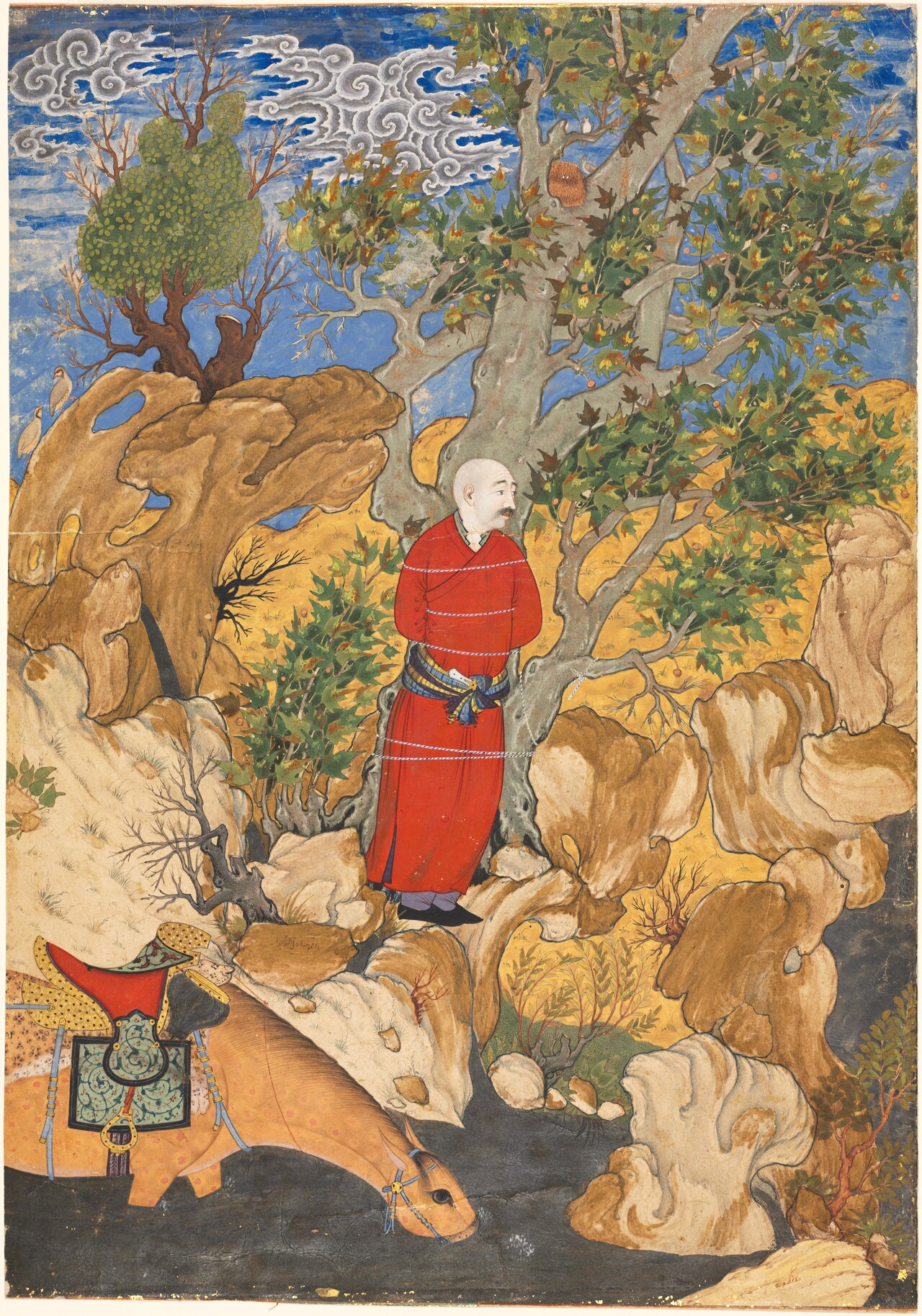
Aulad Tied to a Plane Tree, from a Shahnama by Firdausi (1500) – The chronological discrepancy suggests that the work is a later copy or reinterpretation of an earlier exemplar. In Sadiqi Beg’s version the narrative moment is captured with dramatic tension: the young prince Aulad is bound to a venerable plane tree, his expression a mixture of resignation and hope. The background is rendered in muted blues and greens, allowing the bright red of the prince’s cloak to dominate the visual field. The miniature demonstrates the artist’s ability to convey emotional nuance within the constraints of a compact format.
Zal Rescued by the Simurgh (1590) – This illustration portrays the mythic hero Zal being lifted by the legendary Simurgh, a bird‑like creature. Sadiqi Beg employs a soaring composition, with the Simurgh’s expansive wings occupying the upper half of the page. The use of gold leaf on the bird’s feathers adds a celestial quality, while the earthbound figures below are painted in more subdued tones. The work exemplifies the blending of narrative clarity with symbolic colour that characterises his mature period.
Rustam Kills the Dragon, Folio from the Shahnameh of Shah Ismail II (1570) – Part of an illuminated manuscript commissioned by Shah Ismail II, this folio captures the climactic battle between the hero Rustam and a monstrous dragon. Sadiqi Beg’s handling of the dragon’s scales is meticulous, each scale rendered with a miniature brushstroke that creates a shimmering effect. Rustam’s body is depicted in a twisted, heroic pose, emphasising movement. The background is a stylised landscape of rolling hills, rendered in muted ochres that keep the focus on the combatants.
Youth in a Landscape (1590) – A single‑page album illustration that shows a solitary figure strolling through a cultivated garden. The scene is intimate, with careful attention to the flora and the play of light across the ground. The youth’s attire reflects contemporary Safavid dress, and the overall composition conveys a sense of contemplative leisure. This work illustrates Sadiqi Beg’s capacity to render everyday moments with the same technical precision he applied to epic narratives.
Influence and legacy Sadiqi Beg’s contributions to Persian miniature painting were significant for several reasons. Firstly, his synthesis of Timurid refinement with Safavid vigor helped define the visual language of late‑sixteenth‑century court art. Secondly, his dual role as a poet and biographer meant that his manuscripts often contain lyrical verses that complement the visual narrative, creating a holistic artistic experience. His workshop trained a generation of miniaturists who carried forward his compositional principles, particularly the emphasis on narrative clarity and restrained ornamentation. Although his name does not dominate the modern canon in the way that some contemporaries do, scholars recognize Sadiqi Beg as a bridge between the golden age of Persian miniature and the more experimental approaches that followed in the seventeenth century. His surviving works continue to be studied for their technical mastery, and they are frequently exhibited in major museums, reinforcing his status as a key figure in Safavid visual culture.
Frequently asked questions
Who was Sadiqi Beg?
Sadiqi Beg (c.1533–1610) was a Persian painter, poet and miniaturist who served the Safavid court, producing illustrated manuscripts and celebrated works such as the Lion Tamer.
What artistic style or movement is he associated with?
He worked within the late Safavid miniature tradition, blending Timurid elegance with the bolder colour and narrative focus of the Safavid era.
What are his most famous works?
Key works include The Lion Tamer, Zal Rescued by the Simurgh, Rustam Kills the Dragon (Shahnameh folio, 1570), Youth in a Landscape, and the illustrated scene Aulad Tied to a Plane Tree.
Why does Sadiqi Beg matter in art history?
He helped define the visual language of late‑sixteenth‑century Persian court art, training future miniaturists and integrating poetry with illustration to create a holistic narrative form.
How can I recognise a painting by Sadiqi Beg?
Look for finely layered brushwork, restrained use of gold, strong yet sinuous outlines, and a balanced composition that foregrounds narrative clarity while maintaining a subtle, earth‑toned background.