Muhammadi
1600 – 1600
In short
Muhammadi, also known as Muhammad Haravi, was a Safavid court painter active in mid‑16th‑century Iran, serving Shah Tahmasp and his successors. He is recognised for his miniature illustrations such as Picnic in the Mountains, Lovers in a Landscape, and Hamza Mirza Entertained.
Notable works
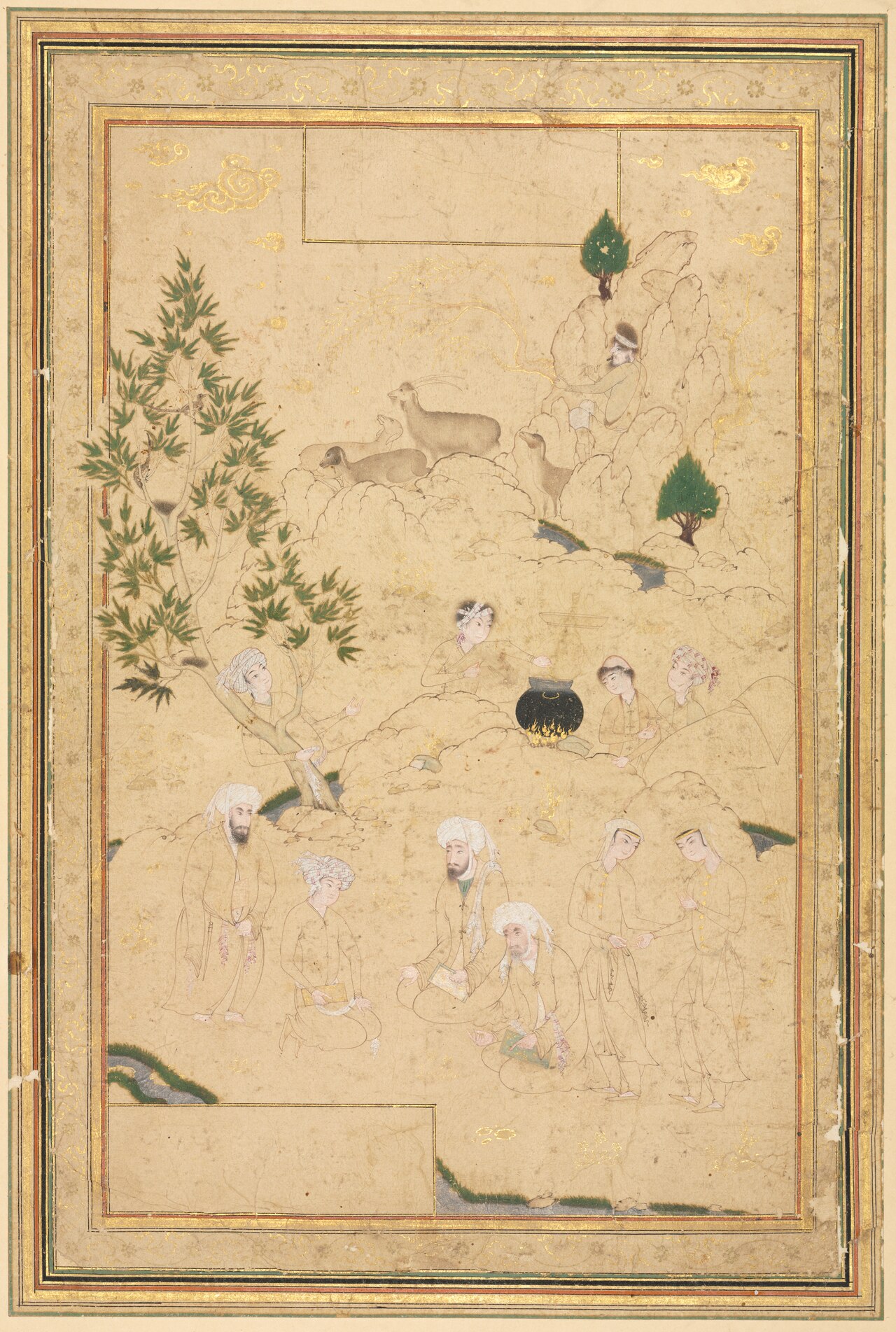


Early life Muhammad Haravi, who signed his works as Muhammadi, was born in Iran around the turn of the 16th century. Little is recorded about his family background, but the name "Haravi" suggests a connection to the city of Herat, a historic centre of Persian artistic activity. Growing up under the Safavid dynasty, he would have been exposed to the flourishing of Persian miniature painting that characterised the court of Shah Tahmasp (r. 1524‑1576). Training for court painters typically began in a workshop attached to the royal atelier, where apprentices learned to copy classical manuscripts, master the use of mineral pigments, and develop the delicate brushwork required for miniature illustration.
Career and style Muhammadi entered the royal workshop during the reign of Shah Tahmasp, a period when the Safavid court invested heavily in the production of illuminated manuscripts and album pages (muraqqa). His career continued under Tahmasp's successors, indicating both artistic adaptability and a reputation for reliability. The painter’s style aligns with the mature Safavid miniature tradition, characterised by a balanced composition, rich chromatic palettes, and a lyrical treatment of narrative scenes. While the broader movement of Safavid painting is not defined by a single aesthetic, Muhammadi’s work reflects the court’s preference for refined elegance, subtle emotional expression, and an emphasis on courtly and literary subjects.
Signature techniques Muhammadi’s miniatures display several technical hallmarks that help identify his hand:
* Fine linear drawing – He employed a delicate, almost calligraphic line to delineate figures and architectural elements, a technique inherited from earlier Persian masters. * Layered colour washes – Using translucent mineral pigments, he built depth through successive layers, creating a luminous surface that captures light. * Gold leaf accents – Strategic applications of gold leaf highlight ornamental details such as halos, jewellery, and decorative borders, adding a regal sheen to the composition. * Narrative integration – Figures are placed within expansive natural settings that complement, rather than dominate, the storyline, a hallmark of Safavid narrative painting. * Attention to texture – Fabrics, foliage, and stone surfaces are rendered with subtle variations, giving each element a tactile quality.
These techniques, combined with a restrained yet expressive use of colour, distinguish Muhammadi’s work from that of his contemporaries.
Major works
### Picnic in the Mountains (1600) This single‑page illustration presents a leisurely gathering of aristocratic figures set against a stylised mountain landscape. The composition balances foreground activity with a mist‑shrouded backdrop, allowing the viewer to sense both intimacy and grandeur. The work exemplifies Muhammadi’s command of atmospheric perspective, achieved through gradations of blue and green pigments that recede into the distance.
### Lovers in a Landscape (1570) In this piece, a pair of lovers is depicted amid a lush garden and gently rolling hills. The scene captures a moment of private affection, a theme often explored in Persian poetry. Muhammadi’s use of soft pinks and gold highlights to render the lovers’ garments underscores their elevated status while maintaining a naturalistic sense of space.
### Hamza Mirza Entertained (1584)\nThis miniature illustrates the young prince Hamza Mirza receiving entertainment, a subject drawn from courtly chronicles. The composition is populated with musicians, dancers, and elaborate decorative objects. Muhammadi’s meticulous attention to the details of musical instruments and costume design provides valuable insight into Safavid court culture. The work also demonstrates his skill in arranging multiple figures within a cohesive visual narrative.
Collectively, these works illustrate Muhammadi’s versatility: he could render serene pastoral scenes, intimate romantic encounters, and bustling courtly festivities with equal proficiency.
Influence and legacy Although specific records of pupils or a formal workshop under Muhammadi are lacking, his contributions helped sustain the high standards of Safavid miniature painting into the late 16th century. By adhering to the court’s aesthetic preferences while introducing subtle innovations—particularly in the treatment of landscape and atmospheric effects—he influenced subsequent generations of Persian illustrators. Modern scholars regard his surviving pieces as exemplary models of Safavid court art, valuable both for their artistic merit and for the cultural insights they provide into Safavid Iran’s elite society.
Today, Muhammadi’s miniatures are housed in major museum collections, where they continue to inform exhibitions on Persian art and inspire contemporary artists exploring the dialogue between historic techniques and modern visual storytelling.
Frequently asked questions
Who was Muhammadi?
Muhammadi, also known as Muhammad Haravi, was a Safavid court painter active in mid‑16th‑century Iran, serving Shah Tahmasp and his successors.
What artistic style or movement is Muhammadi associated with?
He worked within the mature Safavid miniature tradition, noted for refined composition, vibrant pigments, and elegant narrative scenes.
What are Muhammadi's most famous works?
His best‑known pieces include Picnic in the Mountains (1600), Lovers in a Landscape (1570), and Hamza Mirza Entertained (1584).
Why is Muhammadi important in art history?
His paintings exemplify the high quality of Safavid court art and provide valuable insight into the cultural and aesthetic values of 16th‑century Iran.
How can I recognise a painting by Muhammadi?
Look for fine linear drawing, layered translucent colours, selective gold leaf accents, and a balanced integration of figures within detailed natural settings.