René Théodore Berthon
1776 – 1859
In short
René Théodore Berthon (1776–1859) was a French painter known for religious, historical and portrait works. He was born in Tours, trained in Paris, and died in Paris, leaving a modest but respected body of work that includes portraits of notable literary and aristocratic figures.
Notable works



_Portrait_de_Madame_d%27Arjuzon.jpg)
Early life René Théodore Berthon was born in 1776 in the city of Tours, in the historic province of Touraine. Little is recorded about his family background, but the fact that he pursued a career in the visual arts suggests that he received at least a basic education in drawing and painting, likely through a local drawing academy. Like many provincial talents of the late eighteenth century, Berstein would have moved to Paris to complete his training, where the capital offered access to the École des Beaux‑Arts, the official academy, and a network of patrons.
Career and style Berthon’s professional life unfolded during a period of great political and cultural upheaval in France. The French Revolution, the Napoleonic Empire, and the Restoration all left their imprint on artistic production. Berthon worked primarily as a painter of religious and historical subjects, a genre that remained popular among state and ecclesiastical patrons. He also cultivated a reputation as a portraitist, receiving commissions from members of the aristocracy, the emerging bourgeoisie, and notable literary figures.
His style does not fit neatly into a single movement. While his contemporaries were increasingly drawn to Romanticism, Berthon’s work retains a strong classical grounding. He favoured clear compositional structures, balanced proportions and a restrained colour palette, echoing the academic standards of the late eighteenth and early nineteenth centuries. At the same time, his treatment of light and his attention to the psychological nuance of his sitters hint at a subtle shift toward the more expressive concerns of the Romantic era.
Signature techniques Berthon’s paintings are characterised by a careful modelling of form through chiaroscuro, allowing him to render flesh and fabric with a tactile realism. He employed a layered glazing technique, building thin translucent layers of paint to achieve depth and luminosity, particularly in the rendering of skin tones. His brushwork is generally smooth and controlled in the background, while the focal figures are often treated with slightly more expressive strokes that capture subtle facial expressions. In his historical compositions, he used a muted, earthy palette for architectural elements, reserving richer reds and blues for the garments of principal characters, thereby directing the viewer’s eye toward the narrative centre.
Major works Berthon’s extant oeuvre includes several works that illuminate both his technical skill and his choice of subjects.
* Portrait of Lady Morgan (Sydney Owenson) (1818) – This portrait captures the Irish novelist Lady Morgan, a leading literary figure of the early nineteenth century. The work is notable for its psychological depth; Lady Morgan is presented with a thoughtful gaze, her attire rendered in delicate pastel tones that contrast with a darker, indeterminate background, highlighting her intellectual presence.
* The Emperor receiving the deputies of the Conservative Senate in Berlin at the royal palace, 19 November 1806 (1850) – Although painted many years after the event it depicts, this large‑scale historical canvas demonstrates Berthon’s ability to organise complex groupings. The composition places the Emperor at the centre of a grand architectural setting, flanked by senators rendered with individualized features, underscoring the diplomatic significance of the meeting.
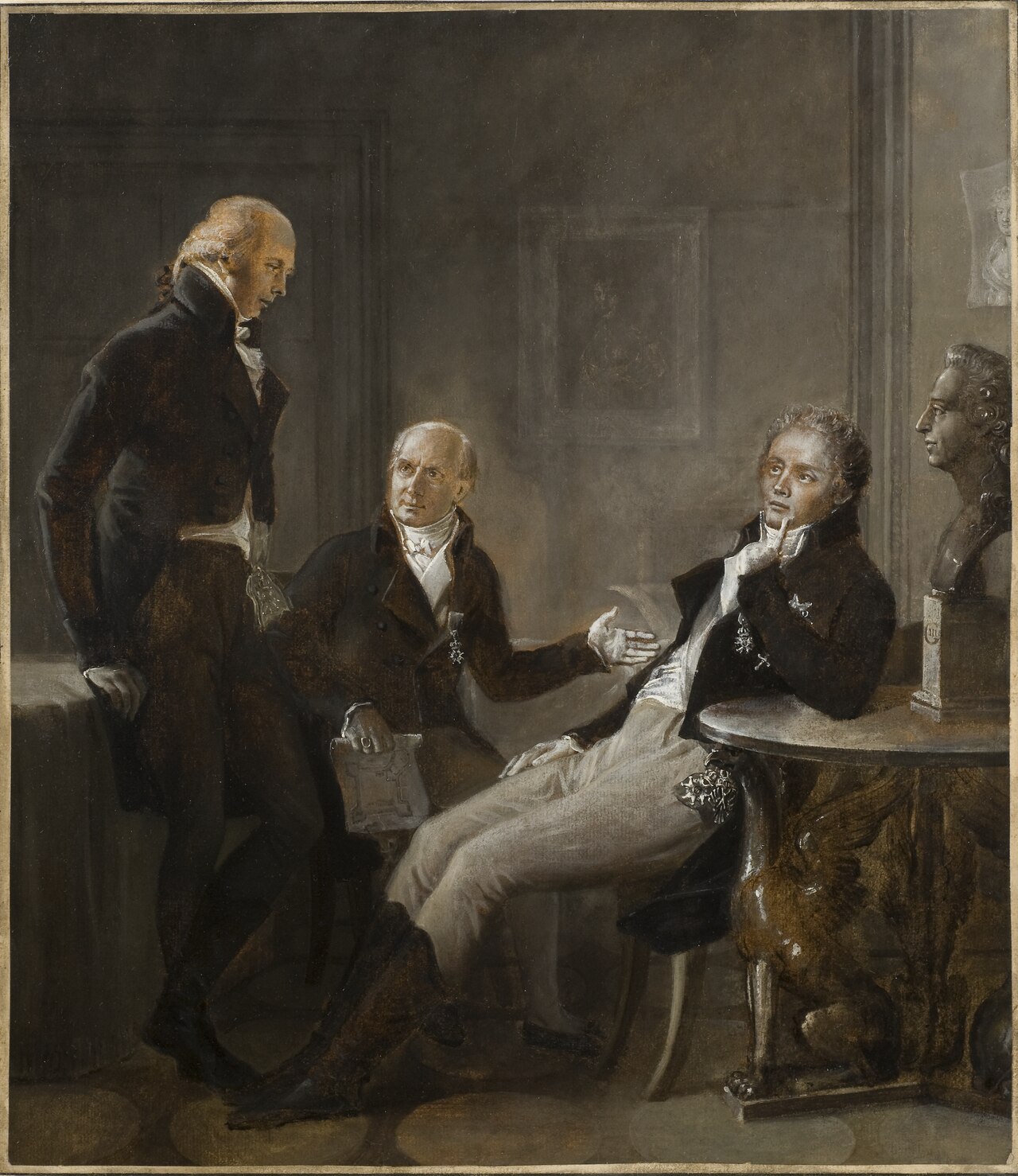
* Johan Fredrik Aminoff, Johan Albrekt Ehrenström and Gustaf Mauritz Armfelt (1804) – This group portrait of three Swedish dignitaries showcases Berthon’s skill in rendering multiple sitters within a single frame. Each figure is distinguished by distinct clothing and posture, and the subtle interplay of light across their faces creates a sense of camaraderie and mutual respect.
* Portrait of Madame Charles Delamalle (1827) – In this intimate portrait, Berthon portrays Madame Delamalle with a soft modelling of her features and a gentle smile. The work exemplifies his capacity to convey the elegance of Parisian society during the Restoration period, using a restrained colour scheme that accentuates the sitter’s complexion.
* Portrait of Madame d'Arjuzon (1801) – One of his earlier portrait commissions, this painting demonstrates Berthon’s early mastery of the academic portrait tradition. The sitter is depicted in an elegant gown, with careful attention to the folds of fabric and the reflective quality of jewellery, set against a muted interior that does not compete with the figure.
Collectively, these works illustrate Berthon’s versatility: from intimate, single‑figure portraits to expansive historical scenes, he consistently balanced technical precision with a sensitivity to the personalities he depicted.
Influence and legacy René Théodore Berthon never achieved the fame of contemporaries such as Jacques-Louis David or Eugène Delacroix, yet his contributions to French academic painting remain significant. His portraits provide valuable visual documentation of early‑nineteenth‑century cultural and political elites, offering historians insight into the fashions, attitudes and social networks of the period. Moreover, his historical canvases reflect the continued demand for narrative art that commemorated state events, a genre that persisted well into the Restoration.
Berthon’s work was collected by a modest number of private patrons and occasionally entered public exhibitions, ensuring that his paintings were seen by younger artists who would later adopt and adapt his compositional clarity and restrained colour. While he did not found a distinct school, his adherence to academic standards helped sustain the continuity of French academic painting during a time of stylistic transition.
Today, his paintings are housed in regional museums in France and in a few international collections, where they are valued for their historical relevance as much as for their aesthetic qualities. Art historians regard Berthon as a representative figure of the generation that straddled the revolutionary and post‑Napoleonic eras, embodying both the classical discipline of the Ancien Régime and the emerging personal expressiveness that would later define Romantic portraiture.
In summary, René Théodore Berthon occupies a modest but respectable niche within French art history: a painter whose disciplined technique, nuanced portraiture and careful handling of historical subjects provide a window onto a transformative epoch in European culture.
Frequently asked questions
Who was René Théodore Berthon?
René Théodore Berthon (1776–1859) was a French painter of religious, historical and portrait subjects, born in Tours and active mainly in Paris.
What artistic style or movement is he associated with?
Berthon’s style is rooted in the French academic tradition; his work shows classical composition with subtle Romantic influences, but he is not linked to a specific movement.
What are his most famous works?
His best‑known pieces include the Portrait of Lady Morgan (1818), The Emperor receiving the deputies of the Conservative Senate in Berlin (1850), and portraits of Madame Charles Delamalle (1827) and Madame d’Arjuzon (1801).
Why does he matter in art history?
He provides a valuable visual record of early‑nineteenth‑century French and European elites and exemplifies the continuity of academic painting during a period of political and stylistic change.
How can I recognise a painting by René Théodore Berthon?
Look for smooth, academic brushwork, careful chiaroscuro, a restrained colour palette, and a focus on clear, balanced composition, especially in portraiture.