Pieter Schoubroeck
1560 – 1607
In short
Pieter Schoubroeck (1560–1607) was a German landscape painter associated with the Frankenthal school, noted for his imaginative biblical and mythological scenes rendered in a detailed, atmospheric style.
Notable works



Early life Pieter Schoubroeck was born in 1560 in the small town of Heßheim, located in the Rhineland-Palatinate region of what is now Germany. Little is recorded about his family background, but the town's proximity to the Palatinate court and its vibrant artistic milieu suggest that he was exposed to visual culture from an early age. The mid‑16th century was a period of religious and political upheaval in the Holy Roman Empire, and many artists sought patronage beyond their native towns. It is therefore plausible that Schoubroeck received an apprenticeship in a regional workshop, where he would have learned the fundamentals of drawing, oil painting, and the preparation of panels and canvases.
Career and style By the 1580s Schoubroeck had established himself as an independent painter in the emerging Frankfurt‑Frankenthal artistic circle. The Frankenthal school, named after the town of Frankenthal where a number of Dutch and Flemish refugees settled, was characterised by a synthesis of Northern Renaissance naturalism and a growing interest in imaginative, often biblical, landscapes. Schoubroeck’s work reflects this synthesis: he combined meticulous observation of topography with dramatic narrative content, placing mythic or scriptural events within convincingly rendered countryside settings. His palette tends toward earthy greens, muted ochres and occasional bursts of warm colour to highlight focal points such as fire or divine light. Throughout his career he remained active in the Rhineland, moving to Frankenthal later in life where he died in 1607.
Signature techniques Schoubroeck’s paintings are distinguished by several technical hallmarks. First, he employed a layered glazing technique, applying thin, translucent oil layers over a detailed underdrawing to achieve depth and atmospheric perspective. Second, his handling of foliage shows a keen observation of botanical forms; trees and shrubs are rendered with individual leaf clusters, yet the overall composition retains a harmonious flow. Third, he often used a compositional device known as the "landscape arch," wherein a natural element such as a hill or a riverbank creates a visual gateway that draws the viewer’s eye toward the central narrative action. Finally, his treatment of light—especially the contrast between illuminated and shadowed zones—contributes to a sense of drama that aligns with the moral or theological message of the scene.
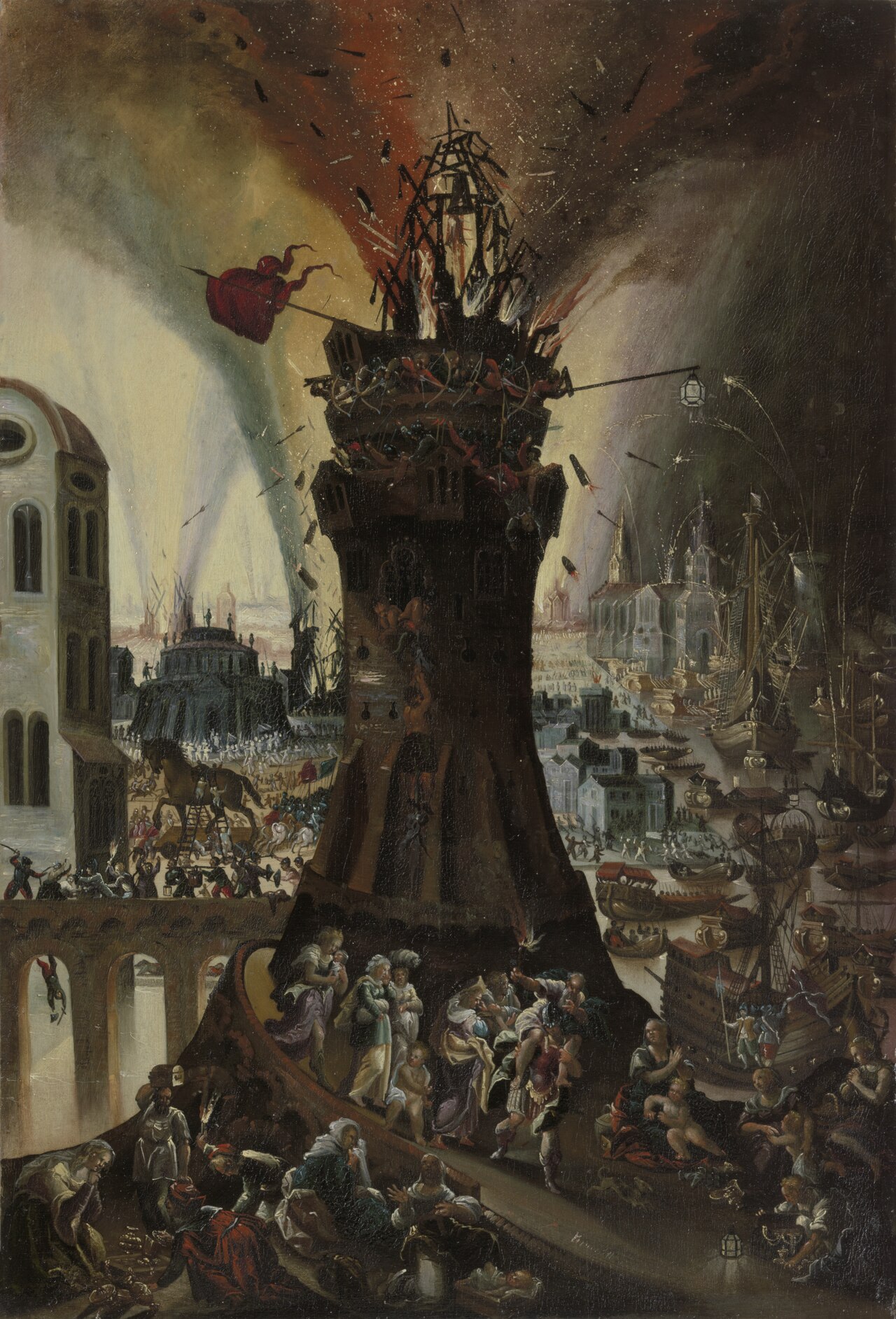
Major works Schoubroeck’s extant oeuvre is limited, but several works provide insight into his artistic concerns. *Village in the Hills* (1597) depicts a tranquil rural settlement nestled among rolling hills, bathed in soft, diffused light. The painting showcases his skill in rendering atmospheric effects, with distant hills rendered in bluish‑green tones that recede into a hazy horizon. *The Fire of Troy* (1601) illustrates a dramatic moment from classical mythology, where the city of Troy is engulfed in flames. Here Schoubroeck’s mastery of firelight is evident; the orange‑red blaze illuminates the surrounding architecture and creates stark, dynamic silhouettes. *The Tower of Babel* (1570), an early work, presents the biblical tower under construction, surrounded by a bustling landscape of workers and distant settlements. The composition balances the monumental structure with the surrounding topography, underscoring the theme of human ambition. Finally, *Lot and His Daughters* (1600) interprets the biblical narrative with a sober, naturalistic setting; the figures are placed within a desolate, yet meticulously rendered, valley, emphasizing the moral gravity of the story. Across these works, Schoubroeck consistently merges narrative content with a richly detailed landscape, a hallmark of the Frankenthal school.
Influence and legacy Although Pieter Schoubroeck is not as widely known as some of his contemporaries, his contribution to the development of German landscape painting is recognised by scholars of the period. His integration of biblical and mythological narratives into realistic countryside settings anticipated later Baroque approaches to landscape, where the environment becomes an active participant in storytelling. The Frankenthal school itself served as a conduit for the transmission of Dutch and Flemish techniques into German art, and Schoubroeck’s works exemplify this cross‑cultural exchange. Modern art historians cite his paintings as early examples of the dramatic chiaroscuro and atmospheric depth that would become central to the work of 17th‑century masters such as Peter Paul Rubens and Jan Brueghel the Elder. While few of his paintings survive, the surviving pieces are valued for their technical proficiency and for offering a window into the artistic climate of late‑Renaissance Germany. Schoubroeck’s legacy endures in the continued study of the Frankenthal school and its role in shaping the trajectory of Northern European landscape painting.
Frequently asked questions
Who was Pieter Schoubroeck?
Pieter Schoubroeck (1560–1607) was a German landscape painter of the Frankenthal school, known for blending detailed natural settings with biblical and mythological narratives.
What style or movement is Schoubroeck associated with?
He is linked to the Frankenthal school, a regional style that combined Northern Renaissance naturalism with imaginative, narrative‑driven landscapes.
What are his most famous works?
His best‑known paintings include *Village in the Hills* (1597), *The Fire of Troy* (1601), *The Tower of Babel* (1570) and *Lot and His Daughters* (1600).
Why does Schoubroeck matter in art history?
Schoubroeck helped pioneer the integration of dramatic storytelling within realistic landscape settings, influencing later Baroque landscape painters and illustrating the cross‑cultural exchange between Dutch, Flemish and German art.
How can I recognise a painting by Pieter Schoubroeck?
Look for finely detailed foliage, layered glazing that creates depth, a landscape arch that frames the narrative, and a subtle yet dramatic use of light—especially in scenes depicting fire or divine illumination.