Pierre-Nolasque Bergeret
1782 – 1863
In short
Pierre-Nolasque Bergeret was a French painter and early lithographer active in the 19th century. He is known for his historical and genre scenes, often depicting moments from the lives of famous artists or significant historical events.
Notable works


.jpg)

# Pierre-Nolasque Bergeret
Pierre-Nolasque Bergeret (1782–1863) was a French painter, lithographer, and designer. Born in Bordeaux, he spent much of his career in Paris, contributing to the artistic landscape of the era through his historical paintings and pioneering work in lithography.
Early life
Born in Bordeaux in 1782, Pierre-Nolasque Bergeret received his artistic training in Paris. He was a student of the renowned neoclassical painter Jacques-Louis David, a pivotal figure in French art. This tutelage under David undoubtedly shaped Bergeret's early approach to composition, draftsmanship, and the classical ideals prevalent in art education at the time. His formative years would have been marked by the artistic and political upheavals of the late 18th and early 19th centuries, a period of significant transition in French history and culture.
Career and style
Bergeret's career spanned a period of considerable change in French art, from the late Neoclassicism and Empire style through to the Romantic era. While he is not definitively associated with a single, named art movement, his works often engage with historical and literary themes, a characteristic shared by artists across various contemporary currents. He demonstrated a capacity for detailed historical narrative and genre scenes. His work as a designer extended to costumes for theatrical productions, indicating a broader engagement with the visual arts beyond easel painting.
Bergeret was also an early adopter and practitioner of lithography, a relatively new printing technique in the early 19th century. This pioneering spirit in adopting new technologies set him apart and allowed him to disseminate his artistic vision through prints as well as paintings. His contributions to medal design further illustrate the breadth of his artistic practice, showcasing his skill in creating detailed and often symbolic imagery in a different medium.
Signature techniques
As a painter, Bergeret's technique likely reflected the academic training he received, emphasizing clear draughtsmanship, balanced composition, and a refined palette. His historical subjects often required meticulous research into costume, architecture, and historical detail, which he rendered with considerable attention. The compositions are typically grand and theatrical, designed to convey the narrative and emotional weight of the depicted moment.
His work in lithography was particularly significant. As one of the pioneers of this medium in France, Bergeret explored its potential for reproducing drawings and paintings, as well as for creating original works. Lithography allowed for a greater degree of spontaneity and tonal variation compared to earlier printmaking methods, and Bergeret's use of it contributed to the medium's growing popularity and artistic acceptance. He also designed medals, a discipline requiring precision and symbolic clarity, further honing his skills in detailed representation.
Major works
Bergeret is recognized for several significant paintings that highlight his interest in art history and historical events. Among his notable works is Charles V Picking up Titian's Paintbrush (1808). This painting dramatizes a moment of respect and artistic admiration, portraying the Holy Roman Emperor Charles V stooping to retrieve a paintbrush dropped by the renowned Venetian painter Titian. It speaks to themes of artistic genius and imperial patronage.
Another important work is Honors Rendered to Raphael on His Deathbed (1806). This piece depicts the mourning and reverence shown to the great Renaissance master Raphael after his passing, emphasizing his profound impact on the art world. The composition likely conveys a sense of solemnity and artistic legacy.
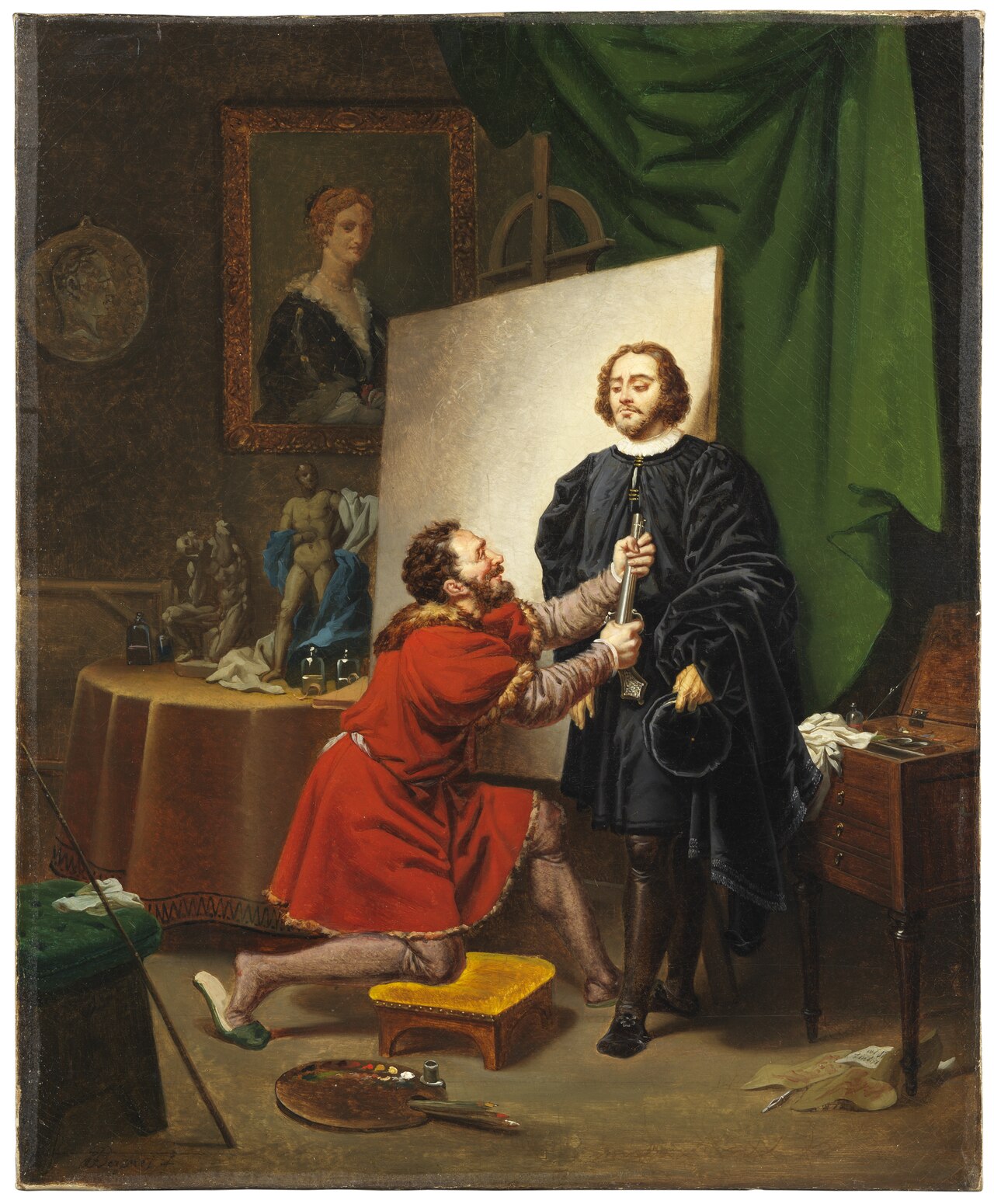
Aretino in the Studio of Tintoretto (1822) is another example of Bergeret's fascination with the lives of past artists. It imagines a scene involving the notorious writer and critic Pietro Aretino interacting with the painter Tintoretto, exploring the dynamics between artists and their contemporaries or influential figures.
Bergeret also created Alexander I presents to Napoleon I the Kalmyks, Cossacks and Baskirs of the Russian army, July 9, 1807. This painting captures a specific moment of political and military significance during the Napoleonic era, illustrating the diplomatic and strategic interactions between major European powers. It is a grand historical tableau.
Finally, Artist Drawing a Man in Turkish Dress (1819) offers a glimpse into genre painting and perhaps a reflection on artistic practice itself, depicting a scene of observation and representation.
Influence and legacy
Pierre-Nolasque Bergeret's influence is most directly felt through his role as an early adopter and practitioner of lithography in France. By embracing and developing the techniques of this new medium, he helped to establish its viability as an artistic and reproductive tool. His paintings, while perhaps not as widely recognized today as those of some of his contemporaries, contribute to our understanding of 19th-century French historical painting and the ways artists engaged with art history and national narratives.
His legacy lies in his versatility – a painter, lithographer, and designer – and his keen interest in depicting moments of artistic and historical significance. He stands as an example of the many skilled artists who contributed to the rich artistic output of 19th-century France, often working across different media and subject matter. His works offer valuable insights into the cultural and intellectual currents of his time, particularly concerning the veneration of artistic masters and the representation of historical events.
Frequently asked questions
Who was Pierre-Nolasque Bergeret?
Pierre-Nolasque Bergeret was a French painter and pioneer lithographer who lived from 1782 to 1863. He studied under Jacques-Louis David and is known for his historical paintings and early work in lithography.
What art movement is Pierre-Nolasque Bergeret associated with?
Pierre-Nolasque Bergeret is not definitively associated with a single art movement. His work spans elements of Neoclassicism and the historical painting trends of the early 19th century, often focusing on themes from art history and significant events.
What are Pierre-Nolasque Bergeret's most famous works?
Some of his notable works include 'Charles V Picking up Titian's Paintbrush' (1808), 'Honors Rendered to Raphael on His Deathbed' (1806), and 'Aretino in the Studio of Tintoretto' (1822), which often depict scenes from the lives of famous artists or historical moments.
Why is Pierre-Nolasque Bergeret considered important?
Bergeret is important for his contributions to early lithography in France, helping to establish it as an artistic medium. His paintings also offer valuable depictions of art historical moments and broader 19th-century French historical interests.
How can I recognize a painting by Pierre-Nolasque Bergeret?
Look for paintings with detailed historical settings, classical compositions, and subjects that often involve famous artists, literary figures, or significant historical events. His technique typically displays academic precision and a refined approach to narrative.